

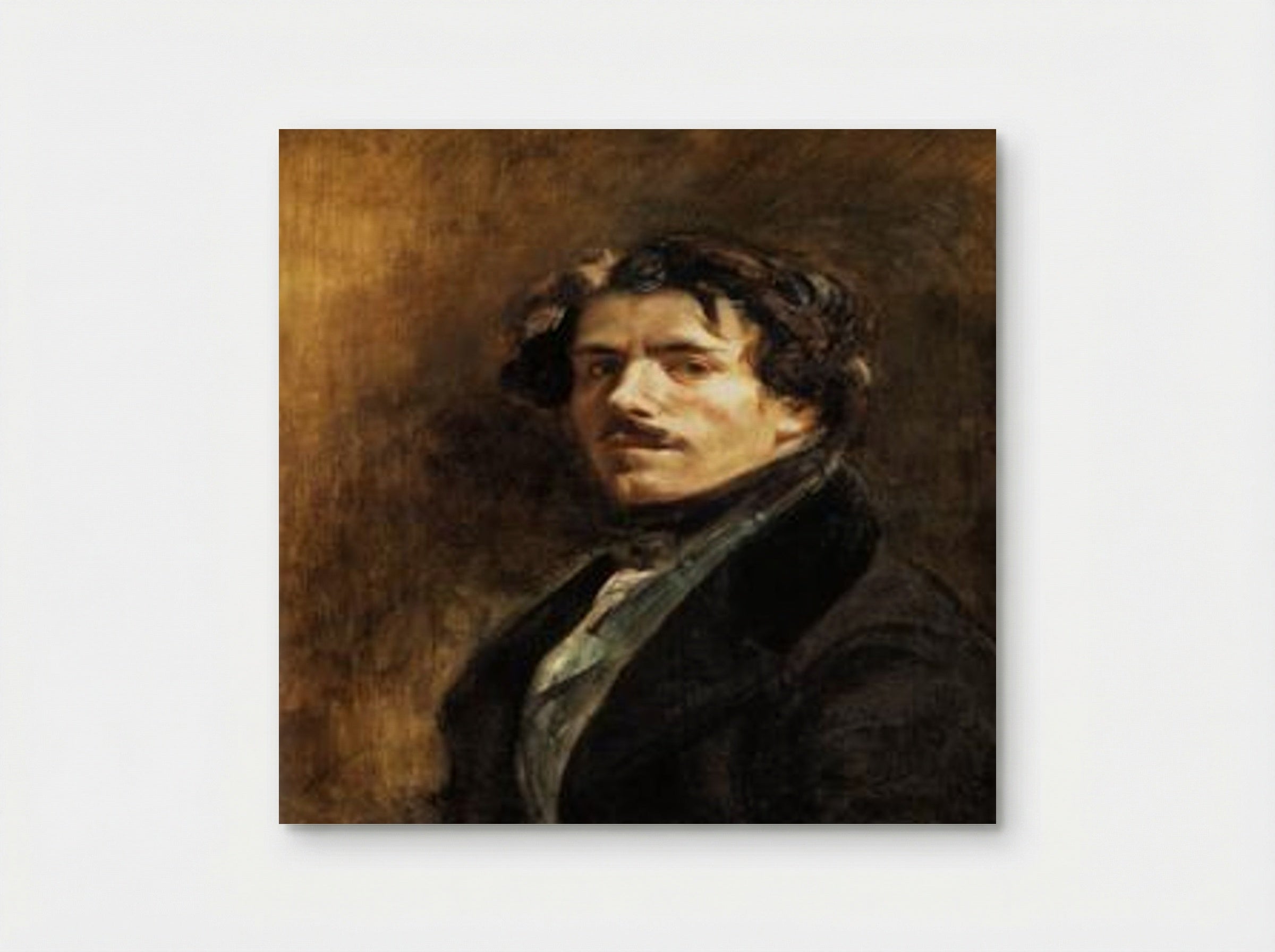
Self Portrait - Eugène Delacroix
Archival giclée
Frames arrive ready to hang
Secure checkout
Made to order
Description
A compelling self-portrait by the French Romantic master Eugène Delacroix, showcasing his characteristic expressive brushwork and dramatic use of light.
This portrait captures the French Romantic painter Eugène Delacroix during his mature period. The work displays the characteristic brushwork and tonal control associated with his practice. Delacroix often utilised a limited palette to focus on the psychological presence of his subjects, and this self-representation is no exception. The artist is depicted with a direct, steady gaze, his features emerging from a dark, atmospheric background that suggests a sense of introspection. Delacroix was a central figure in the French Romantic movement, known for his interest in colour theory and the expressive potential of paint. In this study, the application of oil paint is fluid, with visible strokes that define the contours of his face and the texture of his dark coat. The lighting is dramatic, creating a contrast between the illuminated planes of his face and the surrounding shadows. This technique draws the viewer towards his eyes, which remain the primary focus of the composition. Unlike the formal, rigid portraits of the Neoclassical tradition, this work prioritises the emotional state of the sitter. The loose handling of paint and the focus on light and shadow reflect the artist's broader interest in the subjectivity of vision. By avoiding excessive detail in the background, Delacroix ensures that the viewer engages directly with his persona. This print provides an opportunity to observe the technical skill of one of the nineteenth century's most influential painters, offering a clear view of his approach to portraiture and his mastery of oil media.
Return policy
Because every print is made to order, we don't offer change-of-mind returns, refunds or exchanges. If your order arrives faulty, damaged or incorrect, we'll replace it free of charge — just contact us within 48 hours of delivery. See our refunds page for full details.
Shipping
We ship worldwide, printing at the production hub nearest to your delivery address. Delivery times and costs vary by destination — you'll see the options available to you at checkout.
Manufacturing
Each print is produced to order using 12-colour giclée printing on FSC-certified archival paper. Designed in Britain and printed at your nearest production hub to reduce waste and speed up delivery.
Care and materials
Specific Features
Every Solis piece is made to order with archival, gallery-quality materials built to last.
- Museum-grade giclée printing for rich, fade-resistant colour
- Archival matte fine-art paper, FSC-certified
- Multiple sizes and framing options available
- Frames in black, natural wood, dark wood or white
- Framed prints arrive ready to hang
Care & Cleaning
To keep your artwork looking its best:
- Dust gently with a soft, dry cloth
- Avoid prolonged direct sunlight
- Never use liquid cleaners on the print or canvas surface
- Keep in a dry, room-temperature space
- Handle prints with clean, dry hands
Materials & Sizing
Museum-grade giclée on FSC-certified archival matte paper, with framed and canvas options.
- Paper sizes: A4, A3, A2, A1, A0 and B2 (50×70 cm)
- Canvas: XS (20×30 cm) to Large (60×90 cm)
- Frames: black, natural wood, dark wood or white
Self Portrait - Eugène Delacroix

Artist Biography
Eugene Delacroix
He was born in Charenton-Saint-Maurice, near Paris. His legal father was a diplomat. His biological father may have been Talleyrand, the foreign minister, which would explain several things about his career including his early access to government commissions. He studied at the Ecole des Beaux-Arts under Pierre-Narcisse Guerin and was influenced by Gericault's The Raft of the Medusa, which showed him that contemporary events could be painted at the scale previously reserved for mythology.
His brushwork was loose and fast by the standards of the Academy. He preferred colour to line, which put him in direct opposition to Ingres, the master of precise contour. The rivalry between Delacroix and Ingres, colour versus drawing, became the central argument of French painting in the mid-nineteenth century. Delacroix won in the long run: the Impressionists claimed him, the Fauves revered him, and Cezanne called him the starting point of modern painting.
He travelled to Morocco in 1832 and came back with notebooks full of colour studies that influenced the rest of his career. The North African light loosened his palette permanently. He died in 1863, at sixty-five, and left a journal that is one of the most intelligent accounts of painting ever written.
Why Choose Us ?
Damage-free delivery guarantee
Fast Shipping
Museum-Quality Materials
You May Also Like