

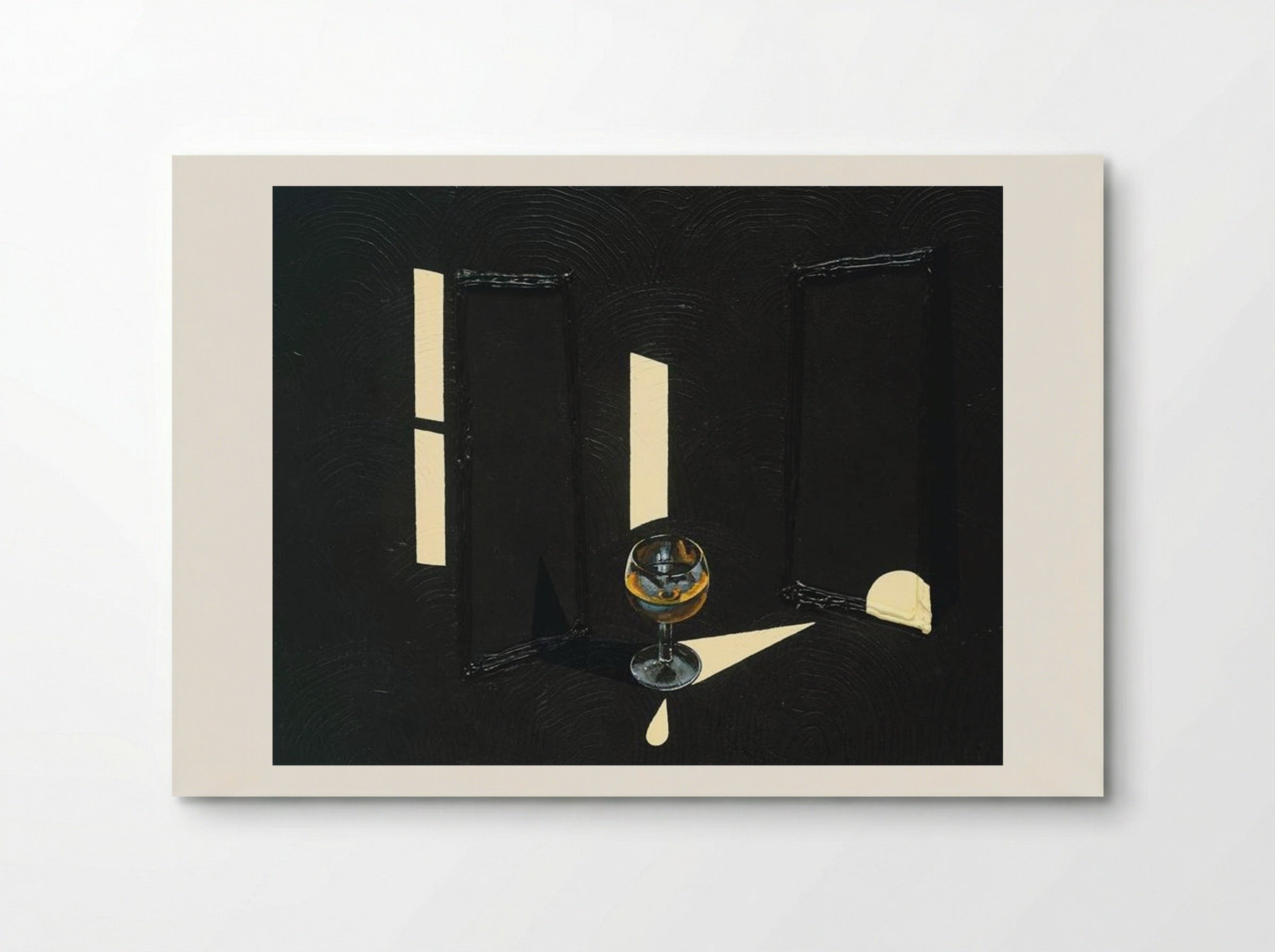
Second Glass of Whisky - Patrick Caulfield
Archival giclée
Frames arrive ready to hang
Secure checkout
Made to order
Description
A striking 1969 still life by Patrick Caulfield, featuring a glass of whisky rendered with bold outlines and dramatic, geometric light against a dark background.
Patrick Caulfield, a central figure in British Pop Art, produced Second Glass of Whisky in 1969. The work demonstrates his characteristic approach to the still life genre, where he employs a stark, graphic language to represent everyday objects. Caulfield often utilised flat areas of colour and bold, black outlines to define his subjects, a technique that draws from commercial illustration and sign painting. In this composition, the artist presents a single glass of amber liquid set against a deep, textured black background. The scene is punctuated by geometric shapes of light, which suggest the presence of windows or architectural elements outside the frame. These simplified forms create a sense of spatial ambiguity, as the light appears to exist as a physical object rather than a natural phenomenon. The contrast between the dark, heavy background and the precise, luminous highlights creates a tension between the representational subject and the abstract arrangement of shapes. Caulfield was known for his interest in the mundane, often choosing subjects that were unremarkable in their own right. By isolating the glass of whisky, he invites the viewer to consider the object through a formal lens. The deliberate lack of detail in the surrounding space forces the eye to focus on the interplay of light and shadow. This work reflects the artist's broader interest in the history of painting, particularly the tradition of the still life, while simultaneously subverting those conventions through a modern, graphic aesthetic. The result is a quiet, contemplative image that avoids narrative clutter, favouring instead a rigorous examination of form, colour, and the act of looking itself. The work remains a clear example of his ability to transform the ordinary into a precise, visual statement.
You might also like
Return policy
Because every print is made to order, we don't offer change-of-mind returns, refunds or exchanges. If your order arrives faulty, damaged or incorrect, we'll replace it free of charge — just contact us within 48 hours of delivery. See our refunds page for full details.
Shipping
We ship worldwide, printing at the production hub nearest to your delivery address. Delivery times and costs vary by destination — you'll see the options available to you at checkout.
Manufacturing
Each print is produced to order using 12-colour giclée printing on FSC-certified archival paper. Designed in Britain and printed at your nearest production hub to reduce waste and speed up delivery.
Care and materials
Specific Features
Every Solis piece is made to order with archival, gallery-quality materials built to last.
- Museum-grade giclée printing for rich, fade-resistant colour
- Archival matte fine-art paper, FSC-certified
- Multiple sizes and framing options available
- Frames in black, natural wood, dark wood or white
- Framed prints arrive ready to hang
Care & Cleaning
To keep your artwork looking its best:
- Dust gently with a soft, dry cloth
- Avoid prolonged direct sunlight
- Never use liquid cleaners on the print or canvas surface
- Keep in a dry, room-temperature space
- Handle prints with clean, dry hands
Materials & Sizing
Museum-grade giclée on FSC-certified archival matte paper, with framed and canvas options.
- Paper sizes: A4, A3, A2, A1, A0 and B2 (50×70 cm)
- Canvas: XS (20×30 cm) to Large (60×90 cm)
- Frames: black, natural wood, dark wood or white
Second Glass of Whisky - Patrick Caulfield

Artist Biography
Patrick Caulfield
He joined the RAF at seventeen for national service, then studied at the Royal College of Art from 1960 to 1963, alongside Hockney, Allen Jones, R.B. Kitaj, and Derek Boshier. The 1964 New Generation exhibition at the Whitechapel Gallery tagged him as Pop Art. He rejected the label for the rest of his life, calling himself a formal artist.
His paintings use bold, flat outlines and blocks of colour. They depict interiors, still lifes, restaurants, and domestic scenes with a deadpan quality that sits somewhere between commercial illustration and painting. The spaces are often empty or nearly so. A potted plant, a wine glass, a candle: the objects are ordinary but the treatment makes them strange. He was nominated for the Turner Prize in 1987. David Bowie and Charles Saatchi both collected his work. He died in 2005. The street in Acton where he was born was renamed Caulfield Road.
Why Choose Us ?
Damage-free delivery guarantee
Fast Shipping
Museum-Quality Materials
You May Also Like