

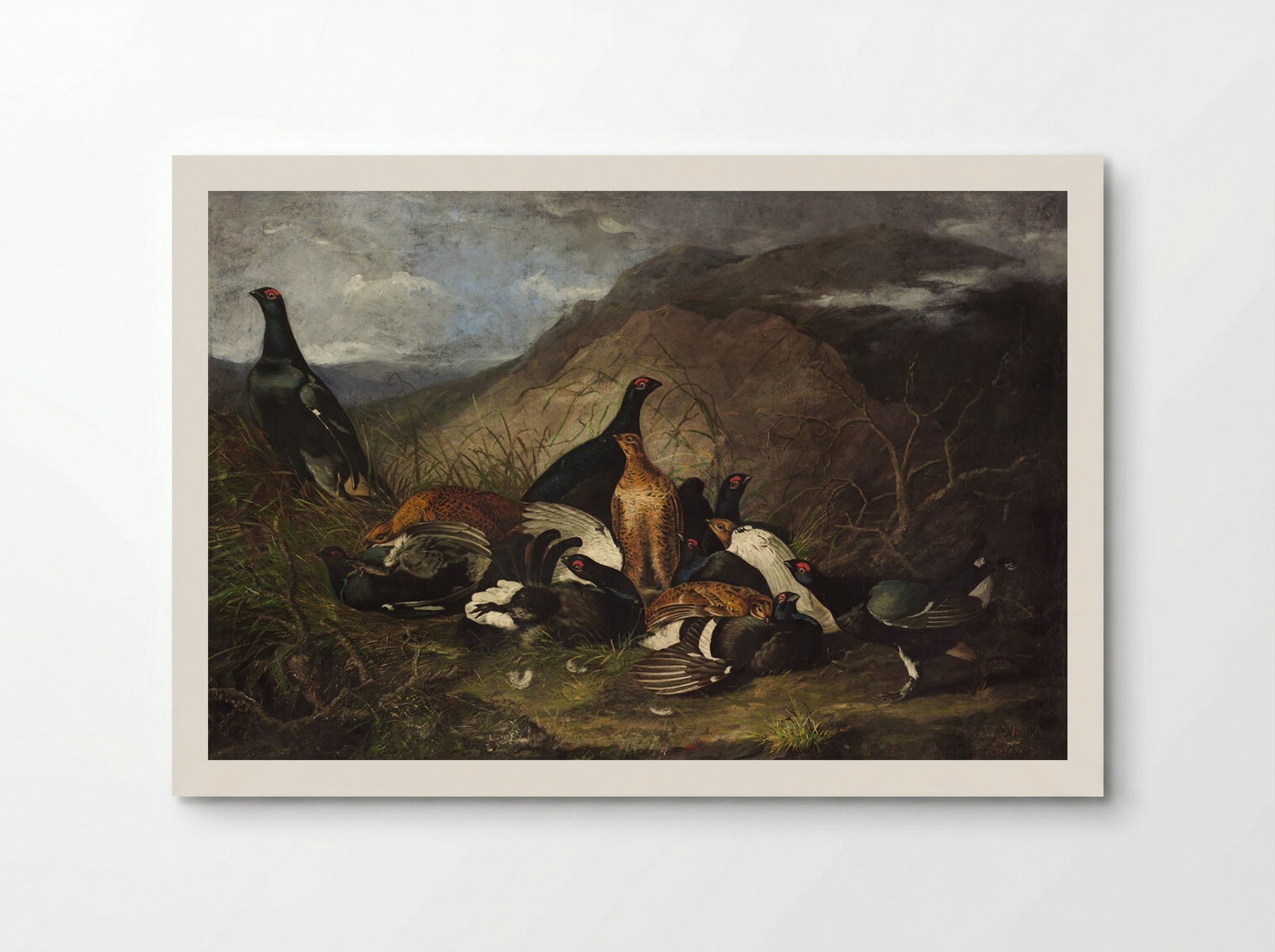
Scottish Black Grouse, Cocks and Hens - John James Audubon
Archival giclée
Frames arrive ready to hang
Secure checkout
Made to order
Description
A detailed oil painting by John James Audubon capturing a group of black grouse in a rugged, atmospheric Scottish highland setting.
This work depicts a gathering of black grouse (Lyrurus tetrix) set against a rugged, atmospheric Scottish highland backdrop. John James Audubon, primarily known for his meticulous ornithological studies, produced this oil painting during his time in Britain. Unlike his more clinical, life-sized watercolours intended for scientific publication, this composition adopts the conventions of nineteenth-century sporting art. The birds are arranged in a dense, naturalistic grouping, displaying the distinct plumage variations between the iridescent black cocks with their characteristic red wattles and the mottled brown hens. The handling of the paint suggests a focus on texture, from the soft down of the birds to the coarse, windswept grasses and the craggy, shadowed mountainside. The lighting is dramatic, typical of the Romantic period, with heavy clouds casting deep shadows across the terrain. This creates a sense of place that feels both wild and remote. The composition balances the individual anatomical details of the birds with the broader, moody environment they inhabit. Audubon's ability to observe avian behaviour is evident in the varied postures of the grouse, which range from alert, upright stances to more relaxed, resting positions. The work reflects the artist's deep familiarity with his subjects, captured through careful observation of their physical form and their interaction with the environment. By moving away from the stark white backgrounds of his famous 'Birds of America' series, Audubon here engages with the tradition of European animal painting. The result is a study that captures the essence of the species within its natural habitat, rendered with a painterly approach that prioritises mood and atmosphere alongside biological accuracy.
Return policy
Because every print is made to order, we don't offer change-of-mind returns, refunds or exchanges. If your order arrives faulty, damaged or incorrect, we'll replace it free of charge — just contact us within 48 hours of delivery. See our refunds page for full details.
Shipping
We ship worldwide, printing at the production hub nearest to your delivery address. Delivery times and costs vary by destination — you'll see the options available to you at checkout.
Manufacturing
Each print is produced to order using 12-colour giclée printing on FSC-certified archival paper. Designed in Britain and printed at your nearest production hub to reduce waste and speed up delivery.
Scottish Black Grouse, Cocks and Hens - John James Audubon
Our Features
Designed for Lasting Impact
Specific Features
Every Solis piece is made to order with archival, gallery-quality materials built to last.
- Museum-grade giclée printing for rich, fade-resistant colour
- Archival matte fine-art paper, FSC-certified
- Multiple sizes and framing options available
- Frames in black, natural wood, dark wood or white
- Framed prints arrive ready to hang
Care & Cleaning
To keep your artwork looking its best:
- Dust gently with a soft, dry cloth
- Avoid prolonged direct sunlight
- Never use liquid cleaners on the print or canvas surface
- Keep in a dry, room-temperature space
- Handle prints with clean, dry hands
Materials & Sizing
Museum-grade giclée on FSC-certified archival matte paper, with framed and canvas options.
- Paper sizes: A4, A3, A2, A1, A0 and B2 (50×70 cm)
- Canvas: XS (20×30 cm) to Large (60×90 cm)
- Frames: black, natural wood, dark wood or white
Why Choose Us ?
Damage-free delivery guarantee
Fast Shipping
Museum-Quality Materials

Artist Biography
John James Audubon
He was born illegitimate in 1785 in Les Cayes, Saint-Domingue (now Haiti), the son of a French merchant and a Creole woman. He was sent to America at eighteen to avoid Napoleonic conscription. He was also a serial fabricator: he claimed his father was an admiral (he was a captain), said his family had been imprisoned in the Bastille (they had not), and invented frontier stories about fighting wolves and sleeping in igloos. He ran a dry-goods store in Kentucky and was jailed for bankruptcy in 1819.
The paintings themselves are extraordinary: precise, dynamic, and composed with a narrative quality that goes beyond scientific illustration. His legacy is contested. The National Audubon Society and several regional chapters dropped his name in 2023 because of his documented history as an enslaver. He died in 1851.
You May Also Like