

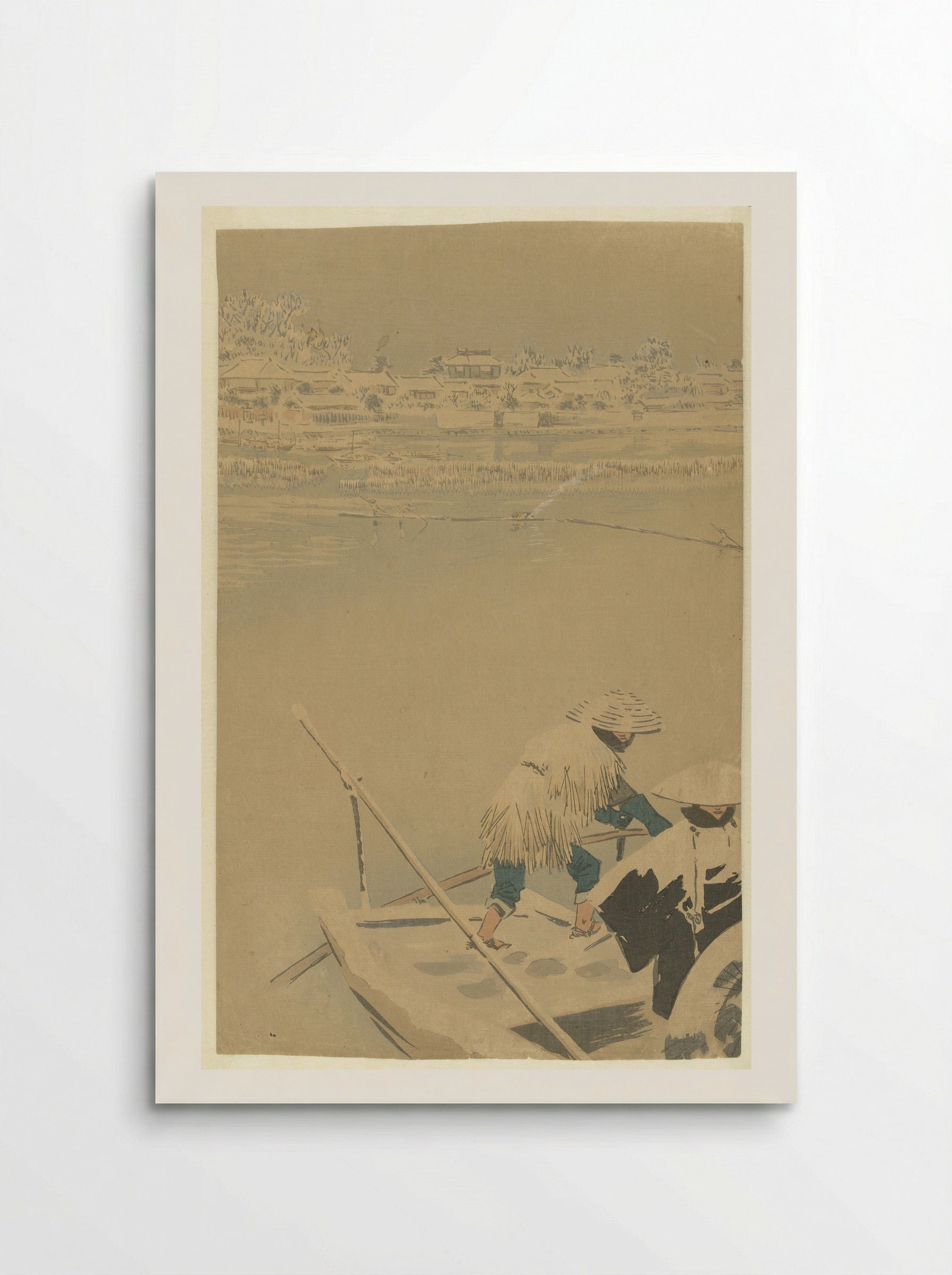
Schemersneeuw te Matsuchiyama - Fine Art Print
Archival giclée
Frames arrive ready to hang
Secure checkout
Made to order
Description
A serene woodblock print depicting figures on a boat during a snowy twilight at Matsuchiyama, rendered in a muted, atmospheric palette.
This woodblock print, titled Schemersneeuw te Matsuchiyama, captures a quiet moment of winter travel. The scene depicts two figures navigating a small boat across a body of water, likely the Sumida River, with the snow-dusted buildings of Matsuchiyama visible in the distance. The composition relies on a muted, monochromatic palette, which effectively conveys the hushed atmosphere of a snowy twilight. The artist employs a minimalist approach, allowing the negative space of the water and sky to dominate the frame, while the figures in the foreground provide a sense of scale and human presence. The print belongs to the Ukiyo-e tradition, a genre of Japanese art that flourished from the 17th to the 19th century. These works often focused on scenes of daily life, travel, and the changing seasons. The use of woodblock printing allowed for the mass production of such images, making them accessible to a wide audience. In this specific work, the delicate lines and subtle gradations of tone reflect the technical skill required to produce atmospheric effects without relying on a wide range of colours. The figures are dressed in traditional straw rain capes, known as mino, which were practical garments for protection against the elements. Their posture and the steady grip on the oars suggest the routine nature of their journey, despite the cold conditions. This print offers a glimpse into the aesthetic values of the period, where the beauty of a scene was found in its simplicity and the quiet observation of nature. The absence of bold, saturated colours encourages the viewer to focus on the textures of the snow and the rhythmic movement of the boat. It is a work that rewards careful looking, revealing the subtle details of the architecture and the figures through its restrained use of ink and paper.
Return policy
Because every print is made to order, we don't offer change-of-mind returns, refunds or exchanges. If your order arrives faulty, damaged or incorrect, we'll replace it free of charge — just contact us within 48 hours of delivery. See our refunds page for full details.
Shipping
We ship worldwide, printing at the production hub nearest to your delivery address. Delivery times and costs vary by destination — you'll see the options available to you at checkout.
Manufacturing
Each print is produced to order using 12-colour giclée printing on FSC-certified archival paper. Designed in Britain and printed at your nearest production hub to reduce waste and speed up delivery.
Schemersneeuw te Matsuchiyama - Fine Art Print
Artist Biography
Unknown Artist
The artistic approach of the Unknown Artist varies between the formal composition of the carte-de-visite and the narrative style of the war prints. In the Moroccan portraits, the focus rests on the subject's posture and attire against a neutral studio backdrop. The Japanese prints use bold lines and flat colours to depict military movements and naval victories. Despite the lack of a specific attribution, these works demonstrate a high level of technical skill in both lithography and woodblock carving.
Modern collectors often value anonymous works for their mystery and focus on the image itself. These prints provide a direct connection to history without the distraction of a famous name. They function as windows into the 19th-century world, from the quiet dignity of a young girl in a studio to the chaos of a distant conflict. These pieces offer a sense of discovery for those who appreciate the aesthetic qualities of vintage photography and historical illustration.
Our Features
Designed for Lasting Impact
Specific Features
Every Solis piece is made to order with archival, gallery-quality materials built to last.
- Museum-grade giclée printing for rich, fade-resistant colour
- Archival matte fine-art paper, FSC-certified
- Multiple sizes and framing options available
- Frames in black, natural wood, dark wood or white
- Framed prints arrive ready to hang
Care & Cleaning
To keep your artwork looking its best:
- Dust gently with a soft, dry cloth
- Avoid prolonged direct sunlight
- Never use liquid cleaners on the print or canvas surface
- Keep in a dry, room-temperature space
- Handle prints with clean, dry hands
Materials & Sizing
Museum-grade giclée on FSC-certified archival matte paper, with framed and canvas options.
- Paper sizes: A4, A3, A2, A1, A0 and B2 (50×70 cm)
- Canvas: XS (20×30 cm) to Large (60×90 cm)
- Frames: black, natural wood, dark wood or white
Why Choose Us ?
Damage-free delivery guarantee
Fast Shipping
Museum-Quality Materials
Artist Biography
Unknown Artist
The artistic approach of the Unknown Artist varies between the formal composition of the carte-de-visite and the narrative style of the war prints. In the Moroccan portraits, the focus rests on the subject's posture and attire against a neutral studio backdrop. The Japanese prints use bold lines and flat colours to depict military movements and naval victories. Despite the lack of a specific attribution, these works demonstrate a high level of technical skill in both lithography and woodblock carving.
Modern collectors often value anonymous works for their mystery and focus on the image itself. These prints provide a direct connection to history without the distraction of a famous name. They function as windows into the 19th-century world, from the quiet dignity of a young girl in a studio to the chaos of a distant conflict. These pieces offer a sense of discovery for those who appreciate the aesthetic qualities of vintage photography and historical illustration.
You May Also Like