

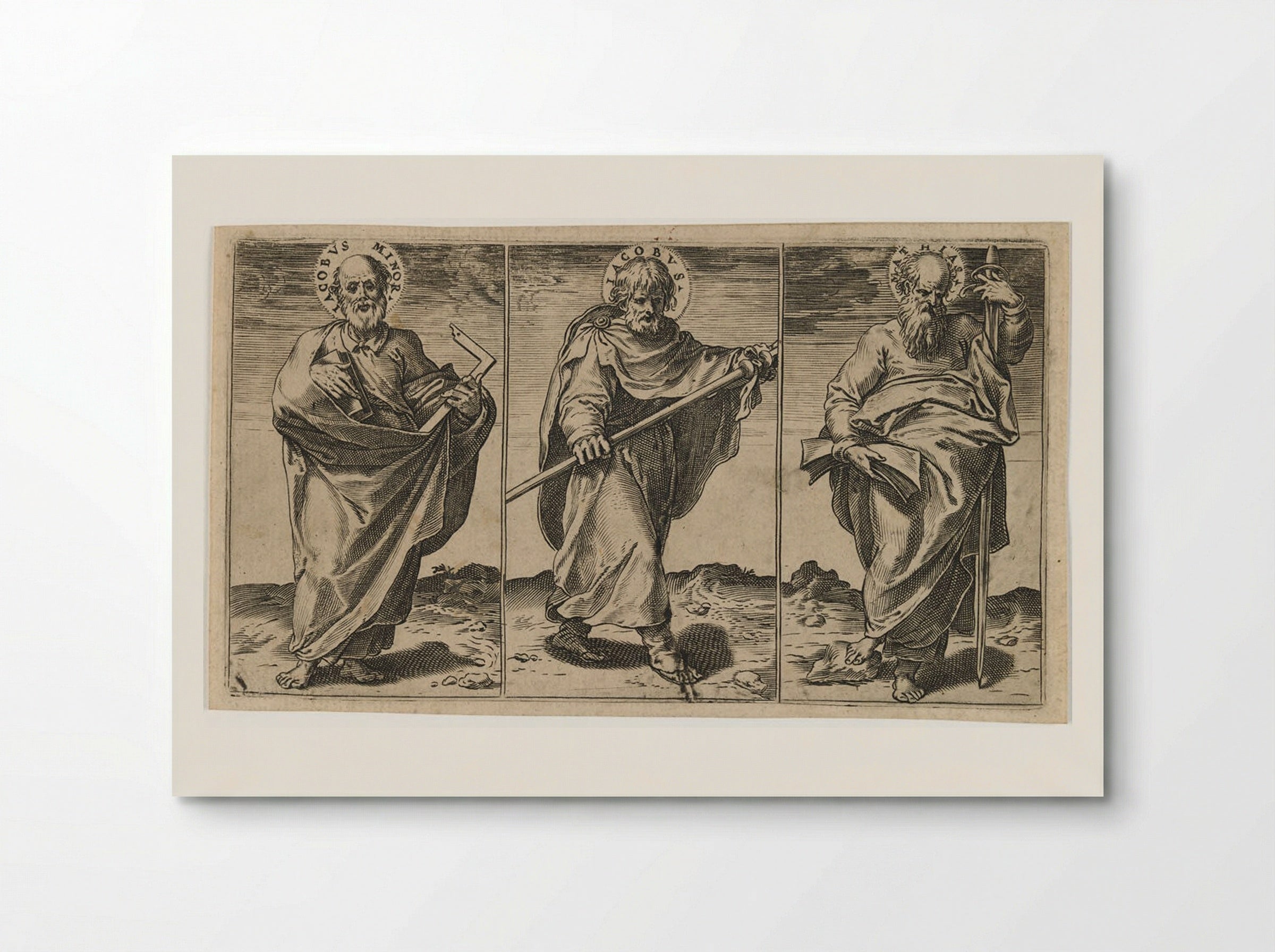
Saint James Minor, Saint James Major and Saint Matthias - Agostino Carracci
Archival giclée
Frames arrive ready to hang
Secure checkout
Made to order
Description
A detailed engraving by Agostino Carracci depicting three apostles, each identified by their traditional iconographic attributes.
This engraving by Agostino Carracci depicts three figures from the apostolic tradition: Saint James the Minor, Saint James the Major, and Saint Matthias. Carracci, a member of the influential Bolognese family of painters and printmakers, demonstrates his technical proficiency in the medium of copperplate engraving. The composition is divided into three distinct vertical panels, each containing a single standing figure identified by their respective attributes and halos. Saint James the Minor is shown on the left, holding a fuller's club, which is his traditional iconographic symbol. In the centre, Saint James the Major is depicted with a pilgrim's staff, reflecting his association with the pilgrimage to Santiago de Compostela. On the right, Saint Matthias holds a sword, the instrument of his martyrdom. The figures are rendered with a focus on the weight and volume of their drapery, a hallmark of the Carracci style that sought to balance classical form with naturalistic observation. The cross-hatching and fine line work create a sense of depth and texture within the garments, while the background remains minimal, allowing the viewer to focus on the anatomical structure and posture of each saint. As a printmaker, Carracci was instrumental in disseminating the stylistic innovations of the Carracci Academy, which prioritised drawing from life and the study of classical antiquity. This work reflects the period's interest in clear, didactic religious imagery, intended for both devotional use and the instruction of art students. The print captures the disciplined approach to form that defined the transition from late Mannerism to the early Baroque period in Italy.
Return policy
Because every print is made to order, we don't offer change-of-mind returns, refunds or exchanges. If your order arrives faulty, damaged or incorrect, we'll replace it free of charge — just contact us within 48 hours of delivery. See our refunds page for full details.
Shipping
We ship worldwide, printing at the production hub nearest to your delivery address. Delivery times and costs vary by destination — you'll see the options available to you at checkout.
Manufacturing
Each print is produced to order using 12-colour giclée printing on FSC-certified archival paper. Designed in Britain and printed at your nearest production hub to reduce waste and speed up delivery.
Care and materials
Specific Features
Every Solis piece is made to order with archival, gallery-quality materials built to last.
- Museum-grade giclée printing for rich, fade-resistant colour
- Archival matte fine-art paper, FSC-certified
- Multiple sizes and framing options available
- Frames in black, natural wood, dark wood or white
- Framed prints arrive ready to hang
Care & Cleaning
To keep your artwork looking its best:
- Dust gently with a soft, dry cloth
- Avoid prolonged direct sunlight
- Never use liquid cleaners on the print or canvas surface
- Keep in a dry, room-temperature space
- Handle prints with clean, dry hands
Materials & Sizing
Museum-grade giclée on FSC-certified archival matte paper, with framed and canvas options.
- Paper sizes: A4, A3, A2, A1, A0 and B2 (50×70 cm)
- Canvas: XS (20×30 cm) to Large (60×90 cm)
- Frames: black, natural wood, dark wood or white
Saint James Minor, Saint James Major and Saint Matthias - Agostino Carracci

Artist Biography
Agostino Carracci
His masterpiece as a painter, The Last Communion of Saint Jerome (1592), hangs in the Pinacoteca Nazionale di Bologna. The composition is controlled and deeply felt, with the dying saint receiving the sacrament in a soft, Correggesque light that reveals Agostino's careful study of the Parma master. He also contributed to major fresco cycles at Palazzo Fava (1584, Lives of Jason and Medea) and Palazzo Magnani (1590-92, Scenes from the Foundation of Rome), working alongside Annibale on both.
The engraving work that critics sometimes dismissed as mere reproduction turns out to have had an unexpectedly long legacy. His print after Paolo Fiammingo's Love in the Golden Age is recorded as a direct source for Matisse's Le bonheur de vivre (1905-06), connecting a Bologna workshop of the 1580s to Fauvist Paris three centuries later. Agostino died in Parma in March 1602, at forty-four, leaving a son, Antonio, who also became a painter.
Why Choose Us ?
Damage-free delivery guarantee
Fast Shipping
Museum-Quality Materials
You May Also Like