

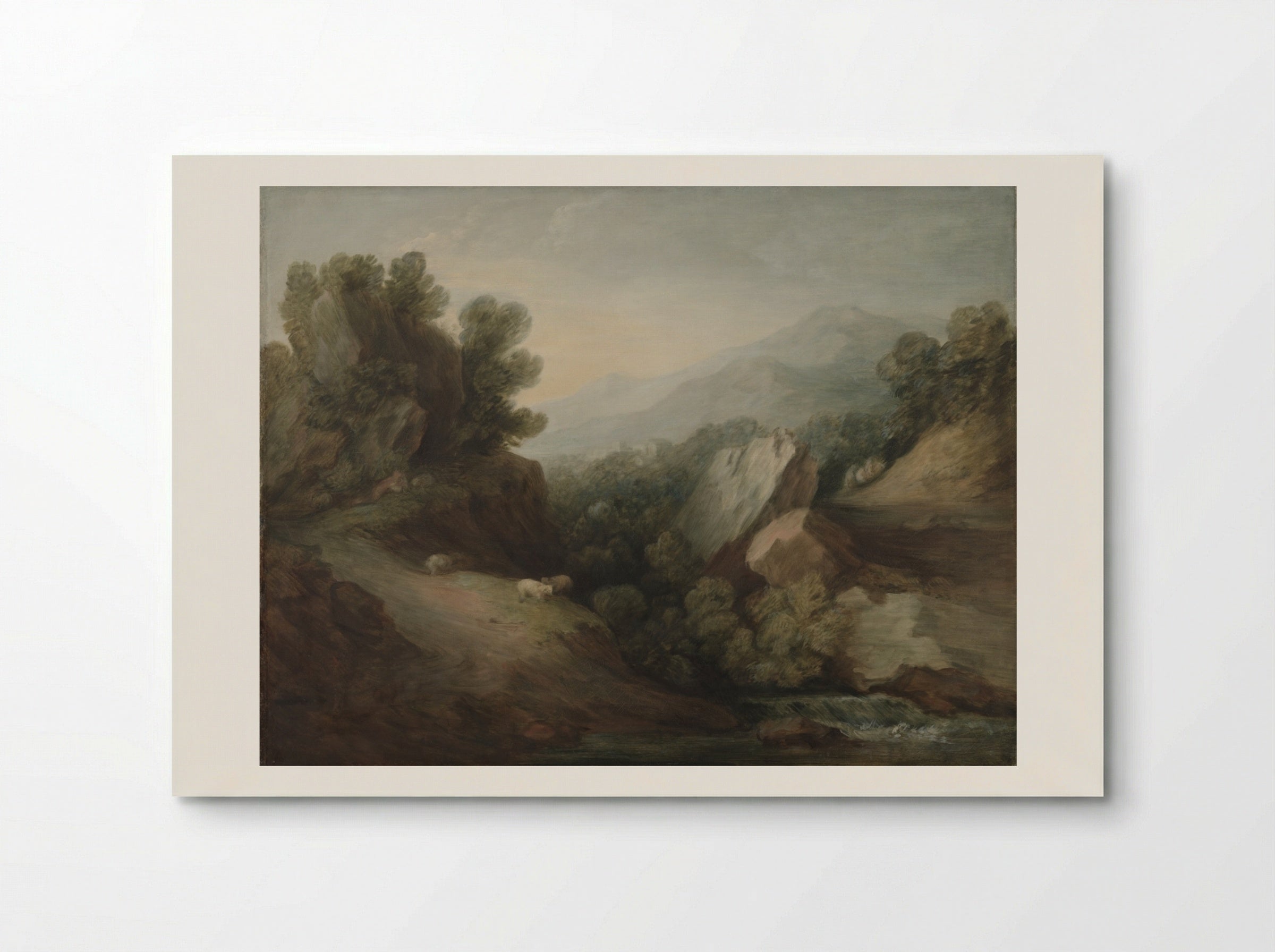
Rocky, Wooded Landscape with a Dell and Weir - Thomas Gainsborough
Archival giclée
Frames arrive ready to hang
Secure checkout
Made to order
Description
A pastoral scene by Thomas Gainsborough featuring rugged terrain, grazing sheep, and a quiet weir, rendered with fluid, atmospheric brushwork.
Thomas Gainsborough, a founding member of the Royal Academy, maintained a lifelong preoccupation with the British countryside. While he achieved professional success as a portraitist, his personal preference remained with the depiction of rural scenes. This work demonstrates his characteristic approach to composition, where he balances natural observation with a degree of artifice. The scene presents a rugged terrain defined by steep, rocky banks and dense foliage. A small weir occupies the lower right, providing a sense of movement to the water. Gainsborough employs a fluid, feathery brushwork that suggests the texture of trees and the uneven surface of the earth without resorting to rigid detail. The palette is dominated by earthy tones, including ochre, umber, and muted greens, which unify the composition. In the foreground, small figures of sheep graze along the path, a common motif in Gainsborough's work that provides scale and a sense of pastoral quietude. The middle ground recedes into a soft, atmospheric distance, where the forms of hills are obscured by a hazy, light-filled sky. This treatment of light reflects the influence of Dutch masters like Jacob van Ruisdael, yet the execution remains distinctly Gainsborough's own. The painting avoids the topographical precision of his contemporaries, opting instead for a mood-driven interpretation of the English terrain. It is an example of his ability to construct a scene that feels both observed and imagined, capturing the character of the countryside through light and shadow rather than literal transcription.
Return policy
Because every print is made to order, we don't offer change-of-mind returns, refunds or exchanges. If your order arrives faulty, damaged or incorrect, we'll replace it free of charge — just contact us within 48 hours of delivery. See our refunds page for full details.
Shipping
We ship worldwide, printing at the production hub nearest to your delivery address. Delivery times and costs vary by destination — you'll see the options available to you at checkout.
Manufacturing
Each print is produced to order using 12-colour giclée printing on FSC-certified archival paper. Designed in Britain and printed at your nearest production hub to reduce waste and speed up delivery.
Rocky, Wooded Landscape with a Dell and Weir - Thomas Gainsborough

Artist Biography
Thomas Gainsborough
He was born in Sudbury, Suffolk, in 1727. His father went bankrupt in 1733. He moved to London as a teenager and trained under the French engraver Hubert-Francois Gravelot. By his thirties he was one of the two dominant portrait painters in Georgian England, the other being Joshua Reynolds. The rivalry with Reynolds defined both their careers.
The Blue Boy is probably his most famous painting, though he would have preferred to be remembered for his landscapes. On his deathbed he reconciled with Reynolds. Reynolds later wrote that the Royal Academy had lost one of its greatest ornaments. Gainsborough died in 1788, aged sixty-one.
Our Features
Designed for Lasting Impact
Specific Features
Every Solis piece is made to order with archival, gallery-quality materials built to last.
- Museum-grade giclée printing for rich, fade-resistant colour
- Archival matte fine-art paper, FSC-certified
- Multiple sizes and framing options available
- Frames in black, natural wood, dark wood or white
- Framed prints arrive ready to hang
Care & Cleaning
To keep your artwork looking its best:
- Dust gently with a soft, dry cloth
- Avoid prolonged direct sunlight
- Never use liquid cleaners on the print or canvas surface
- Keep in a dry, room-temperature space
- Handle prints with clean, dry hands
Materials & Sizing
Museum-grade giclée on FSC-certified archival matte paper, with framed and canvas options.
- Paper sizes: A4, A3, A2, A1, A0 and B2 (50×70 cm)
- Canvas: XS (20×30 cm) to Large (60×90 cm)
- Frames: black, natural wood, dark wood or white
Why Choose Us ?
Damage-free delivery guarantee
Fast Shipping
Museum-Quality Materials
Artist Biography
Thomas Gainsborough
He was born in Sudbury, Suffolk, in 1727. His father went bankrupt in 1733. He moved to London as a teenager and trained under the French engraver Hubert-Francois Gravelot. By his thirties he was one of the two dominant portrait painters in Georgian England, the other being Joshua Reynolds. The rivalry with Reynolds defined both their careers.
The Blue Boy is probably his most famous painting, though he would have preferred to be remembered for his landscapes. On his deathbed he reconciled with Reynolds. Reynolds later wrote that the Royal Academy had lost one of its greatest ornaments. Gainsborough died in 1788, aged sixty-one.
You May Also Like