

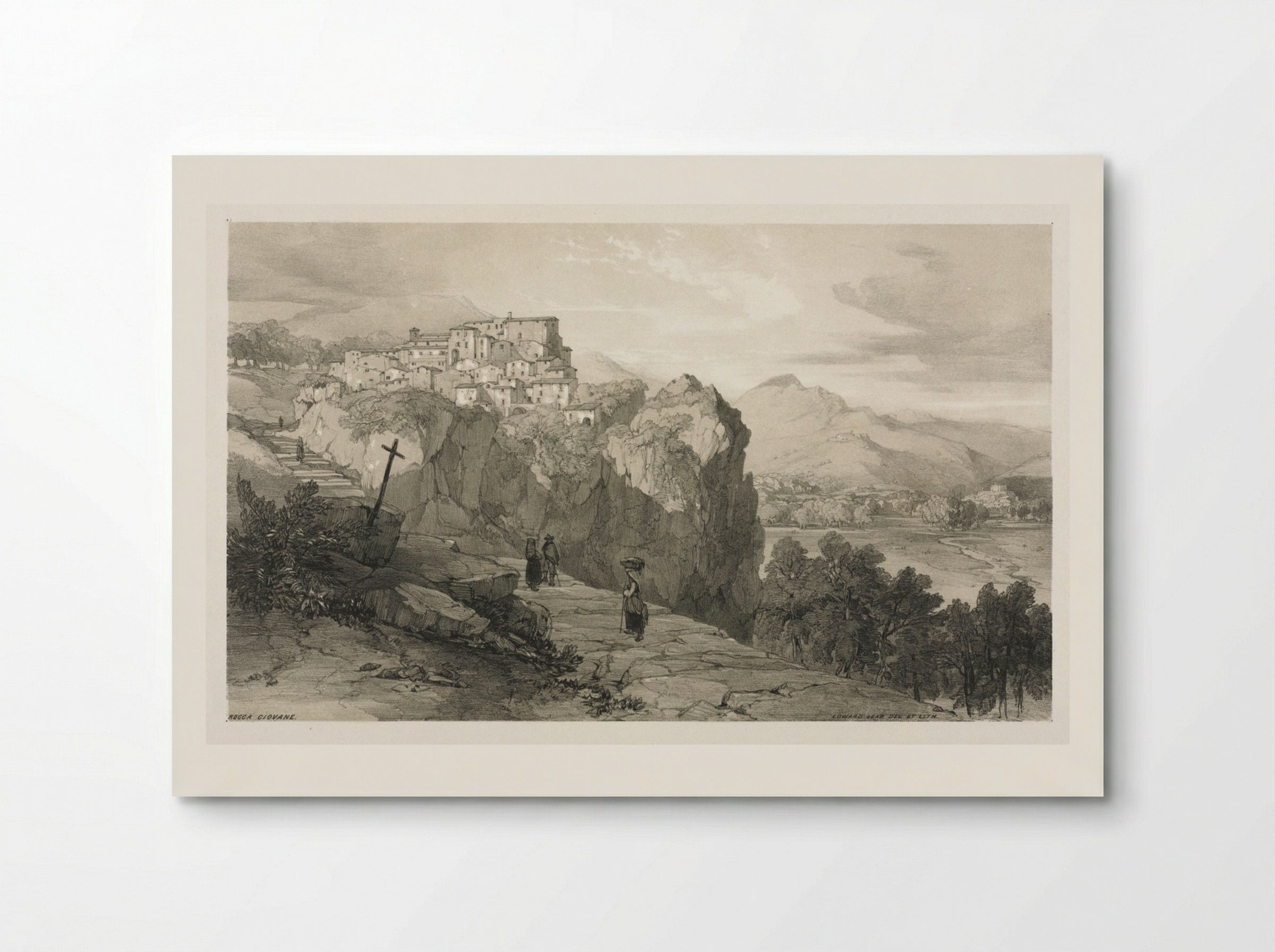
Rocca Giovane - Edward Lear
Archival giclée
Frames arrive ready to hang
Secure checkout
Made to order
Description
A detailed lithograph by Edward Lear capturing the Italian village of Rocca Giovane, showcasing his mastery of topographical illustration and atmospheric perspective.
This lithograph by Edward Lear depicts the Italian village of Rocca Giovane, perched upon a rocky outcrop. Lear, widely recognised for his travel journals and topographical illustrations, produced this work during his extensive travels through Italy in the mid-nineteenth century. The composition captures the rugged terrain of the Sabine Hills, with the village structures appearing to grow directly from the limestone cliffs. In the foreground, a stone path winds towards the village, populated by small figures that provide a sense of scale to the vast, mountainous surroundings. A solitary cross stands near the path, a common feature in the rural Italian regions Lear documented. The artist employs a delicate range of grey tones to define the textures of the rock face, the foliage, and the distant valley. His technical skill as a lithographer allows for a precise rendering of architectural detail, while maintaining the atmospheric quality of the hazy, sun-drenched sky. Lear's approach to this subject reflects the nineteenth-century fascination with the picturesque, where the interaction between human habitation and the natural environment forms the primary subject. The work is part of a broader collection of views that documented the lesser-known regions of Italy for a British audience. By balancing the sharp, jagged forms of the foreground rocks with the soft, receding planes of the valley, Lear creates a sense of depth that draws the viewer into the scene. This print offers a glimpse into the travel habits and aesthetic interests of the Victorian era, capturing a moment of quiet observation in a remote corner of the Italian countryside.
Return policy
Because every print is made to order, we don't offer change-of-mind returns, refunds or exchanges. If your order arrives faulty, damaged or incorrect, we'll replace it free of charge — just contact us within 48 hours of delivery. See our refunds page for full details.
Shipping
We ship worldwide, printing at the production hub nearest to your delivery address. Delivery times and costs vary by destination — you'll see the options available to you at checkout.
Manufacturing
Each print is produced to order using 12-colour giclée printing on FSC-certified archival paper. Designed in Britain and printed at your nearest production hub to reduce waste and speed up delivery.
Rocca Giovane - Edward Lear
Our Features
Designed for Lasting Impact
Specific Features
Every Solis piece is made to order with archival, gallery-quality materials built to last.
- Museum-grade giclée printing for rich, fade-resistant colour
- Archival matte fine-art paper, FSC-certified
- Multiple sizes and framing options available
- Frames in black, natural wood, dark wood or white
- Framed prints arrive ready to hang
Care & Cleaning
To keep your artwork looking its best:
- Dust gently with a soft, dry cloth
- Avoid prolonged direct sunlight
- Never use liquid cleaners on the print or canvas surface
- Keep in a dry, room-temperature space
- Handle prints with clean, dry hands
Materials & Sizing
Museum-grade giclée on FSC-certified archival matte paper, with framed and canvas options.
- Paper sizes: A4, A3, A2, A1, A0 and B2 (50×70 cm)
- Canvas: XS (20×30 cm) to Large (60×90 cm)
- Frames: black, natural wood, dark wood or white
Why Choose Us ?
Damage-free delivery guarantee
Fast Shipping
Museum-Quality Materials
Artist Biography
Edward Lear
His landscape career ran simultaneously. From the 1840s he made extended sketching tours through Italy, Albania, Greece, Egypt, Palestine, India, and Ceylon, producing illustrated travel journals of careful documentary precision. In 1846 Queen Victoria sought him out as a drawing teacher, having admired his Italian lithographs; he gave her twelve lessons. Brief study under William Holman Hunt in 1852 introduced Pre-Raphaelite rigour to his oils, though his watercolours and pen-and-ink drawings remain his most direct legacy.
Lear suffered from epilepsy throughout his life, calling it the Demon and concealing it carefully from a society ill-equipped to understand it. He was severely shortsighted from childhood and lived with considerable loneliness, despite the warmth of his nonsense verse. He settled in San Remo in 1871, eventually naming his house Villa Tennyson after his close friend Alfred, Lord Tennyson, for whom he composed settings of 212 poems.
His cat, Foss, was his companion for 15 years. When Lear moved to a larger house in San Remo, he had it built to identical proportions so Foss would not be disoriented. Foss died two months before Lear, in January 1888. The Owl and the Pussycat (1871), containing the word runcible spoon, now in everyday English use, is his most enduring poem.
You May Also Like