

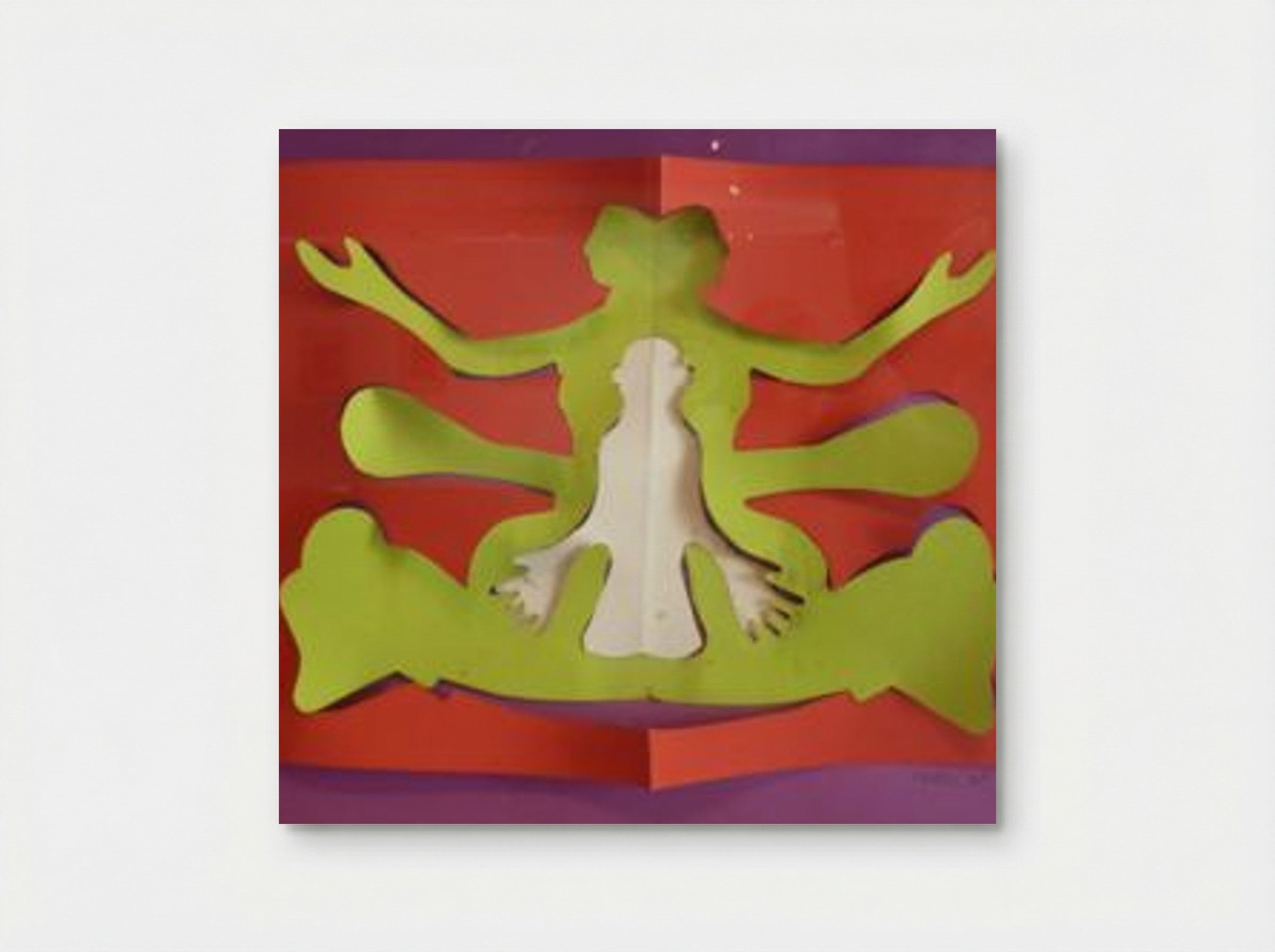
Recorte em relevo - José Escada
Archival giclée
Frames arrive ready to hang
Secure checkout
Made to order
Description
A striking paper cut-out by Portuguese artist José Escada, featuring layered geometric forms in lime green, white, and red.
José Escada was a Portuguese artist known for his experimentation with form, space, and the physical properties of materials. This work, titled Recorte em relevo, demonstrates his interest in the sculptural potential of paper. By cutting and folding the material, Escada transforms a two-dimensional surface into a three-dimensional object that interacts with light and shadow. The composition relies on symmetry and negative space. The artist uses a vibrant lime green layer, which is cut to reveal a white central form. This white shape acts as a core, surrounded by the green paper that appears to expand outwards. The red background provides a high-contrast base, creating a visual tension between the layers. The work is folded along a central vertical axis, which adds a sense of depth and structure to the piece. Escada often explored the boundaries between painting and sculpture. His work frequently involves the manipulation of paper to create relief effects, moving away from traditional canvas-based painting. This specific piece reflects his minimalist approach to shape and colour, where the act of cutting becomes the primary method of mark-making. The resulting form is organic, reminiscent of biological structures or abstract silhouettes, yet it remains firmly rooted in the geometric precision of the cut. By removing material, Escada defines the positive space, allowing the viewer to perceive the work as a series of nested planes. This approach invites a close examination of how the physical edges of the paper create depth without the need for traditional perspective or shading techniques.
Return policy
Because every print is made to order, we don't offer change-of-mind returns, refunds or exchanges. If your order arrives faulty, damaged or incorrect, we'll replace it free of charge — just contact us within 48 hours of delivery. See our refunds page for full details.
Shipping
We ship worldwide, printing at the production hub nearest to your delivery address. Delivery times and costs vary by destination — you'll see the options available to you at checkout.
Manufacturing
Each print is produced to order using 12-colour giclée printing on FSC-certified archival paper. Designed in Britain and printed at your nearest production hub to reduce waste and speed up delivery.
Care and materials
Specific Features
Every Solis piece is made to order with archival, gallery-quality materials built to last.
- Museum-grade giclée printing for rich, fade-resistant colour
- Archival matte fine-art paper, FSC-certified
- Multiple sizes and framing options available
- Frames in black, natural wood, dark wood or white
- Framed prints arrive ready to hang
Care & Cleaning
To keep your artwork looking its best:
- Dust gently with a soft, dry cloth
- Avoid prolonged direct sunlight
- Never use liquid cleaners on the print or canvas surface
- Keep in a dry, room-temperature space
- Handle prints with clean, dry hands
Materials & Sizing
Museum-grade giclée on FSC-certified archival matte paper, with framed and canvas options.
- Paper sizes: A4, A3, A2, A1, A0 and B2 (50×70 cm)
- Canvas: XS (20×30 cm) to Large (60×90 cm)
- Frames: black, natural wood, dark wood or white
Recorte em relevo - José Escada
Why Choose Us ?
Damage-free delivery guarantee
Fast Shipping
Museum-Quality Materials
You May Also Like