

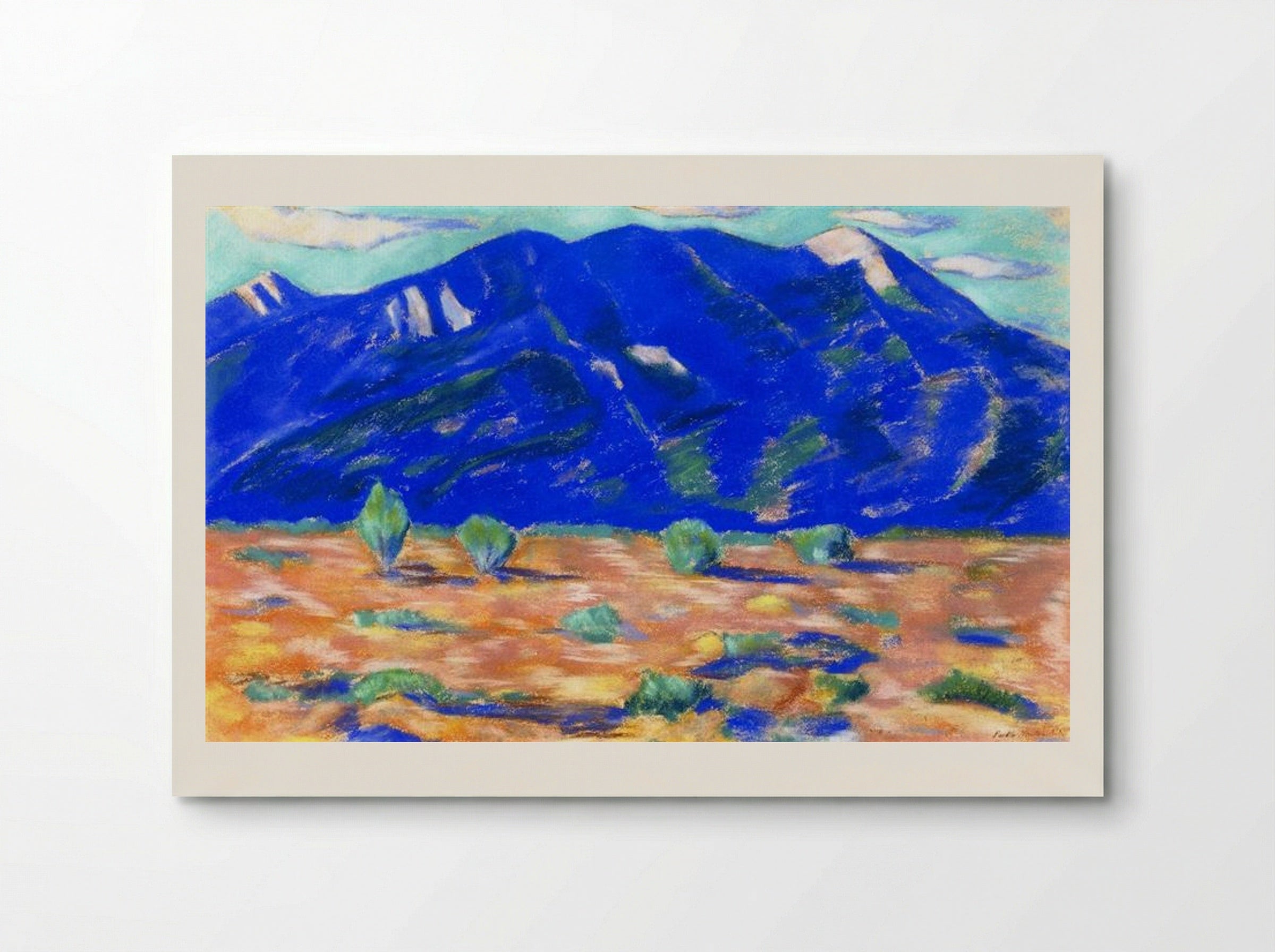
Pueblo Mountain - Marsden Hartley
Archival giclée
Frames arrive ready to hang
Secure checkout
Made to order
Description
A bold pastel study of the New Mexico desert by American modernist Marsden Hartley. The work features a massive blue mountain range set against a warm, sandy foreground.
Marsden Hartley produced this work during his stay in New Mexico between 1918 and 1919. The composition depicts a massive mountain range rendered in saturated blue tones. This period marked a shift in Hartley's practice as he moved away from the abstract symbols of his Berlin years toward a more direct engagement with the American environment. He sought to capture the specific character of the Taos and Santa Fe regions through a modernist lens. The artist used pastels to capture the arid terrain of the Southwest. The foreground consists of sandy ochre and tan hues, punctuated by small green shrubs that provide a sense of scale. Hartley applied the medium with heavy, rhythmic strokes that follow the contours of the land. The paper texture remains visible through the pigment, adding a tactile quality to the surface. This technique allows for a blend of soft edges and sharp definitions. The mountain dominates the upper two-thirds of the frame. Its form is defined by sharp peaks and deep shadows, suggesting the harsh light of the high desert. Small patches of white and pale yellow indicate snow or reflected sunlight on the highest ridges. Above the peaks, a narrow strip of pale turquoise sky contains thin, horizontal clouds. The use of a high horizon line emphasises the bulk of the mountain. Hartley often described the New Mexico scenery as sculptural and austere. This work reflects that perception through its simplified shapes and bold colour choices. The contrast between the cool blues of the mountain and the warm tones of the desert floor creates a balanced visual structure. It is a representative example of how American modernists adapted European expressionist techniques to local subjects. The work avoids sentimental depictions of the West, focusing instead on the raw geometry of the land.
Return policy
Because every print is made to order, we don't offer change-of-mind returns, refunds or exchanges. If your order arrives faulty, damaged or incorrect, we'll replace it free of charge — just contact us within 48 hours of delivery. See our refunds page for full details.
Shipping
We ship worldwide, printing at the production hub nearest to your delivery address. Delivery times and costs vary by destination — you'll see the options available to you at checkout.
Manufacturing
Each print is produced to order using 12-colour giclée printing on FSC-certified archival paper. Designed in Britain and printed at your nearest production hub to reduce waste and speed up delivery.
Pueblo Mountain - Marsden Hartley

Artist Biography
Marsden Hartley
Returning to the United States, Hartley sought to capture the essence of the American landscape and its people. He embraced a more representational style, focusing on the rugged beauty of his native Maine and the working-class communities he encountered. His "Dogtown" series, depicting the desolate landscape of a former settlement, showcases his ability to find beauty in the stark and unforgiving. These works are not mere landscapes; they are meditations on memory, loss, and the enduring power of nature.
Despite facing personal struggles and periods of obscurity, Hartley remained committed to his artistic vision. His willingness to experiment with different styles and subjects, from abstract symbolism to representational landscapes, makes him a truly unique and compelling figure. Marsden Hartley died in 1943, leaving behind a body of work that continues to challenge and inspire, inviting viewers to contemplate the complexities of identity, place, and the human condition.
Our Features
Designed for Lasting Impact
Specific Features
Every Solis piece is made to order with archival, gallery-quality materials built to last.
- Museum-grade giclée printing for rich, fade-resistant colour
- Archival matte fine-art paper, FSC-certified
- Multiple sizes and framing options available
- Frames in black, natural wood, dark wood or white
- Framed prints arrive ready to hang
Care & Cleaning
To keep your artwork looking its best:
- Dust gently with a soft, dry cloth
- Avoid prolonged direct sunlight
- Never use liquid cleaners on the print or canvas surface
- Keep in a dry, room-temperature space
- Handle prints with clean, dry hands
Materials & Sizing
Museum-grade giclée on FSC-certified archival matte paper, with framed and canvas options.
- Paper sizes: A4, A3, A2, A1, A0 and B2 (50×70 cm)
- Canvas: XS (20×30 cm) to Large (60×90 cm)
- Frames: black, natural wood, dark wood or white
Why Choose Us ?
Damage-free delivery guarantee
Fast Shipping
Museum-Quality Materials
Artist Biography
Marsden Hartley
Returning to the United States, Hartley sought to capture the essence of the American landscape and its people. He embraced a more representational style, focusing on the rugged beauty of his native Maine and the working-class communities he encountered. His "Dogtown" series, depicting the desolate landscape of a former settlement, showcases his ability to find beauty in the stark and unforgiving. These works are not mere landscapes; they are meditations on memory, loss, and the enduring power of nature.
Despite facing personal struggles and periods of obscurity, Hartley remained committed to his artistic vision. His willingness to experiment with different styles and subjects, from abstract symbolism to representational landscapes, makes him a truly unique and compelling figure. Marsden Hartley died in 1943, leaving behind a body of work that continues to challenge and inspire, inviting viewers to contemplate the complexities of identity, place, and the human condition.
You May Also Like