

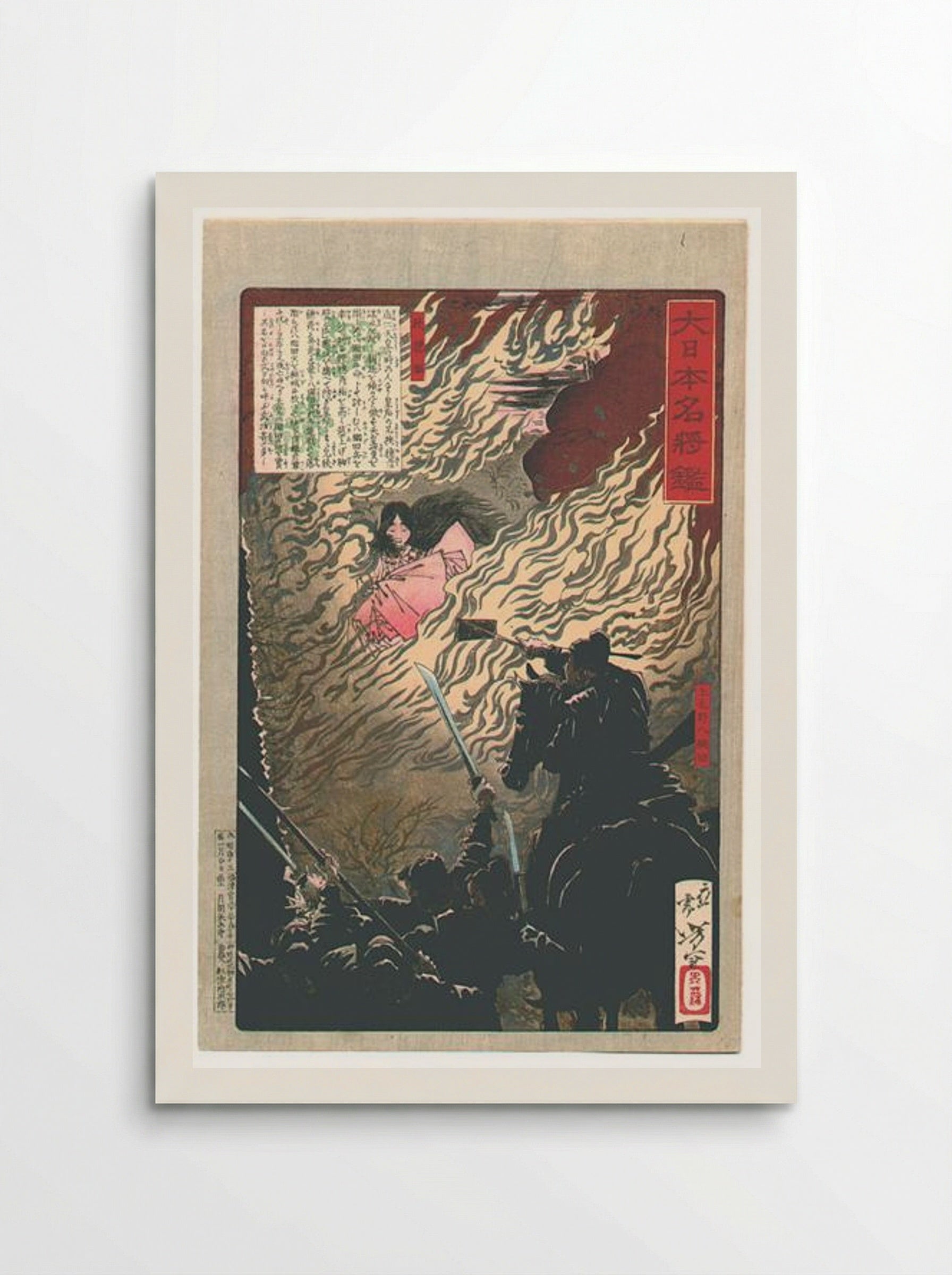
Princess Saohime dies in her brother's castle - Tsukioka Yoshitoshi
Archival giclée
Frames arrive ready to hang
Secure checkout
Made to order
Description
A dramatic woodblock print by Tsukioka Yoshitoshi, depicting Princess Saohime during a castle fire. The artwork showcases the artist's skill in blending traditional Ukiyo-e techniques with emotionally charged historical narratives.
This woodblock print by Tsukioka Yoshitoshi (1839-1892) depicts a scene of dramatic intensity. The artwork shows Princess Saohime amidst a raging fire, presumably within her brother's castle. Yoshitoshi, a prominent figure in the Ukiyo-e movement, was known for his ability to blend traditional Japanese artistic techniques with modern sensibilities, often focusing on historical and legendary subjects. His work is characterised by its dynamic compositions and emotional depth. The print features a stark contrast between the fiery background and the figures in the foreground. Princess Saohime is rendered in pale pink, seemingly floating above the chaos. Below, silhouetted warriors on horseback raise their swords, their forms adding to the overall sense of turmoil. The flames are depicted with swirling lines, creating a sense of movement and destruction. The use of colour is restrained, with the red flames and the pink robe of the princess standing out against the dark background. This print exemplifies Yoshitoshi's skill in conveying both narrative and emotion through the medium of woodblock printing.
Return policy
Because every print is made to order, we don't offer change-of-mind returns, refunds or exchanges. If your order arrives faulty, damaged or incorrect, we'll replace it free of charge — just contact us within 48 hours of delivery. See our refunds page for full details.
Shipping
We ship worldwide, printing at the production hub nearest to your delivery address. Delivery times and costs vary by destination — you'll see the options available to you at checkout.
Manufacturing
Each print is produced to order using 12-colour giclée printing on FSC-certified archival paper. Designed in Britain and printed at your nearest production hub to reduce waste and speed up delivery.
Princess Saohime dies in her brother's castle - Tsukioka Yoshitoshi

Artist Biography
Yoshitoshi
Yoshitoshi's art is characterised by its dramatic intensity and historical themes. He was fascinated by the supernatural, often depicting ghosts, demons, and scenes of violence. His mentor was Utagawa Kuniyoshi, who also explored similar themes. Yoshitoshi's skill in portraying emotion and movement, combined with his mastery of colour and composition, made his prints stand out. His work reflects a turbulent period in Japanese history, capturing the anxieties and uncertainties of a society undergoing rapid change.
Collectors are drawn to Yoshitoshi's prints for their striking imagery and historical value. His works offer a glimpse into a transitional period in Japan, blending traditional artistic techniques with modern sensibilities. His prints appeal to those who appreciate art that is both visually stunning and intellectually stimulating, preserving a vital part of Japanese cultural heritage.
Our Features
Designed for Lasting Impact
Specific Features
Every Solis piece is made to order with archival, gallery-quality materials built to last.
- Museum-grade giclée printing for rich, fade-resistant colour
- Archival matte fine-art paper, FSC-certified
- Multiple sizes and framing options available
- Frames in black, natural wood, dark wood or white
- Framed prints arrive ready to hang
Care & Cleaning
To keep your artwork looking its best:
- Dust gently with a soft, dry cloth
- Avoid prolonged direct sunlight
- Never use liquid cleaners on the print or canvas surface
- Keep in a dry, room-temperature space
- Handle prints with clean, dry hands
Materials & Sizing
Museum-grade giclée on FSC-certified archival matte paper, with framed and canvas options.
- Paper sizes: A4, A3, A2, A1, A0 and B2 (50×70 cm)
- Canvas: XS (20×30 cm) to Large (60×90 cm)
- Frames: black, natural wood, dark wood or white
Why Choose Us ?
Damage-free delivery guarantee
Fast Shipping
Museum-Quality Materials
Artist Biography
Yoshitoshi
Yoshitoshi's art is characterised by its dramatic intensity and historical themes. He was fascinated by the supernatural, often depicting ghosts, demons, and scenes of violence. His mentor was Utagawa Kuniyoshi, who also explored similar themes. Yoshitoshi's skill in portraying emotion and movement, combined with his mastery of colour and composition, made his prints stand out. His work reflects a turbulent period in Japanese history, capturing the anxieties and uncertainties of a society undergoing rapid change.
Collectors are drawn to Yoshitoshi's prints for their striking imagery and historical value. His works offer a glimpse into a transitional period in Japan, blending traditional artistic techniques with modern sensibilities. His prints appeal to those who appreciate art that is both visually stunning and intellectually stimulating, preserving a vital part of Japanese cultural heritage.
You May Also Like