

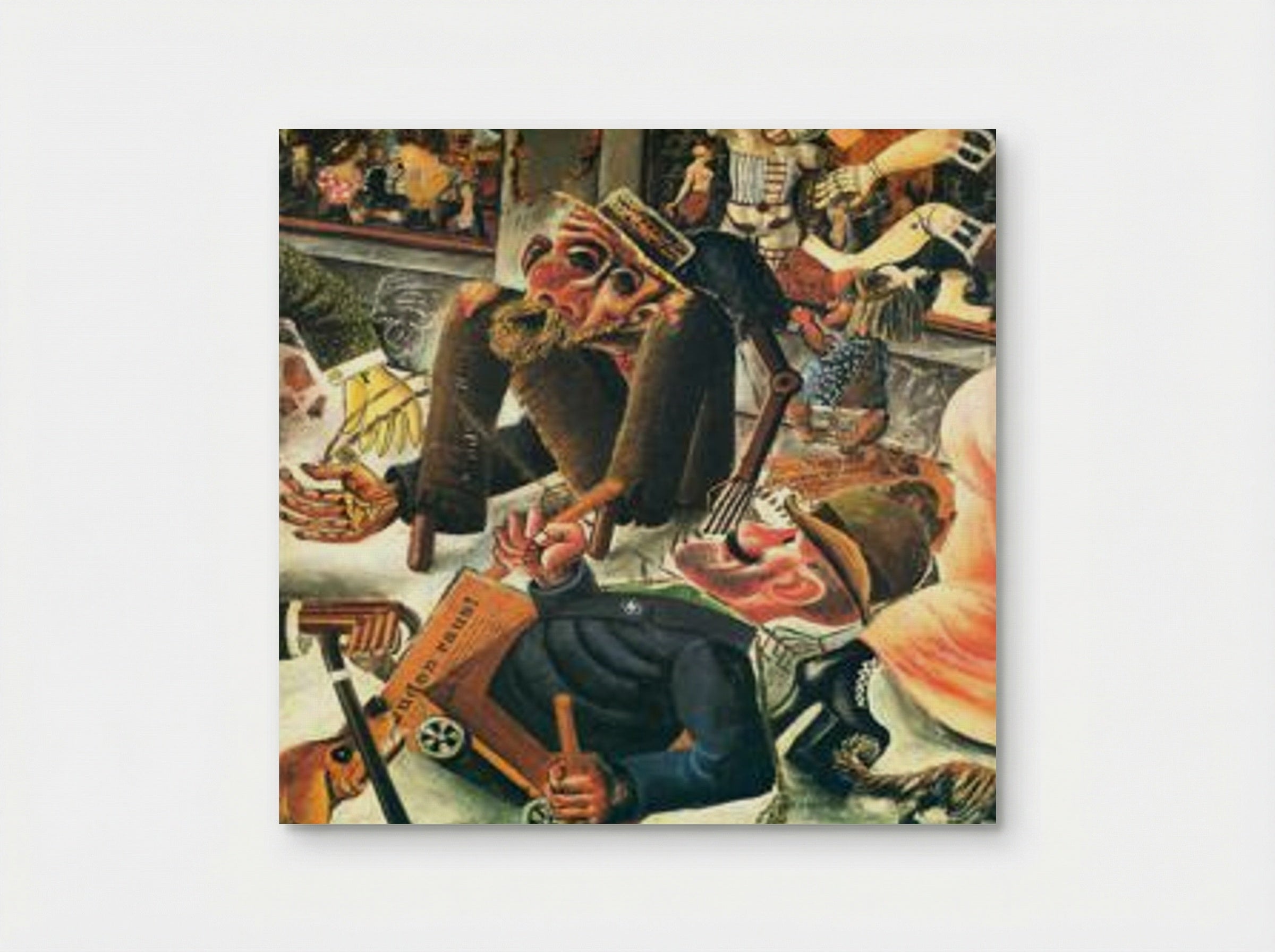
Pragerstrasse - Otto Dix
Archival giclée
Frames arrive ready to hang
Secure checkout
Made to order
Description
A stark, critical depiction of war veterans in Weimar-era Germany, capturing the social disillusionment and physical trauma of the post-war period.
Pragerstrasse, painted in 1920, is a defining work of the New Objectivity movement in Weimar-era Germany. Otto Dix depicts a street scene in Dresden, focusing on the grim reality of war veterans left to survive in public spaces. The composition is crowded with figures, including two disabled men who occupy the foreground. One man, a double amputee, sits on a wheeled platform, while another figure with a prosthetic leg and a cane sits nearby. Their bodies are distorted, reflecting the physical trauma inflicted by the First World War. Dix incorporates collage elements, such as newspaper clippings, to ground the scene in the specific political climate of the time. The newspaper held by the amputee features the headline 'Juden raus!', a detail that signals the rising antisemitism and social tension of the period. The background includes a shop window displaying mannequins, which creates a jarring contrast between the artificial, pristine forms of the store and the broken, suffering bodies of the veterans. The colour palette is harsh, using sickly tones that emphasise the decay and moral bankruptcy of the society depicted. This work functions as a direct critique of the German state, which failed to support those it sent to fight. Dix avoids romanticising the experience of the veteran, choosing instead to present a grotesque, unflinching view of the aftermath of conflict. The perspective is slightly tilted, adding to the sense of unease and instability that permeates the entire image. By placing these figures in a busy urban setting, Dix forces the viewer to confront the human cost of war that was often ignored by the public. The painting remains a stark record of the social fragmentation and disillusionment that characterised the early 1920s in Germany.
Return policy
Because every print is made to order, we don't offer change-of-mind returns, refunds or exchanges. If your order arrives faulty, damaged or incorrect, we'll replace it free of charge — just contact us within 48 hours of delivery. See our refunds page for full details.
Shipping
We ship worldwide, printing at the production hub nearest to your delivery address. Delivery times and costs vary by destination — you'll see the options available to you at checkout.
Manufacturing
Each print is produced to order using 12-colour giclée printing on FSC-certified archival paper. Designed in Britain and printed at your nearest production hub to reduce waste and speed up delivery.
Pragerstrasse - Otto Dix
Our Features
Designed for Lasting Impact
Specific Features
Every Solis piece is made to order with archival, gallery-quality materials built to last.
- Museum-grade giclée printing for rich, fade-resistant colour
- Archival matte fine-art paper, FSC-certified
- Multiple sizes and framing options available
- Frames in black, natural wood, dark wood or white
- Framed prints arrive ready to hang
Care & Cleaning
To keep your artwork looking its best:
- Dust gently with a soft, dry cloth
- Avoid prolonged direct sunlight
- Never use liquid cleaners on the print or canvas surface
- Keep in a dry, room-temperature space
- Handle prints with clean, dry hands
Materials & Sizing
Museum-grade giclée on FSC-certified archival matte paper, with framed and canvas options.
- Paper sizes: A4, A3, A2, A1, A0 and B2 (50×70 cm)
- Canvas: XS (20×30 cm) to Large (60×90 cm)
- Frames: black, natural wood, dark wood or white
Why Choose Us ?
Damage-free delivery guarantee
Fast Shipping
Museum-Quality Materials
Artist Biography
Otto Dix
You May Also Like