

Poèmes Barbares - Paul Gauguin
Archival giclée
Frames arrive ready to hang
Secure checkout
Made to order
Description
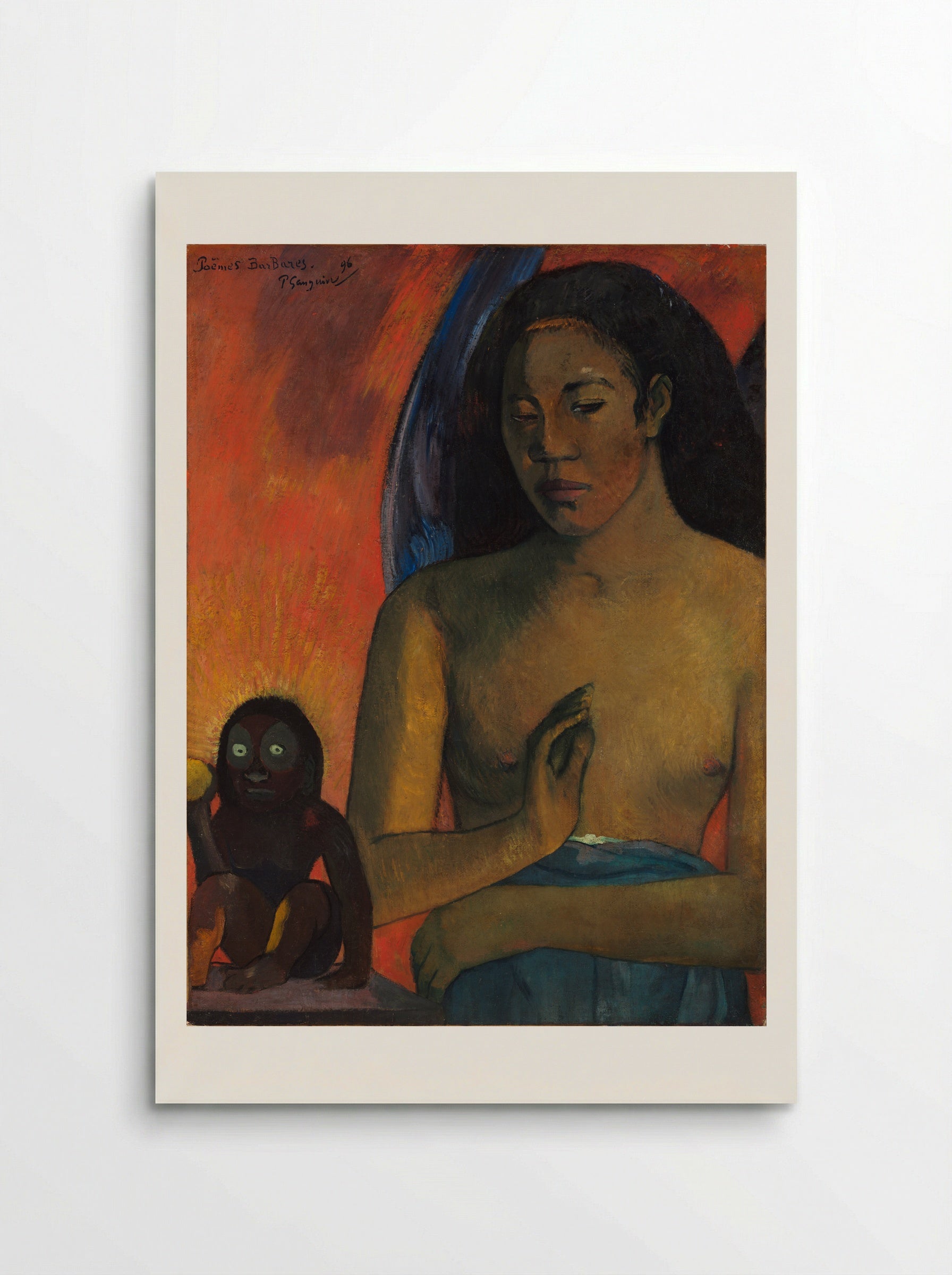
A 1896 oil painting by Paul Gauguin featuring a Tahitian woman and a mythological figure against a bold, fiery red background.
Painted in 1896 during his second stay in Tahiti, Poèmes Barbares captures the synthesis of Gauguin's European background and his immersion in Polynesian culture. The composition features a central female figure, identified as Tehura, who was the artist's companion during his time in the islands. She is depicted with a calm, meditative expression, her body rendered in warm, earthy tones that contrast with the stark, fiery red background. To her left sits a small, enigmatic creature, often interpreted as a representation of a Tahitian deity or a spirit figure. The creature possesses wide, pale eyes and a dark, almost silhouette-like form, adding a layer of mystery to the scene. Gauguin employs a flattened perspective and bold, non-naturalistic colour choices, which were characteristic of his later work. The title, inscribed in the upper left corner, suggests a deliberate attempt to evoke a sense of the primitive, a concept that fascinated the artist throughout his career. This work demonstrates Gauguin's move away from the observational techniques of his earlier Impressionist period. Instead, he prioritises symbolic meaning and emotional resonance through simplified forms and saturated hues. The interplay between the human subject and the mythological figure creates a quiet, otherworldly atmosphere. The painting remains a significant example of the artist's exploration of identity, spirituality, and the intersection of different cultural narratives. The brushwork is deliberate, focusing on large areas of colour rather than fine detail, which allows the viewer to engage with the overall mood of the piece. It is a study in contrast, balancing the stillness of the woman with the strange, watchful presence of the smaller figure.
Return policy
Because every print is made to order, we don't offer change-of-mind returns, refunds or exchanges. If your order arrives faulty, damaged or incorrect, we'll replace it free of charge — just contact us within 48 hours of delivery. See our refunds page for full details.
Shipping
We ship worldwide, printing at the production hub nearest to your delivery address. Delivery times and costs vary by destination — you'll see the options available to you at checkout.
Manufacturing
Each print is produced to order using 12-colour giclée printing on FSC-certified archival paper. Designed in Britain and printed at your nearest production hub to reduce waste and speed up delivery.
Care and materials
Specific Features
Every Solis piece is made to order with archival, gallery-quality materials built to last.
- Museum-grade giclée printing for rich, fade-resistant colour
- Archival matte fine-art paper, FSC-certified
- Multiple sizes and framing options available
- Frames in black, natural wood, dark wood or white
- Framed prints arrive ready to hang
Care & Cleaning
To keep your artwork looking its best:
- Dust gently with a soft, dry cloth
- Avoid prolonged direct sunlight
- Never use liquid cleaners on the print or canvas surface
- Keep in a dry, room-temperature space
- Handle prints with clean, dry hands
Materials & Sizing
Museum-grade giclée on FSC-certified archival matte paper, with framed and canvas options.
- Paper sizes: A4, A3, A2, A1, A0 and B2 (50×70 cm)
- Canvas: XS (20×30 cm) to Large (60×90 cm)
- Frames: black, natural wood, dark wood or white
Poèmes Barbares - Paul Gauguin

Artist Biography
Paul Gauguin
Gauguin soon rejected the Impressionist focus on objective representation, seeking instead to express subjective emotions and spiritual ideas through his art. This led him to develop a distinctive style characterised by flattened forms, simplified lines, and vibrant, non-naturalistic colours. Key works such as *Vision after the Sermon* (1888) exemplify this approach, showcasing his move towards Symbolism and Cloisonnism.
Frustrated with European society, Gauguin sought refuge in French Polynesia, where he created some of his most iconic paintings, including *Where Do We Come From? What Are We? Where Are We Going?* (1897-98). These works depict the beauty and mystery of Tahitian life, albeit through a lens that has since been critiqued for its romanticised and colonial gaze. Despite his controversial legacy, Paul Gauguin's innovative use of colour and his exploration of primal themes profoundly influenced the development of modern art.
Why Choose Us ?
Damage-free delivery guarantee
Fast Shipping
Museum-Quality Materials
You May Also Like