

Fine Art Poster
From £28
A giclée print on 200gsm matte fine art paper, using a twelve-colour process for accurate, fade-resistant colour. Supplied unframed, delivered flat or rolled.



Archival giclée
Frames arrive ready to hang
Secure checkout
Made to order
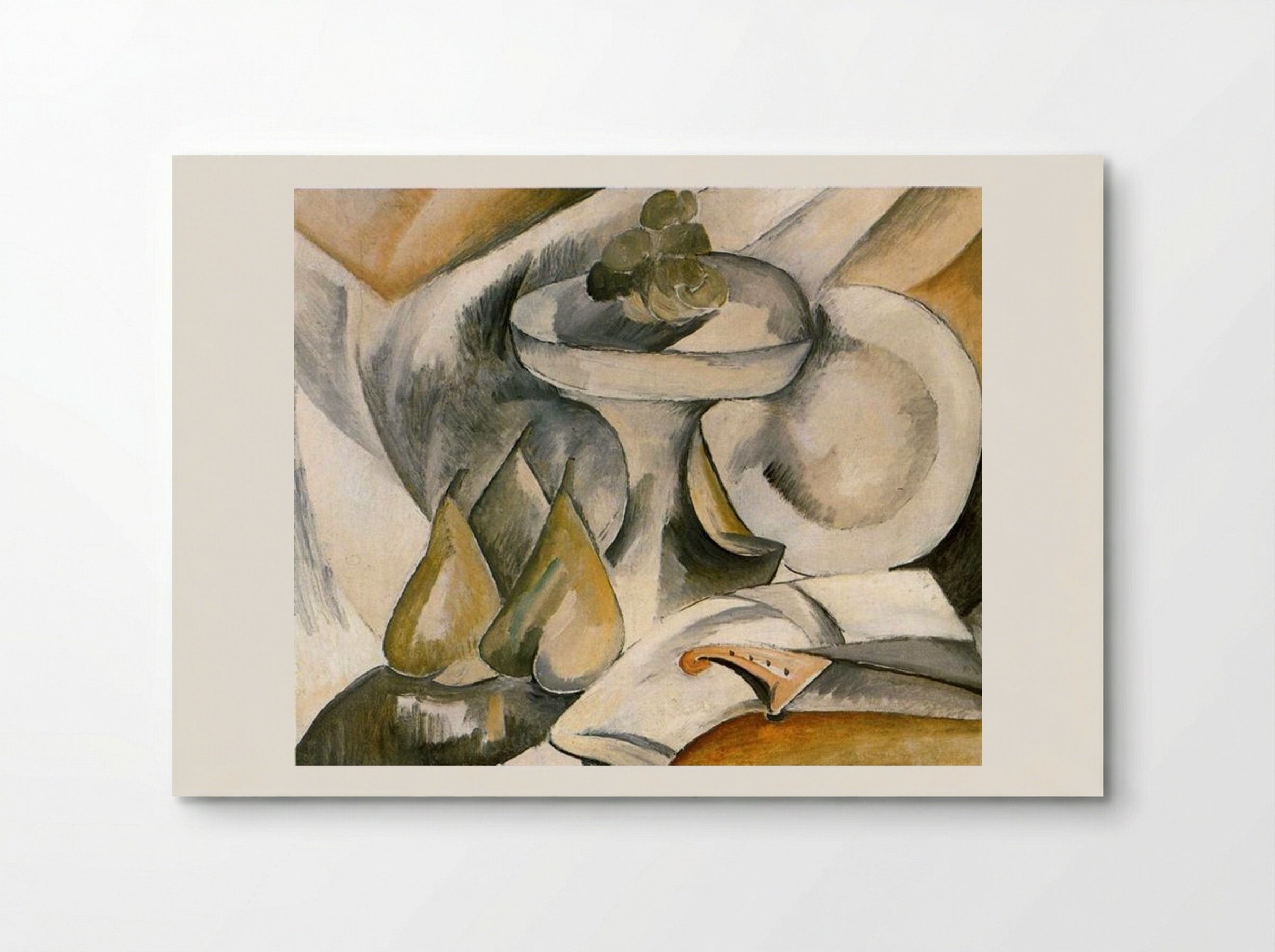
A Cubist still life by Georges Braque, 'Plate and Fruit Dish' exemplifies the artist's exploration of fragmented forms and spatial relationships. The muted palette and geometric shapes create an intellectual analysis of visual reality.
Georges Braque (1882-1963) was a major 20th-century French painter, collagist, draughtsman, printmaker and sculptor. He is most known for his association with Pablo Picasso and the development of Cubism. Braque's work evolved from Impressionism to Fauvism before he began his Cubist experiments. He explored the fragmentation of objects and space, reducing forms to geometric shapes and multiple perspectives. 'Plate and Fruit Dish' is a classic example of Braque's Cubist still life paintings. The composition features a tabletop arrangement of fruit, a plate, and what appears to be a musical instrument, possibly a violin or mandolin. The objects are not depicted realistically but are instead broken down into simplified, overlapping planes and facets. The colour palette is restrained, dominated by muted browns, greys, and creams, which is typical of the Analytical Cubist style. The lack of strong colour emphasis allows the viewer to focus on the forms and spatial relationships within the painting. The overall effect is one of intellectual analysis and reconstruction of visual reality, challenging traditional notions of perspective and representation.
Because every print is made to order, we don't offer change-of-mind returns, refunds or exchanges. If your order arrives faulty, damaged or incorrect, we'll replace it free of charge — just contact us within 48 hours of delivery. See our refunds page for full details.
We ship worldwide, printing at the production hub nearest to your delivery address. Delivery times and costs vary by destination — you'll see the options available to you at checkout.
Each print is produced to order using 12-colour giclée printing on FSC-certified archival paper. Designed in Britain and printed at your nearest production hub to reduce waste and speed up delivery.

Artist Biography
Our Features
Designed for Lasting Impact
Every Solis piece is made to order with archival, gallery-quality materials built to last.
To keep your artwork looking its best:
Museum-grade giclée on FSC-certified archival matte paper, with framed and canvas options.
Made to order
Every piece is printed to order. These are the five finishes, and what makes each one different.
From £28
A giclée print on 200gsm matte fine art paper, using a twelve-colour process for accurate, fade-resistant colour. Supplied unframed, delivered flat or rolled.

From £45
The same fine art print in a solid wood frame with UV-protective acrylic glaze and rigid backing. Five frame colours. Arrives ready to hang.
Why Choose Us ?
Damage-free delivery guarantee
Fast Shipping
Museum-Quality Materials
Artist Biography
Georges Braque
You May Also Like
Cookies show us which prints people love, so we hang the right art. Help us fill it?
Essential cookies only if you prefer · Privacy Policy