

Fine Art Poster
From £28
A giclée print on 200gsm matte fine art paper, using a twelve-colour process for accurate, fade-resistant colour. Supplied unframed, delivered flat or rolled.



Archival giclée
Frames arrive ready to hang
Secure checkout
Made to order
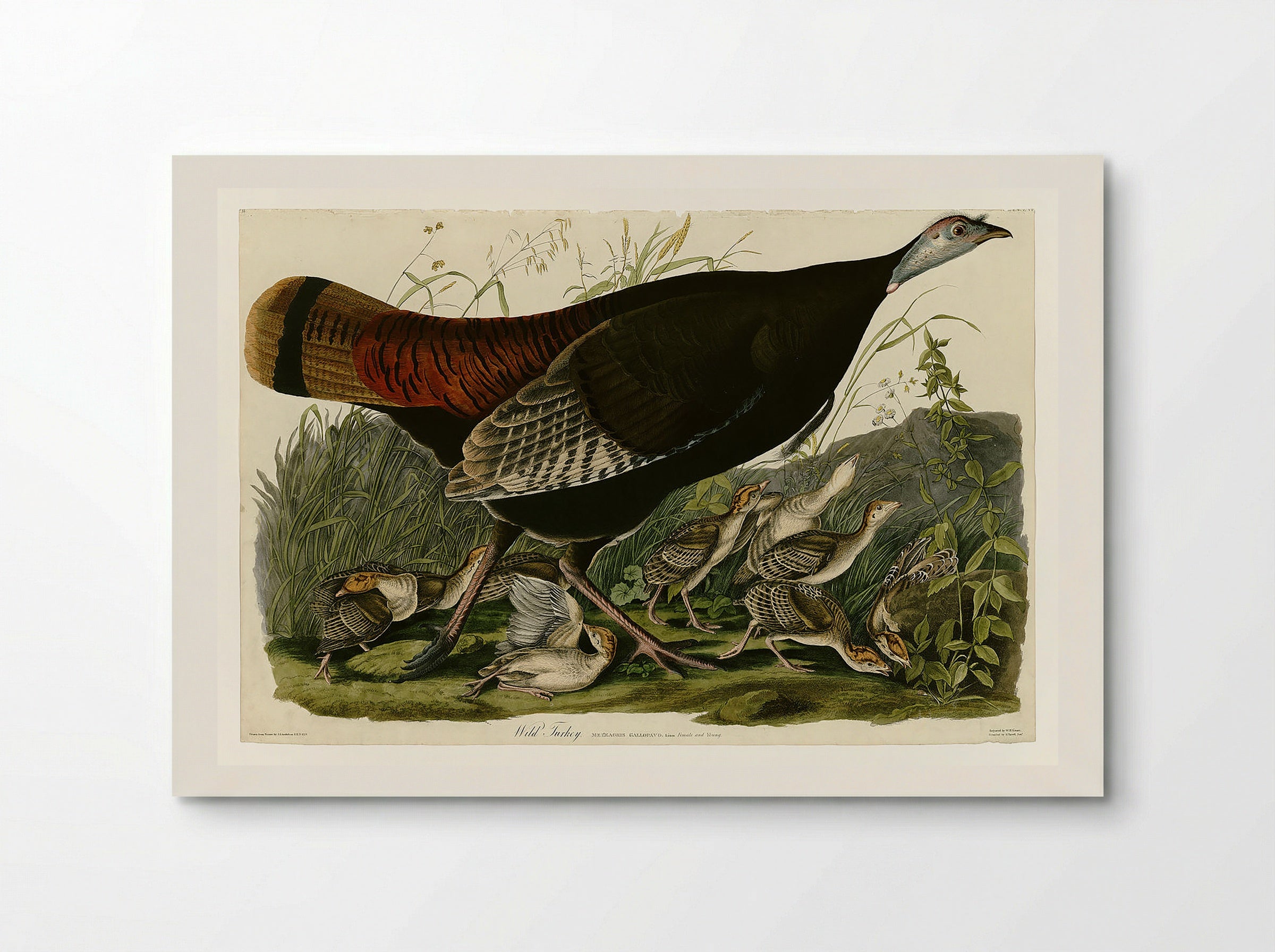
John James Audubon's "Plate 6. Wild Turkey" is a hand-coloured engraving from his "Birds of America" series, showcasing a male wild turkey with its young in a natural setting. This print combines scientific accuracy with artistic skill.
John James Audubon's "Plate 6. Wild Turkey" is a hand-coloured engraving, part of his ambitious "Birds of America" series. Published between 1827 and 1838, this series aimed to document all known bird species of North America in life-size format. Audubon combined scientific accuracy with artistic skill, creating images that are both informative and aesthetically pleasing. His work contributed significantly to ornithology and conservation efforts. He was not formally trained as an artist, but his passion for birds and the natural world drove him to develop his own techniques. He often shot the birds himself, then used wires and boards to pose them realistically for his drawings. This particular plate depicts a male wild turkey, accompanied by several smaller turkeys, likely females and young. The adult male is shown in profile, its dark plumage contrasting with the lighter tones of the younger birds. The composition is carefully arranged, with the birds positioned among grasses and foliage to create a natural setting. The details of the feathers, beaks, and eyes are rendered with precision, reflecting Audubon's meticulous observation and artistic skill. The hand-colouring adds depth and realism to the image, bringing the birds to life on the page.
Because every print is made to order, we don't offer change-of-mind returns, refunds or exchanges. If your order arrives faulty, damaged or incorrect, we'll replace it free of charge — just contact us within 48 hours of delivery. See our refunds page for full details.
We ship worldwide, printing at the production hub nearest to your delivery address. Delivery times and costs vary by destination — you'll see the options available to you at checkout.
Each print is produced to order using 12-colour giclée printing on FSC-certified archival paper. Designed in Britain and printed at your nearest production hub to reduce waste and speed up delivery.

Artist Biography
Our Features
Designed for Lasting Impact
Every Solis piece is made to order with archival, gallery-quality materials built to last.
To keep your artwork looking its best:
Museum-grade giclée on FSC-certified archival matte paper, with framed and canvas options.
Made to order
Every piece is printed to order. These are the five finishes, and what makes each one different.
From £28
A giclée print on 200gsm matte fine art paper, using a twelve-colour process for accurate, fade-resistant colour. Supplied unframed, delivered flat or rolled.

From £45
The same fine art print in a solid wood frame with UV-protective acrylic glaze and rigid backing. Five frame colours. Arrives ready to hang.
Why Choose Us ?
Damage-free delivery guarantee
Fast Shipping
Museum-Quality Materials
Artist Biography
John James Audubon
You May Also Like
Cookies show us which prints people love, so we hang the right art. Help us fill it?
Essential cookies only if you prefer · Privacy Policy