

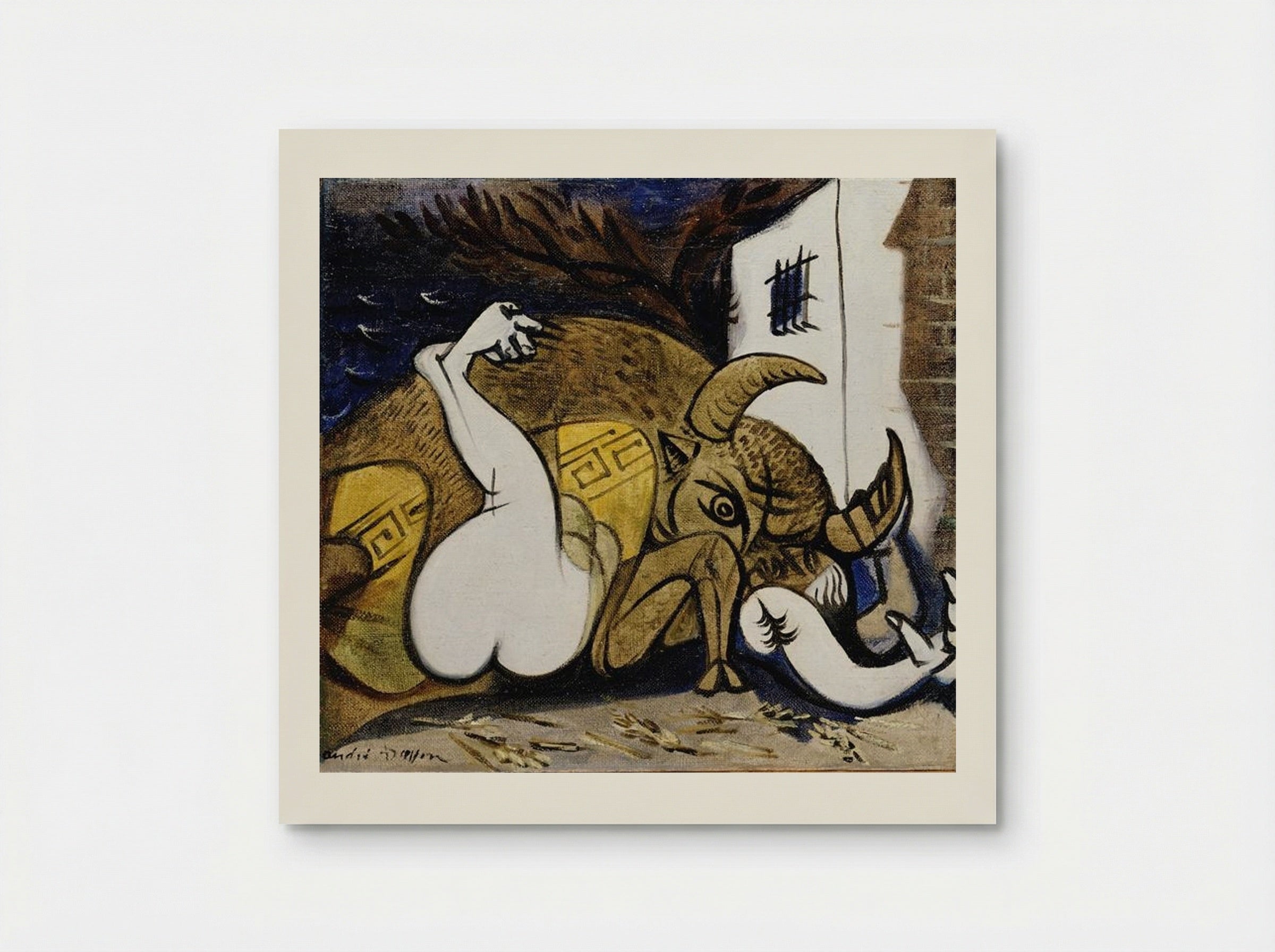
Pasiphae - André Masson
Archival giclée
Frames arrive ready to hang
Secure checkout
Made to order
Description
A striking Surrealist interpretation of the Greek myth of Pasiphae, rendered in bold lines and earth tones by André Masson.
André Masson, a central figure in the Surrealist movement, produced this interpretation of the Greek myth of Pasiphae during his period of exile in the United States. The work depicts the Cretan queen in a physical union with the bull, a subject that allowed Masson to explore themes of eroticism, violence, and the subconscious mind. His approach to the myth is not one of classical restraint, but rather a raw, visceral examination of human desire and animal instinct. The composition is dominated by the heavy, earth-toned form of the bull, which occupies the centre of the frame. Masson uses bold, black outlines to define the figures, creating a stark contrast against the pale, almost luminous skin of Pasiphae. The background is minimal, featuring a simplified architectural element that suggests a structure, perhaps a reference to the labyrinth of Knossos. The dark, moody sky provides a sense of enclosure, forcing the viewer to focus on the central interaction. Masson was deeply interested in automatic drawing and the expression of internal states. In this piece, the distortion of the figures reflects his rejection of traditional perspective and anatomical accuracy. The geometric patterns on the bull's flank add a decorative, almost archaic quality to the scene, grounding the mythological subject in a primitive aesthetic. The brushwork is deliberate, with visible texture that adds to the overall intensity of the image. This work remains a clear example of Masson's ability to translate complex psychological narratives into visual form, using the language of myth to address universal human experiences. The stark palette and aggressive lines create a sense of urgency, capturing a moment of mythic transformation.
Return policy
Because every print is made to order, we don't offer change-of-mind returns, refunds or exchanges. If your order arrives faulty, damaged or incorrect, we'll replace it free of charge — just contact us within 48 hours of delivery. See our refunds page for full details.
Shipping
We ship worldwide, printing at the production hub nearest to your delivery address. Delivery times and costs vary by destination — you'll see the options available to you at checkout.
Manufacturing
Each print is produced to order using 12-colour giclée printing on FSC-certified archival paper. Designed in Britain and printed at your nearest production hub to reduce waste and speed up delivery.
Pasiphae - André Masson
Our Features
Designed for Lasting Impact
Specific Features
Every Solis piece is made to order with archival, gallery-quality materials built to last.
- Museum-grade giclée printing for rich, fade-resistant colour
- Archival matte fine-art paper, FSC-certified
- Multiple sizes and framing options available
- Frames in black, natural wood, dark wood or white
- Framed prints arrive ready to hang
Care & Cleaning
To keep your artwork looking its best:
- Dust gently with a soft, dry cloth
- Avoid prolonged direct sunlight
- Never use liquid cleaners on the print or canvas surface
- Keep in a dry, room-temperature space
- Handle prints with clean, dry hands
Materials & Sizing
Museum-grade giclée on FSC-certified archival matte paper, with framed and canvas options.
- Paper sizes: A4, A3, A2, A1, A0 and B2 (50×70 cm)
- Canvas: XS (20×30 cm) to Large (60×90 cm)
- Frames: black, natural wood, dark wood or white
Why Choose Us ?
Damage-free delivery guarantee
Fast Shipping
Museum-Quality Materials
Artist Biography
André Masson
You May Also Like