

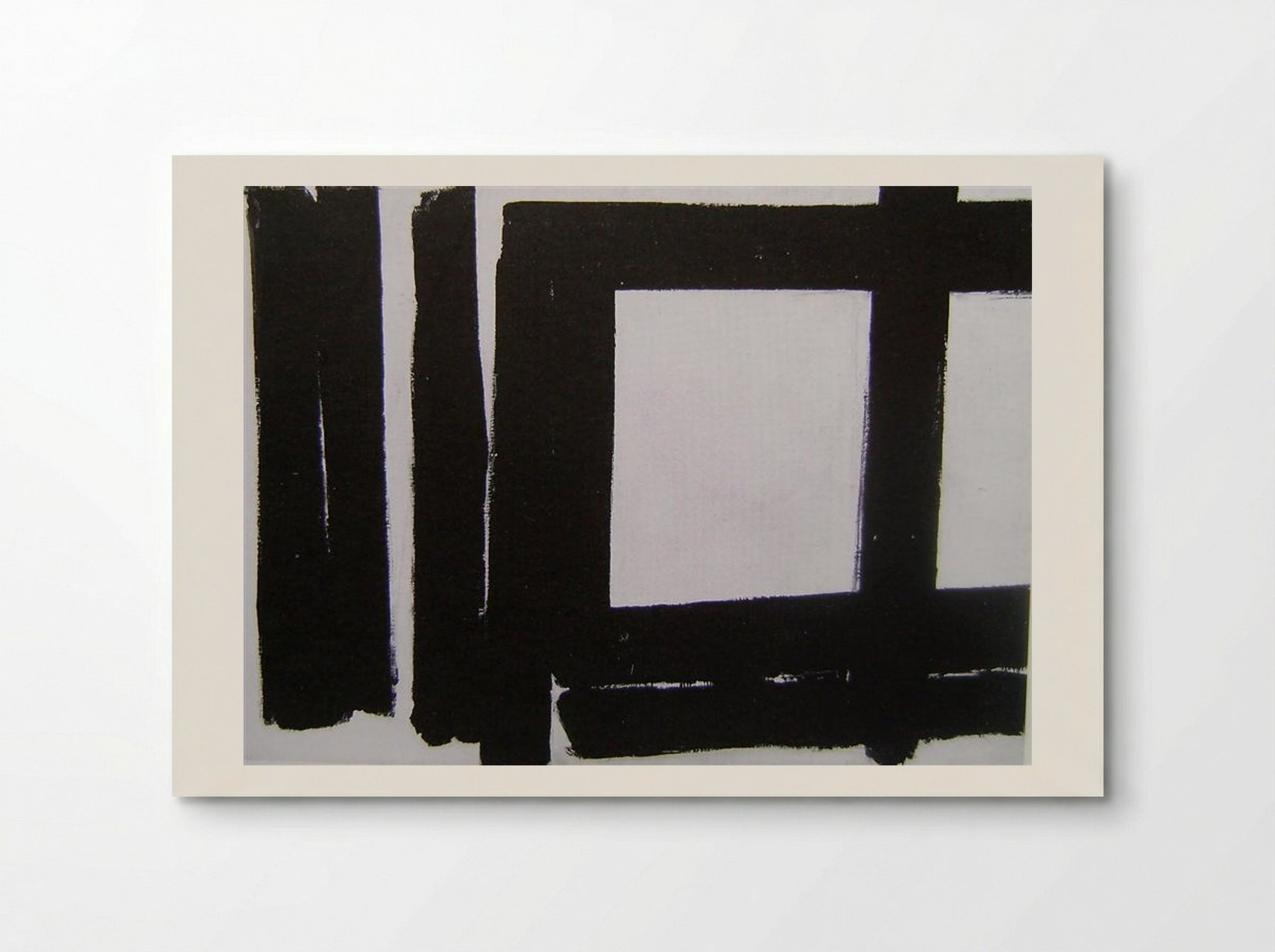
Painting No. 7 - Franz Kline
Archival giclée
Frames arrive ready to hang
Secure checkout
Made to order
Description
A powerful example of Abstract Expressionism, this work by Franz Kline features bold, black gestural forms set against a stark white background.
Franz Kline is recognised for his large-scale, gestural works that define the aesthetic of the New York School during the mid-twentieth century. Painting No. 7 demonstrates his characteristic approach to composition, where bold, black forms are applied against a stark white ground. Unlike many of his contemporaries who focused on colour field painting, Kline restricted his palette to black and white, allowing the structural weight of the brushstrokes to dictate the visual experience. The work is defined by its architectural quality. The heavy, black bars intersect and frame the negative space, creating a sense of tension and balance. Kline often prepared his compositions by projecting small sketches onto a wall, which allowed him to scale up his rapid, spontaneous marks into expansive canvases. This process ensured that the final execution retained the energy of the initial concept. The edges of the forms show the physical texture of the paint, revealing the speed and pressure of the brush as it moved across the surface. In this piece, the interaction between the solid black shapes and the surrounding white space creates a dynamic equilibrium. The composition avoids traditional representational subjects, instead inviting the viewer to engage with the physical presence of the paint itself. Kline's work from this period is often associated with the urban environment of New York, though he maintained that his paintings were not direct depictions of city structures. Instead, they function as autonomous arrangements of form and space. This print captures the stark contrast and the raw, unrefined energy that defined Kline's contribution to the development of American abstraction.
Return policy
Because every print is made to order, we don't offer change-of-mind returns, refunds or exchanges. If your order arrives faulty, damaged or incorrect, we'll replace it free of charge — just contact us within 48 hours of delivery. See our refunds page for full details.
Shipping
We ship worldwide, printing at the production hub nearest to your delivery address. Delivery times and costs vary by destination — you'll see the options available to you at checkout.
Manufacturing
Each print is produced to order using 12-colour giclée printing on FSC-certified archival paper. Designed in Britain and printed at your nearest production hub to reduce waste and speed up delivery.
Care and materials
Specific Features
Every Solis piece is made to order with archival, gallery-quality materials built to last.
- Museum-grade giclée printing for rich, fade-resistant colour
- Archival matte fine-art paper, FSC-certified
- Multiple sizes and framing options available
- Frames in black, natural wood, dark wood or white
- Framed prints arrive ready to hang
Care & Cleaning
To keep your artwork looking its best:
- Dust gently with a soft, dry cloth
- Avoid prolonged direct sunlight
- Never use liquid cleaners on the print or canvas surface
- Keep in a dry, room-temperature space
- Handle prints with clean, dry hands
Materials & Sizing
Museum-grade giclée on FSC-certified archival matte paper, with framed and canvas options.
- Paper sizes: A4, A3, A2, A1, A0 and B2 (50×70 cm)
- Canvas: XS (20×30 cm) to Large (60×90 cm)
- Frames: black, natural wood, dark wood or white
Painting No. 7 - Franz Kline

Artist Biography
Franz Kline
He studied at Boston University and the Heatherley School of Fine Art in London, then spent the 1940s painting figurative work in New York. The shift to abstraction came suddenly, according to legend, when de Kooning projected one of Kline's small drawings onto a wall using a Bell-Opticon projector. The enlarged image, freed from its original scale, became something else entirely. Kline began painting large.
The black and white paintings of 1950-61 are his contribution. Mahoning, Chief, and Painting Number 2 are decisive, architectural compositions that look spontaneous but were carefully planned. He made small preparatory studies on telephone book pages and newspaper, working out the balance of black and white before scaling up. The white is not background; it is as active and deliberate as the black.
He reintroduced colour in his last years, which surprised people who had defined him by its absence. He died of heart disease in 1962, at fifty-one. The career lasted roughly twelve years. The paintings are in every major museum of modern art.
Why Choose Us ?
Damage-free delivery guarantee
Fast Shipping
Museum-Quality Materials
You May Also Like