

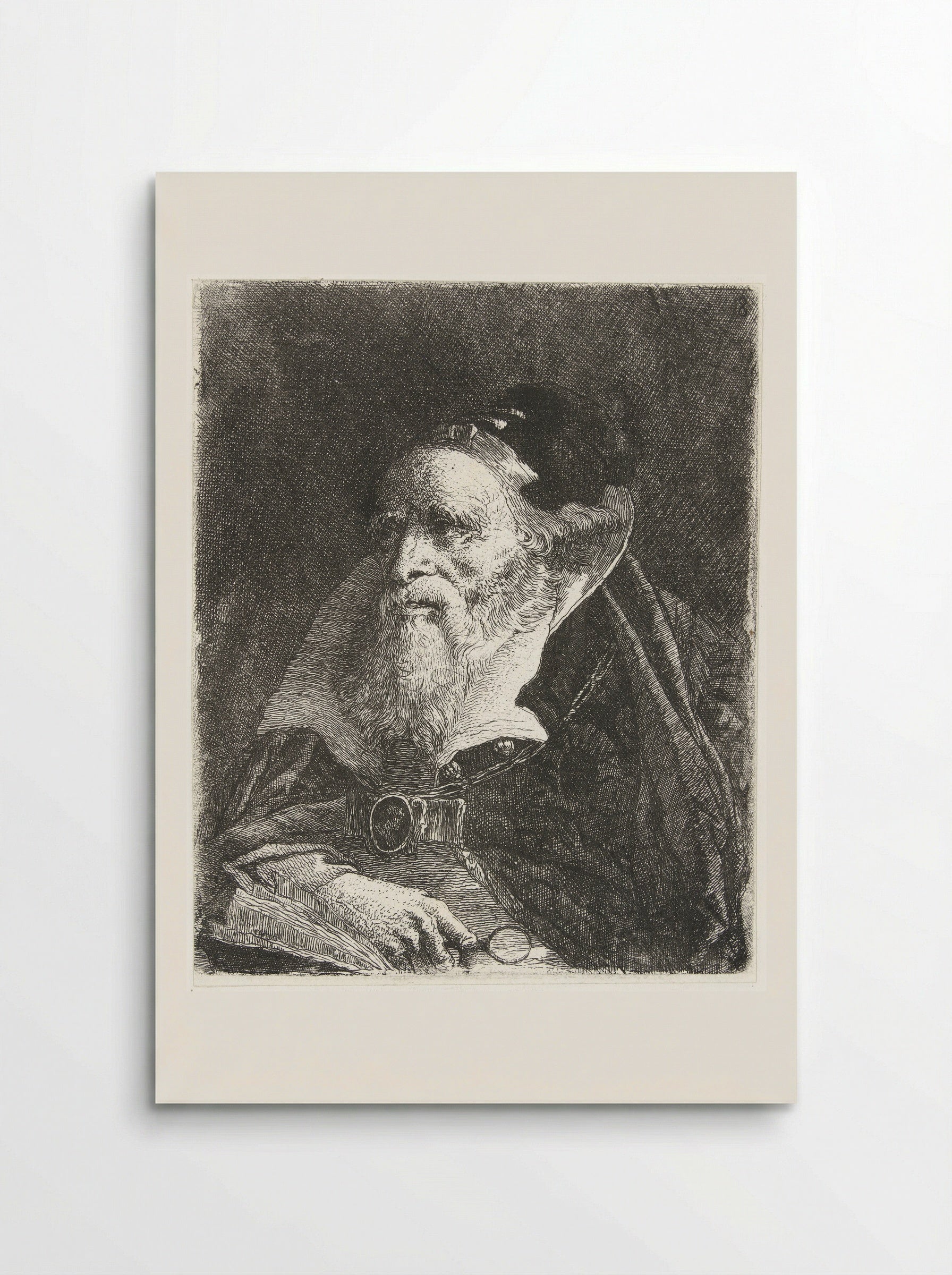
Old Man with Book and Magnifying Glass - Giovanni Domenico Tiepolo
Archival giclée
Frames arrive ready to hang
Secure checkout
Made to order
Description
An etching by Giovanni Domenico Tiepolo, 'Old Man with Book and Magnifying Glass' portrays an elderly man engrossed in reading, rendered with fine lines and detailed cross-hatching.
This etching by Giovanni Domenico Tiepolo presents an elderly man absorbed in reading. The work, executed in a monochrome palette, uses fine lines and cross-hatching to create depth and texture. Tiepolo, son of the celebrated Giovanni Battista Tiepolo, was a master of printmaking, and this piece exemplifies his skill in capturing character and detail through the etching process. The man is depicted from the chest up, his gaze directed downwards towards the book he holds. His features are rendered with careful attention, from the wrinkles on his forehead to the texture of his beard. He wears a cap and a high-collared garment, suggesting a scholar or someone of intellectual standing. A magnifying glass rests on the book, hinting at the man's scholarly pursuits and the close attention he pays to his reading material. The composition is simple yet effective, focusing attention on the figure and his engagement with the book. The use of light and shadow adds dimension to the image, creating a sense of intimacy and drawing the viewer into the man's world of study and contemplation. The etching technique allows for a high level of detail, capturing the nuances of the man's expression and the textures of his clothing and accessories.
Return policy
Because every print is made to order, we don't offer change-of-mind returns, refunds or exchanges. If your order arrives faulty, damaged or incorrect, we'll replace it free of charge — just contact us within 48 hours of delivery. See our refunds page for full details.
Shipping
We ship worldwide, printing at the production hub nearest to your delivery address. Delivery times and costs vary by destination — you'll see the options available to you at checkout.
Manufacturing
Each print is produced to order using 12-colour giclée printing on FSC-certified archival paper. Designed in Britain and printed at your nearest production hub to reduce waste and speed up delivery.
Old Man with Book and Magnifying Glass - Giovanni Domenico Tiepolo

Artist Biography
Giovanni Domenico Tiepolo
He was born in Venice in 1727, the eldest son of Giovanni Battista Tiepolo, the greatest ceiling painter in Europe. By thirteen he was his father's chief assistant; by twenty he was producing independent commissions. He assisted at Wurzburg (1751 to 1753), at the Villa Valmarana in Vicenza (1757), and at the Royal Palace in Madrid (1762 to 1770).
His father's death in Madrid in 1770 freed him to develop his own direction. He returned to Venice and turned increasingly away from the luminous Baroque grandeur of his father's work toward genre scenes, religious subjects treated with narrative intimacy, and the Punchinello drawings that became his finest achievement. In retirement at the family villa at Zianigo, he painted frescoes now in the Correr Museum and produced nearly two hundred etchings. He died in Venice in 1804, at seventy-six.
Our Features
Designed for Lasting Impact
Specific Features
Every Solis piece is made to order with archival, gallery-quality materials built to last.
- Museum-grade giclée printing for rich, fade-resistant colour
- Archival matte fine-art paper, FSC-certified
- Multiple sizes and framing options available
- Frames in black, natural wood, dark wood or white
- Framed prints arrive ready to hang
Care & Cleaning
To keep your artwork looking its best:
- Dust gently with a soft, dry cloth
- Avoid prolonged direct sunlight
- Never use liquid cleaners on the print or canvas surface
- Keep in a dry, room-temperature space
- Handle prints with clean, dry hands
Materials & Sizing
Museum-grade giclée on FSC-certified archival matte paper, with framed and canvas options.
- Paper sizes: A4, A3, A2, A1, A0 and B2 (50×70 cm)
- Canvas: XS (20×30 cm) to Large (60×90 cm)
- Frames: black, natural wood, dark wood or white
Why Choose Us ?
Damage-free delivery guarantee
Fast Shipping
Museum-Quality Materials
Artist Biography
Giovanni Domenico Tiepolo
He was born in Venice in 1727, the eldest son of Giovanni Battista Tiepolo, the greatest ceiling painter in Europe. By thirteen he was his father's chief assistant; by twenty he was producing independent commissions. He assisted at Wurzburg (1751 to 1753), at the Villa Valmarana in Vicenza (1757), and at the Royal Palace in Madrid (1762 to 1770).
His father's death in Madrid in 1770 freed him to develop his own direction. He returned to Venice and turned increasingly away from the luminous Baroque grandeur of his father's work toward genre scenes, religious subjects treated with narrative intimacy, and the Punchinello drawings that became his finest achievement. In retirement at the family villa at Zianigo, he painted frescoes now in the Correr Museum and produced nearly two hundred etchings. He died in Venice in 1804, at seventy-six.
You May Also Like