

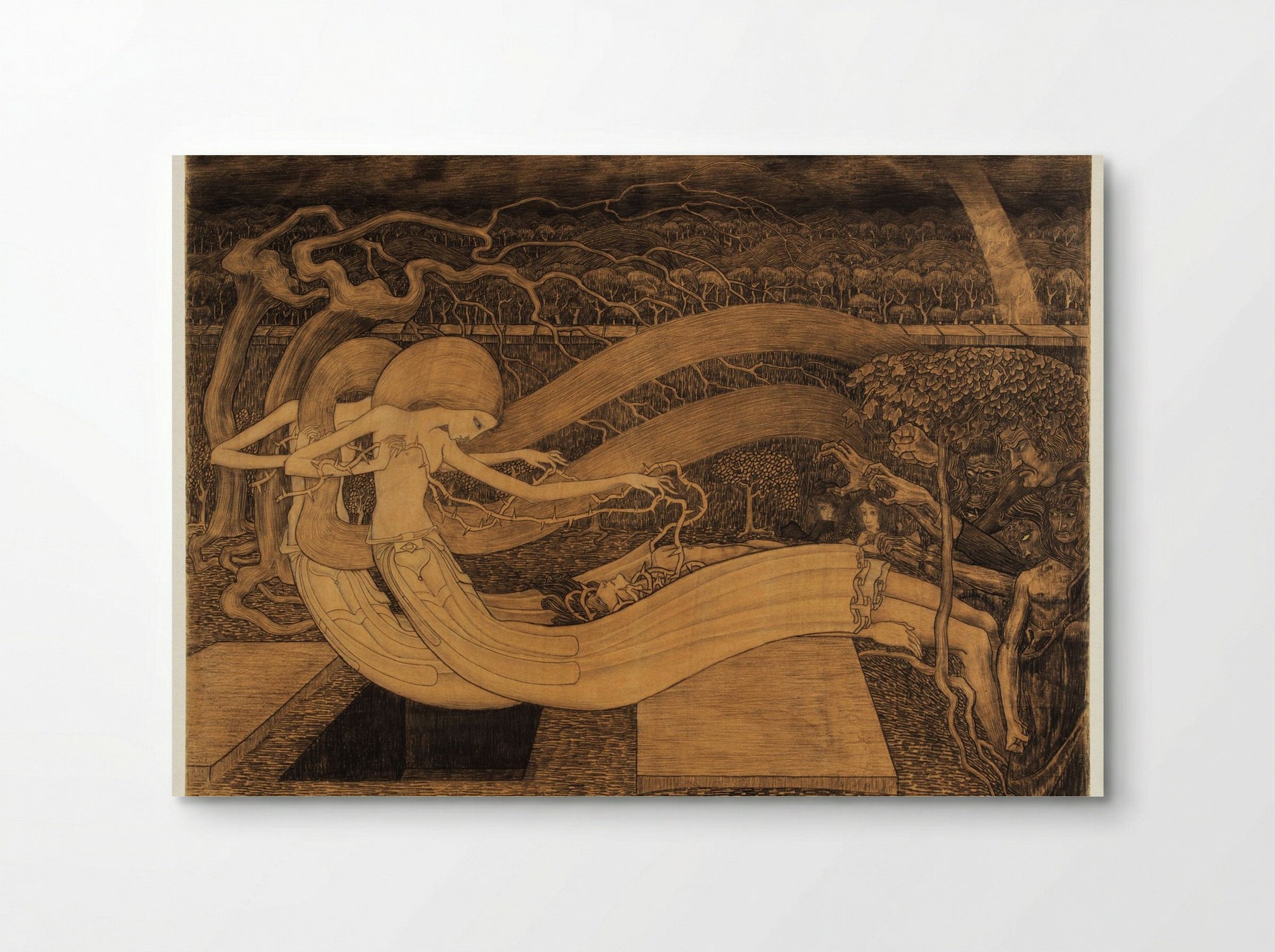

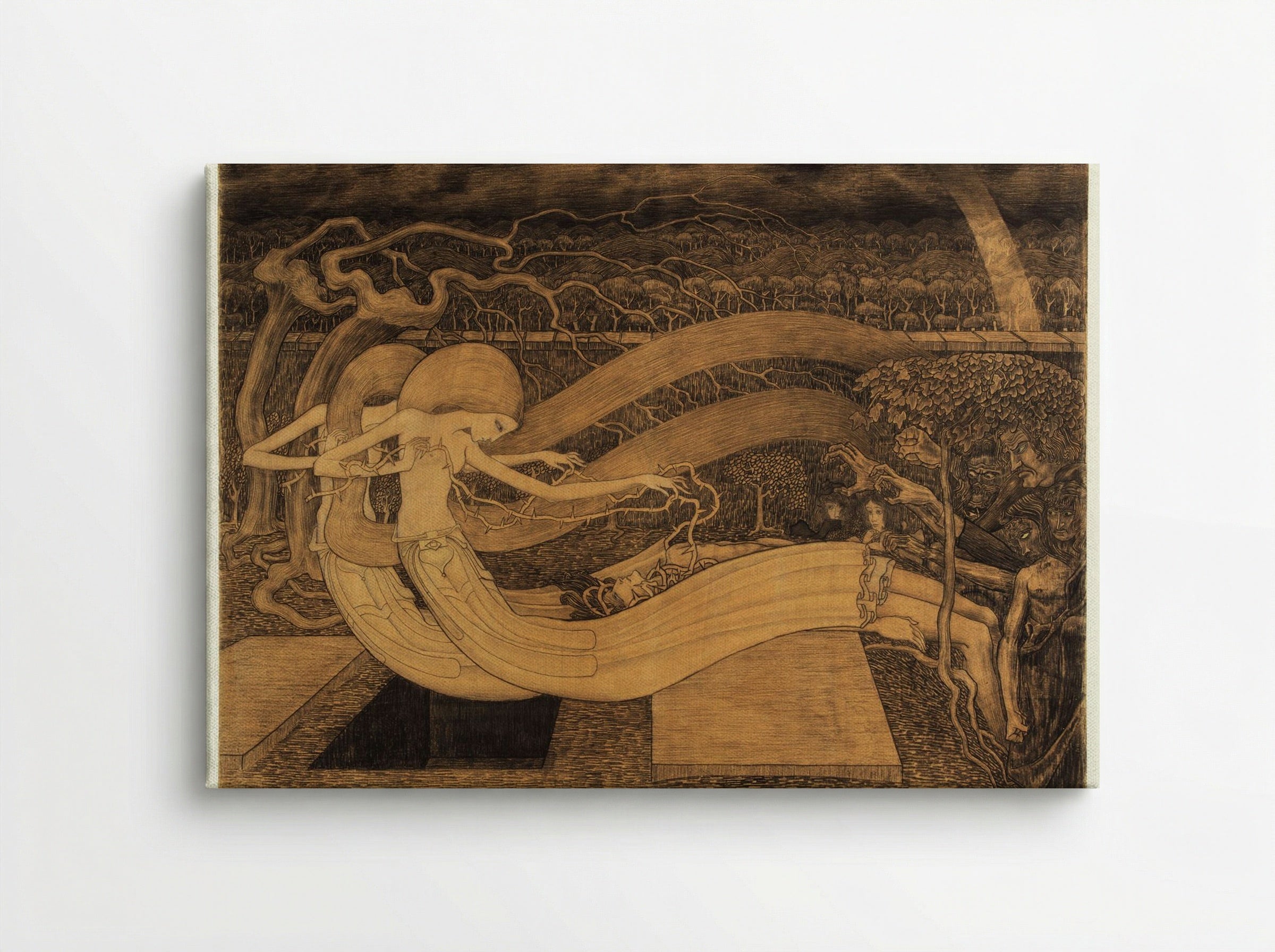

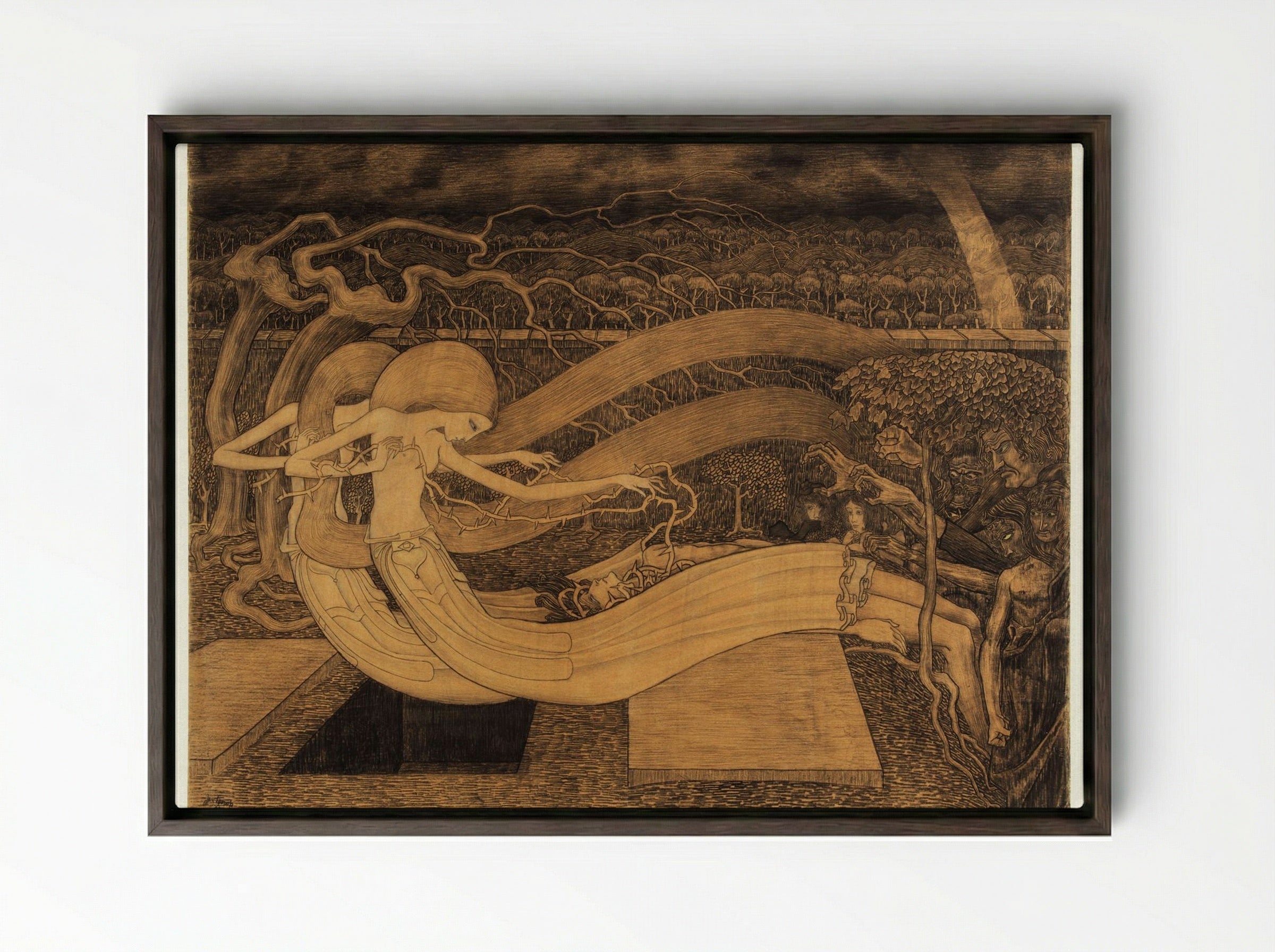


O Grave, Where is Thy Victory? - Jan Toorop
Archival giclée
Ready to hang
Secure checkout
Made to order
Description
Jan Toorop's 'O Grave, Where is Thy Victory?' (1892) is a Symbolist masterpiece exploring themes of mortality and spirituality through haunting imagery and delicate linework. A striking and thought-provoking addition to any space.
Jan Toorop's haunting 1892 drawing, 'O Grave, Where is Thy Victory?', is a quintessential example of Symbolist art, reflecting the movement's preoccupation with mortality, spirituality, and the darker aspects of the human condition. Toorop, a Dutch artist who worked in various styles, embraced Symbolism in the late 19th century, creating works that explored complex themes through evocative imagery and dreamlike compositions. The drawing presents a stark and unsettling vision. A pale, ethereal figure, seemingly suspended between life and death, dominates the foreground. Her elongated form intertwines with thorny branches, suggesting both entrapment and a connection to the natural world. To the right, a group of figures emerges from the shadows, their faces etched with anguish and despair. The overall effect is one of profound melancholy and spiritual unease. Toorop's masterful use of line and shading enhances the drawing's emotional impact. The delicate lines create a sense of fragility and transience, while the stark contrasts between light and shadow heighten the drama and mystery. This print offers a unique opportunity to bring a piece of Symbolist history into your home, sparking conversation and contemplation. Its muted tones and intricate details make it a striking addition to any room, particularly a study, living room, or hallway.
Return policy
Because every print is made to order, we don't offer change-of-mind returns, refunds or exchanges. If your order arrives faulty, damaged or incorrect, we'll replace it free of charge — just contact us within 48 hours of delivery. EU customers have a 14-day cooling-off right. See our refunds page for full details.
Shipping
We ship worldwide, printing at the production hub nearest to your delivery address. Delivery times and costs vary by destination — you'll see the options available to you at checkout.
Manufacturing
Each print is produced to order using 12-colour giclée printing on FSC-certified archival paper. Designed in Britain and printed at your nearest production hub to reduce waste and speed up delivery.
O Grave, Where is Thy Victory? - Jan Toorop
Our Features
Designed for Lasting Impact
Specific Features
Every Solis piece is made to order with archival, gallery-quality materials built to last.
- Museum-grade giclée printing for rich, fade-resistant colour
- Archival matte fine-art paper, FSC-certified
- Choose poster, framed print, canvas or framed canvas
- Frames in black, natural wood, dark wood or white
- Framed prints arrive ready to hang
Care & Cleaning
To keep your artwork looking its best:
- Dust gently with a soft, dry cloth
- Avoid prolonged direct sunlight
- Never use liquid cleaners on the print or canvas surface
- Keep in a dry, room-temperature space
- Handle prints with clean, dry hands
Materials & Sizing
Museum-grade giclée on FSC-certified archival matte paper, with framed and canvas options.
- Paper sizes: A4, A3, A2, A1, A0 and B2 (50×70 cm)
- Canvas: XS (20×30 cm) to Large (60×90 cm)
- Frames: black, natural wood, dark wood or white
Why Choose Us ?
100% Satisfaction Guarantee
Fast Shipping
Museum-Quality Materials

Artist Biography
Jan Toorop
Toorop's willingness to experiment extended beyond style to subject matter. He captured not only ethereal visions but also the realities of working-class life, as seen in his depictions of labourers in the docks of Rotterdam. This social consciousness, combined with his stylistic versatility, made him a key figure in the development of modern Dutch art. He was a vital link between the Hague School and later movements.
Despite his significance, Toorop remains somewhat under-appreciated outside the Netherlands. His impact on artists such as Gustav Klimt is well-documented, and his synthesis of Eastern and Western influences feels remarkably contemporary. Owning a Jan Toorop print is not just acquiring a beautiful image; it's possessing a piece of art history, a testament to the power of cross-cultural dialogue and artistic innovation.
You May Also Like