

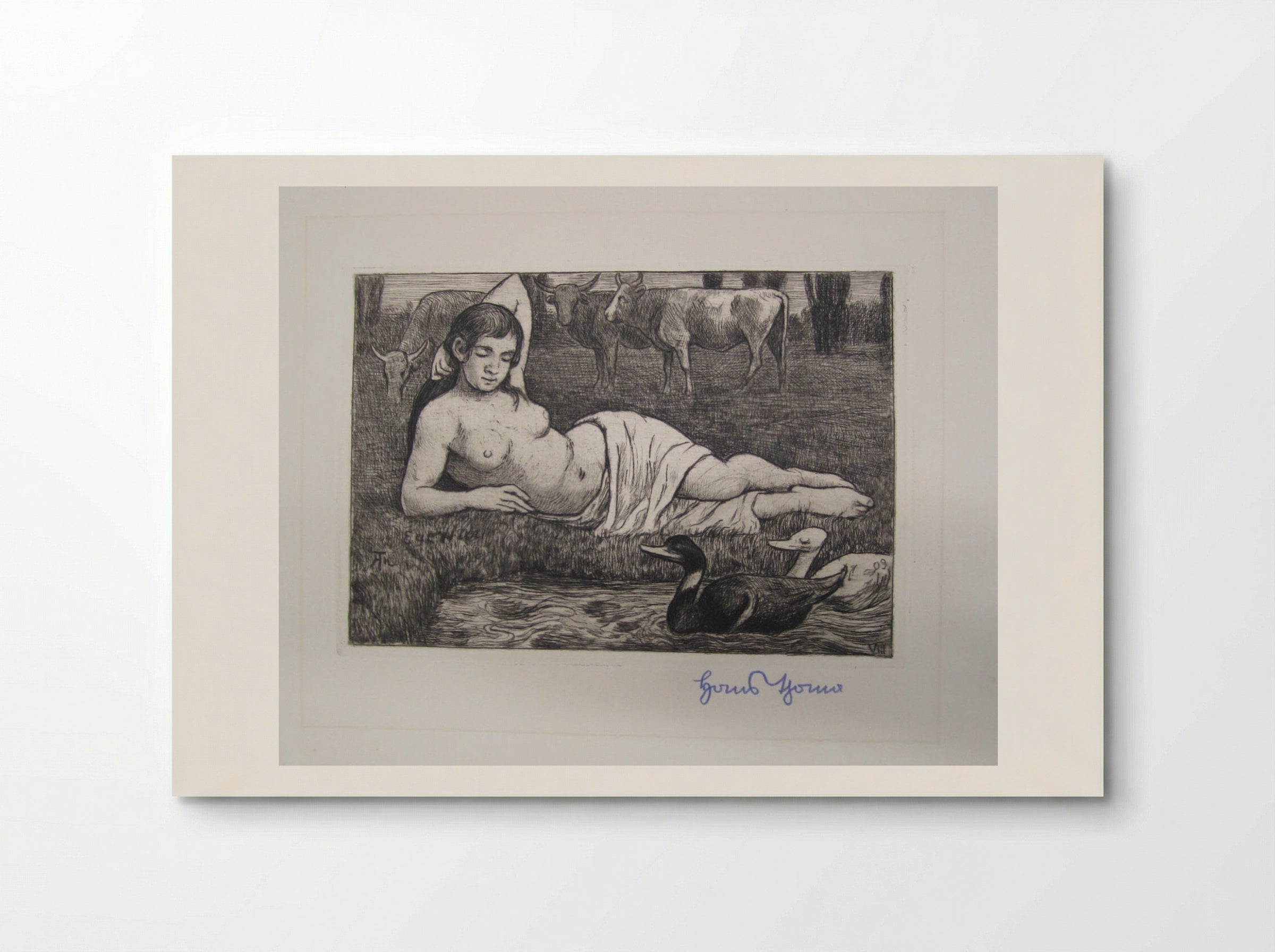
Nymph I (Egeria) - Hans Thoma
Archival giclée
Frames arrive ready to hang
Secure checkout
Made to order
Description
A fine etching by Hans Thoma depicting the nymph Egeria in a pastoral setting, rendered with precise line work and classical sensibilities.
Hans Thoma, a German painter and printmaker, frequently drew upon the traditions of the Black Forest and classical mythology to inform his work. This etching, titled Nymph I (Egeria), demonstrates his technical proficiency with the needle and acid bath. The composition features a reclining female figure, identified as the nymph Egeria, positioned in a pastoral setting. Her relaxed posture, supported by one arm, echoes classical depictions of river deities or nature spirits. Behind the figure, cattle graze in a quiet field, grounding the mythological subject in a rural, earthly reality. In the foreground, ducks swim in a small pool, adding a sense of stillness to the scene. Thoma employs a precise, linear technique to define the forms, using cross-hatching to build shadow and volume across the grass and the figure. The artist's signature is visible in the lower margin, confirming the provenance of this print. Thoma's work often bridged the gap between the academic traditions of the nineteenth century and the emerging Symbolist movement. He favoured themes that explored the connection between humanity and the natural world, often imbuing his subjects with a quiet, contemplative quality. This print reflects his interest in the synthesis of human form and rural environment, a recurring theme throughout his career. The etching process allows for a clarity of line that captures the texture of the grass and the soft contours of the nymph with equal attention. By placing a mythological figure within such a mundane, agricultural context, Thoma invites the viewer to consider the presence of the divine within the everyday. This piece is a representative example of his graphic output, which remained a consistent part of his artistic practice alongside his oil paintings.
Return policy
Because every print is made to order, we don't offer change-of-mind returns, refunds or exchanges. If your order arrives faulty, damaged or incorrect, we'll replace it free of charge — just contact us within 48 hours of delivery. See our refunds page for full details.
Shipping
We ship worldwide, printing at the production hub nearest to your delivery address. Delivery times and costs vary by destination — you'll see the options available to you at checkout.
Manufacturing
Each print is produced to order using 12-colour giclée printing on FSC-certified archival paper. Designed in Britain and printed at your nearest production hub to reduce waste and speed up delivery.
Nymph I (Egeria) - Hans Thoma

Artist Biography
Hans Thoma
A trip to Paris in 1868 with his friend Otto Scholderer exposed him to Courbet and the Barbizon painters, whose realism influenced his landscape style. He moved to Munich and spent six years there, then to Frankfurt, where he lived from 1876 to 1899. He also spent extended periods in Italy, becoming one of the "German Romans", artists who found in Renaissance observation a means of contemporary expression that fed into European Symbolism.
His landscapes of the Black Forest, with their deep greens, rounded hills and pastoral stillness, made him the best-known painter of that region. He also painted mythological and Symbolist subjects, self-portraits with allegorical figures, and genre scenes of German rural life. He married his student Cella Berteneder, who became known as a painter of flowers and still lifes.
In 1899 he was appointed director of the Kunsthalle Karlsruhe, a position he held until 1919. After his death in 1924, his work was appropriated by nationalist and Nazi ideology, and several paintings were looted from Jewish collectors during the Third Reich. The association has complicated his posthumous reputation. He remains little known outside Germany, a painter whose Black Forest landscapes speak to regional identity with an honesty that the political appropriation could not quite destroy.
Our Features
Designed for Lasting Impact
Specific Features
Every Solis piece is made to order with archival, gallery-quality materials built to last.
- Museum-grade giclée printing for rich, fade-resistant colour
- Archival matte fine-art paper, FSC-certified
- Multiple sizes and framing options available
- Frames in black, natural wood, dark wood or white
- Framed prints arrive ready to hang
Care & Cleaning
To keep your artwork looking its best:
- Dust gently with a soft, dry cloth
- Avoid prolonged direct sunlight
- Never use liquid cleaners on the print or canvas surface
- Keep in a dry, room-temperature space
- Handle prints with clean, dry hands
Materials & Sizing
Museum-grade giclée on FSC-certified archival matte paper, with framed and canvas options.
- Paper sizes: A4, A3, A2, A1, A0 and B2 (50×70 cm)
- Canvas: XS (20×30 cm) to Large (60×90 cm)
- Frames: black, natural wood, dark wood or white
Why Choose Us ?
Damage-free delivery guarantee
Fast Shipping
Museum-Quality Materials
Artist Biography
Hans Thoma
A trip to Paris in 1868 with his friend Otto Scholderer exposed him to Courbet and the Barbizon painters, whose realism influenced his landscape style. He moved to Munich and spent six years there, then to Frankfurt, where he lived from 1876 to 1899. He also spent extended periods in Italy, becoming one of the "German Romans", artists who found in Renaissance observation a means of contemporary expression that fed into European Symbolism.
His landscapes of the Black Forest, with their deep greens, rounded hills and pastoral stillness, made him the best-known painter of that region. He also painted mythological and Symbolist subjects, self-portraits with allegorical figures, and genre scenes of German rural life. He married his student Cella Berteneder, who became known as a painter of flowers and still lifes.
In 1899 he was appointed director of the Kunsthalle Karlsruhe, a position he held until 1919. After his death in 1924, his work was appropriated by nationalist and Nazi ideology, and several paintings were looted from Jewish collectors during the Third Reich. The association has complicated his posthumous reputation. He remains little known outside Germany, a painter whose Black Forest landscapes speak to regional identity with an honesty that the political appropriation could not quite destroy.
You May Also Like