

Not Straight Brushstrokes in All Directions - Sol LeWitt
Archival giclée
Frames arrive ready to hang
Secure checkout
Made to order
Description
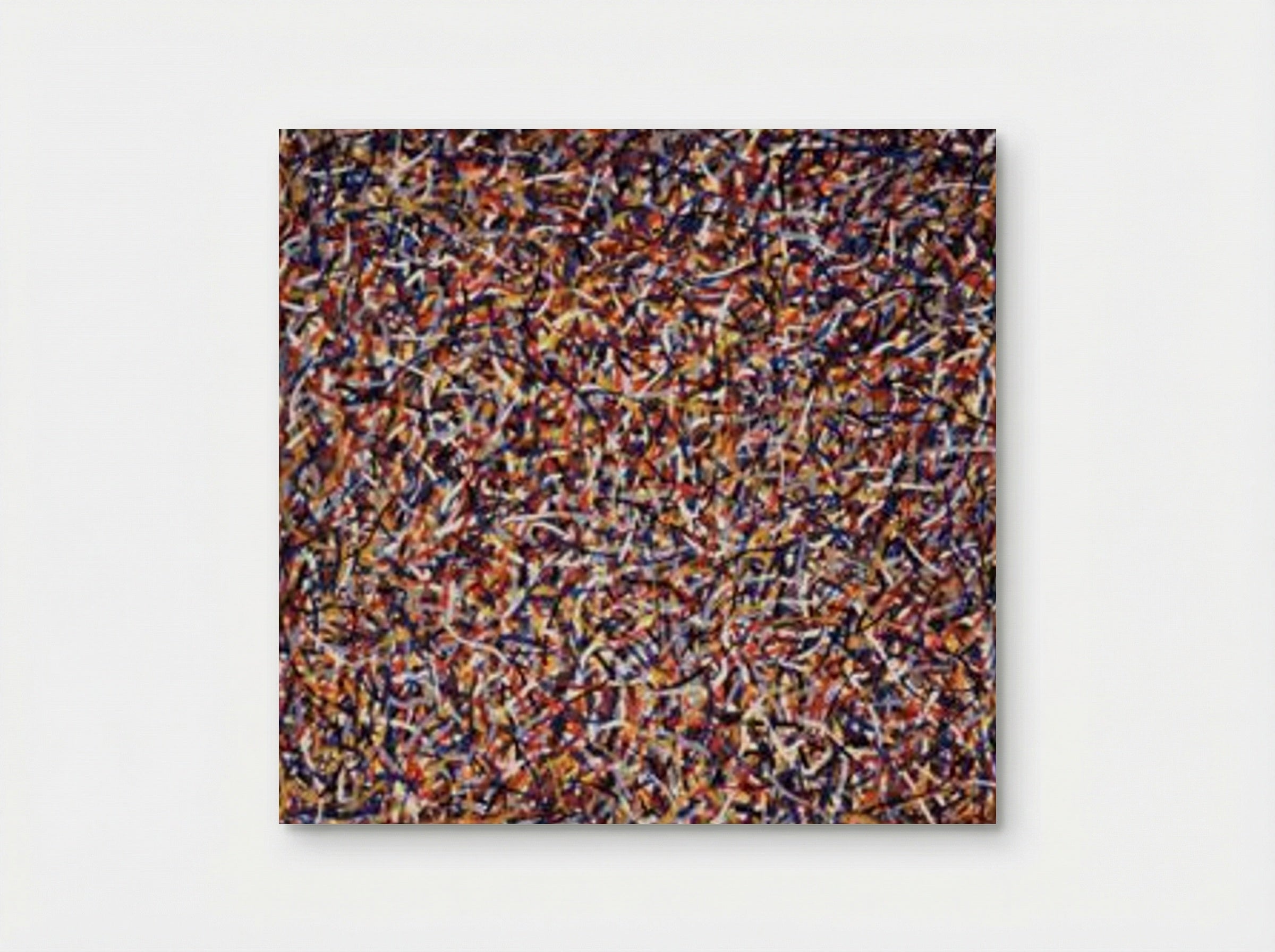
A dense, abstract composition by Sol LeWitt, featuring layered, non-linear brushstrokes applied in all directions according to a systematic process.
Sol LeWitt is widely recognised for his systematic approach to art, where the concept or idea behind the work takes precedence over the execution. In this piece, the artist moves away from the rigid geometric structures often associated with his earlier wall drawings and sculptures. Instead, he employs a set of instructions that dictate the application of paint, resulting in a dense, layered surface of non-linear marks. The composition is defined by a chaotic yet controlled distribution of brushstrokes. Each stroke is deliberately curved or irregular, avoiding the straight lines that dominated his previous output. By applying these marks in all directions, LeWitt creates an all-over effect where no single area of the canvas commands more attention than another. The layering of colours creates a sense of depth, although the work remains fundamentally flat in its visual logic. This work reflects LeWitt's interest in the tension between human gesture and predetermined systems. While the individual brushstrokes appear spontaneous, they are the result of a rigorous, rule-based process. The palette is varied, featuring a mix of primary and secondary colours that overlap to form a complex, textured field. The lack of a central subject or focal point encourages the viewer to scan the entire surface, engaging with the rhythm and density of the marks rather than searching for a representational image. It is a clear example of how LeWitt applied his conceptual rigour to the medium of painting, transforming the act of mark-making into a logical exercise.
Return policy
Because every print is made to order, we don't offer change-of-mind returns, refunds or exchanges. If your order arrives faulty, damaged or incorrect, we'll replace it free of charge — just contact us within 48 hours of delivery. See our refunds page for full details.
Shipping
We ship worldwide, printing at the production hub nearest to your delivery address. Delivery times and costs vary by destination — you'll see the options available to you at checkout.
Manufacturing
Each print is produced to order using 12-colour giclée printing on FSC-certified archival paper. Designed in Britain and printed at your nearest production hub to reduce waste and speed up delivery.
Not Straight Brushstrokes in All Directions - Sol LeWitt
Our Features
Designed for Lasting Impact
Specific Features
Every Solis piece is made to order with archival, gallery-quality materials built to last.
- Museum-grade giclée printing for rich, fade-resistant colour
- Archival matte fine-art paper, FSC-certified
- Multiple sizes and framing options available
- Frames in black, natural wood, dark wood or white
- Framed prints arrive ready to hang
Care & Cleaning
To keep your artwork looking its best:
- Dust gently with a soft, dry cloth
- Avoid prolonged direct sunlight
- Never use liquid cleaners on the print or canvas surface
- Keep in a dry, room-temperature space
- Handle prints with clean, dry hands
Materials & Sizing
Museum-grade giclée on FSC-certified archival matte paper, with framed and canvas options.
- Paper sizes: A4, A3, A2, A1, A0 and B2 (50×70 cm)
- Canvas: XS (20×30 cm) to Large (60×90 cm)
- Frames: black, natural wood, dark wood or white
Why Choose Us ?
Damage-free delivery guarantee
Fast Shipping
Museum-Quality Materials

Artist Biography
Sol LeWitt
He was born in Hartford, Connecticut, in 1928, to Russian Jewish immigrant parents. His father died when he was six. He drew on wrapping paper from his aunt's shop and took art classes at the Wadsworth Atheneum. He served in the Korean War, then settled in New York.
From 1968, he created over a thousand numbered wall drawings. He conceived them as musical scores that anyone could execute: a set of written instructions, carried out by other people, with the physical drawing destroyed after each exhibition. The idea, he argued, was the machine that makes the art. The execution was secondary. He championed and financially supported women artists who were being sidelined by the male-dominated art world. He refused to participate in celebrity culture and remained deliberately private. He died in 2007.
You May Also Like