

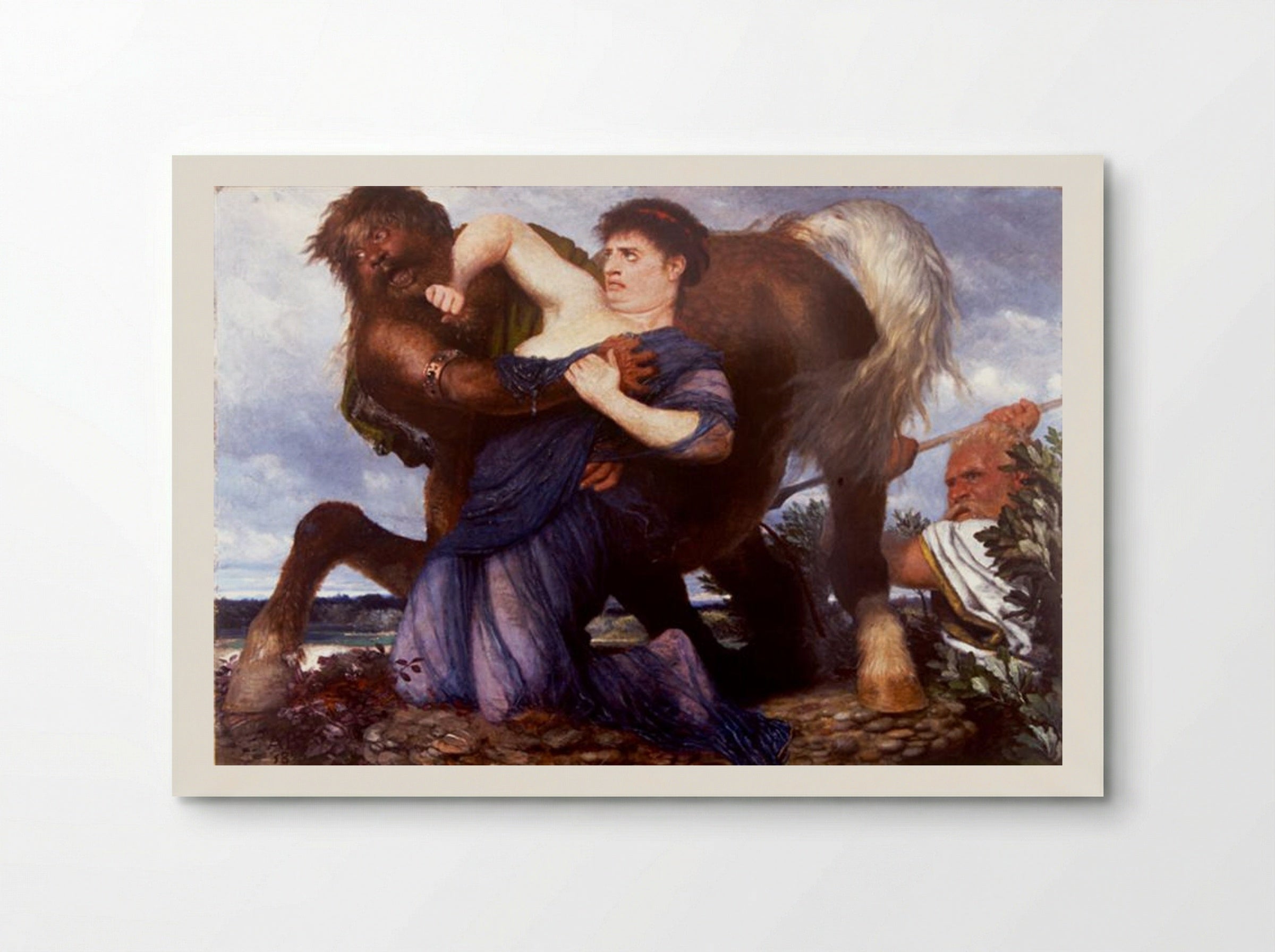
Nessus and Deianeira - Arnold Böcklin
Archival giclée
Frames arrive ready to hang
Secure checkout
Made to order
Description
Arnold Böcklin's 'Nessus and Deianeira' captures a dramatic moment from Greek mythology, depicting the attempted abduction of Deianeira by the centaur Nessus, with Heracles poised to intervene.
Arnold Böcklin, a Swiss Symbolist painter, explored themes of mythology and the macabre. His work often features dramatic scenes and figures set within atmospheric settings. Böcklin's Symbolist style rejected realism in favour of subjective emotion and imaginative content. He aimed to evoke moods and ideas through visual forms, drawing inspiration from classical mythology, literature, and his own personal experiences. His paintings often present a world filled with mystery, allegory, and a sense of the uncanny. Böcklin's influence extended to later artists who explored similar themes of the subconscious and the irrational. 'Nessus and Deianeira' depicts a scene from Greek mythology. The centaur Nessus attempts to abduct Deianeira, the wife of Heracles. Heracles, seen in the background, aims an arrow at Nessus. The composition is dramatic, with the figures arranged in a dynamic, almost chaotic manner. Deianeira, draped in blue fabric, is caught between the two male figures. The colour palette is subdued, with earthy tones dominating the scene. The overall effect is one of tension and impending violence.
Return policy
Because every print is made to order, we don't offer change-of-mind returns, refunds or exchanges. If your order arrives faulty, damaged or incorrect, we'll replace it free of charge — just contact us within 48 hours of delivery. See our refunds page for full details.
Shipping
We ship worldwide, printing at the production hub nearest to your delivery address. Delivery times and costs vary by destination — you'll see the options available to you at checkout.
Manufacturing
Each print is produced to order using 12-colour giclée printing on FSC-certified archival paper. Designed in Britain and printed at your nearest production hub to reduce waste and speed up delivery.
Care and materials
Specific Features
Every Solis piece is made to order with archival, gallery-quality materials built to last.
- Museum-grade giclée printing for rich, fade-resistant colour
- Archival matte fine-art paper, FSC-certified
- Multiple sizes and framing options available
- Frames in black, natural wood, dark wood or white
- Framed prints arrive ready to hang
Care & Cleaning
To keep your artwork looking its best:
- Dust gently with a soft, dry cloth
- Avoid prolonged direct sunlight
- Never use liquid cleaners on the print or canvas surface
- Keep in a dry, room-temperature space
- Handle prints with clean, dry hands
Materials & Sizing
Museum-grade giclée on FSC-certified archival matte paper, with framed and canvas options.
- Paper sizes: A4, A3, A2, A1, A0 and B2 (50×70 cm)
- Canvas: XS (20×30 cm) to Large (60×90 cm)
- Frames: black, natural wood, dark wood or white
Nessus and Deianeira - Arnold Böcklin

Artist Biography
Arnold Bocklin
He was born in Basel in 1827 and studied in Dusseldorf, Antwerp, Brussels and Paris, but found his real inspiration in Italy, where he lived intermittently and where he spent his final years. His landscapes are not observed but invented: mythological creatures inhabit rocky coastlines, centaurs stand in forests, mermaids play in the sea. The Romanticism of his training was filtered through Italian light and classical allusion into a Symbolism that anticipated both the Metaphysical painters and the Surrealists.
Isle of the Dead hung in reproduction in seemingly every middle-class home in Germany at the turn of the century. Sigmund Freud kept a copy in his office. When Marcel Duchamp was asked to name his favourite painter, he named Bocklin, whether sincerely or provocatively remains unclear.
Bocklin also painted a counterpart, Island of Life (1888), which has remained far less well known. He died in San Domenico di Fiesole, near Florence, in 1901, at seventy-three.
Why Choose Us ?
Damage-free delivery guarantee
Fast Shipping
Museum-Quality Materials
You May Also Like