

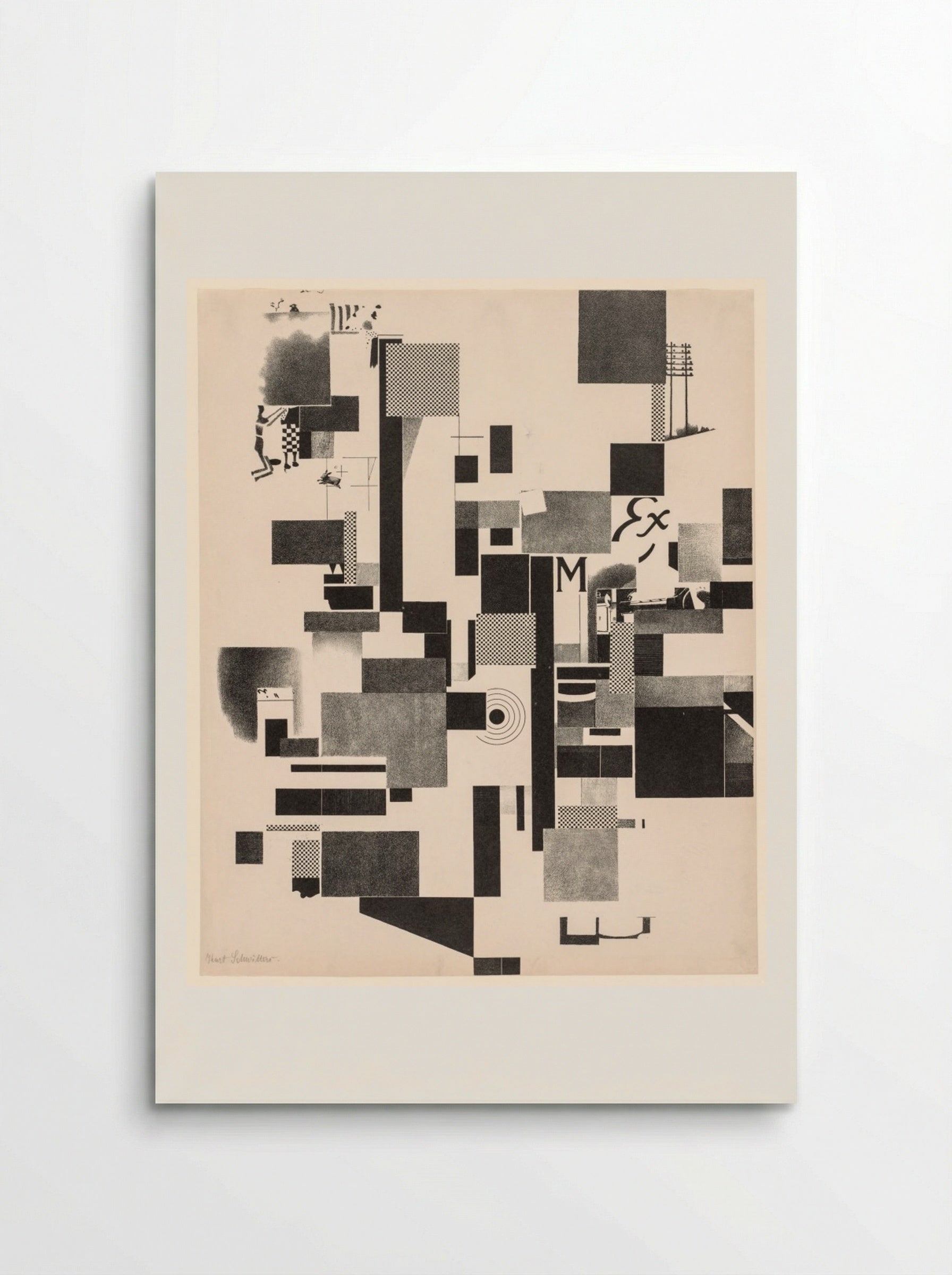
Merz 3 Portfolio: Plate 1 - Kurt Schwitters
Archival giclée
Frames arrive ready to hang
Secure checkout
Made to order
Description
A 1923 lithograph by Kurt Schwitters, featuring a geometric composition of squares, typographic elements, and stippled textures.
This lithograph is the first plate from the Merz 3 portfolio, produced by Kurt Schwitters in 1923. Schwitters, a central figure in the Hanover Dada movement, developed his own aesthetic philosophy which he termed Merz. This term derived from a fragment of the word Kommerz, found in a collage, and came to represent his practice of assembling disparate, discarded materials into coherent artistic compositions. In this work, Schwitters employs a rigorous geometric vocabulary. The composition is built from a series of rectangles, squares, and linear elements that float across the white ground. The artist incorporates typographic fragments, such as the letter M and an ampersand, alongside mechanical patterns like checkerboard grids and concentric circles. These elements are arranged with a sense of balance that defies the chaotic nature of his earlier collage work. The lithographic process allows for subtle variations in tone, ranging from dense, solid blacks to soft, stippled greys that suggest depth and texture. Unlike the more aggressive, anti-art stance of the Berlin Dadaists, Schwitters maintained a focus on formal construction. This print demonstrates his interest in the relationship between typography, architecture, and abstract form. The inclusion of small, representational motifs, such as a tiny figure and a telegraph pole, provides a jarring contrast to the surrounding geometric abstraction. This juxtaposition is characteristic of the Merz approach, where the artist seeks to unify the mundane and the abstract within a single frame. The work reflects the influence of De Stijl and Russian Constructivism, yet it retains the idiosyncratic, playful spirit that defined Schwitters' career. It is a precise example of how the artist translated his collage techniques into the medium of printmaking, maintaining the tension between order and fragmentation.
Return policy
Because every print is made to order, we don't offer change-of-mind returns, refunds or exchanges. If your order arrives faulty, damaged or incorrect, we'll replace it free of charge — just contact us within 48 hours of delivery. See our refunds page for full details.
Shipping
We ship worldwide, printing at the production hub nearest to your delivery address. Delivery times and costs vary by destination — you'll see the options available to you at checkout.
Manufacturing
Each print is produced to order using 12-colour giclée printing on FSC-certified archival paper. Designed in Britain and printed at your nearest production hub to reduce waste and speed up delivery.
Merz 3 Portfolio: Plate 1 - Kurt Schwitters
Our Features
Designed for Lasting Impact
Specific Features
Every Solis piece is made to order with archival, gallery-quality materials built to last.
- Museum-grade giclée printing for rich, fade-resistant colour
- Archival matte fine-art paper, FSC-certified
- Multiple sizes and framing options available
- Frames in black, natural wood, dark wood or white
- Framed prints arrive ready to hang
Care & Cleaning
To keep your artwork looking its best:
- Dust gently with a soft, dry cloth
- Avoid prolonged direct sunlight
- Never use liquid cleaners on the print or canvas surface
- Keep in a dry, room-temperature space
- Handle prints with clean, dry hands
Materials & Sizing
Museum-grade giclée on FSC-certified archival matte paper, with framed and canvas options.
- Paper sizes: A4, A3, A2, A1, A0 and B2 (50×70 cm)
- Canvas: XS (20×30 cm) to Large (60×90 cm)
- Frames: black, natural wood, dark wood or white
Why Choose Us ?
Damage-free delivery guarantee
Fast Shipping
Museum-Quality Materials

Artist Biography
Kurt Schwitters
He was born in Hanover in 1887, an only child whose father ran a ladies' clothing shop. He suffered from epilepsy throughout his life. He fled to Norway in 1937, then to Scotland in 1940, where he was classified as an enemy alien and interned in camps including Hutchinson Camp on the Isle of Man. While interned, he allegedly made small sculptures from leftover oatmeal.
His art, which he called Merz (a fragment of the word Kommerz), used collage, found objects, poetry, sound art, typography, and installation. He worked across Dadaism, Constructivism, and Surrealism, often simultaneously. He was largely neglected by the time he died.
You May Also Like