

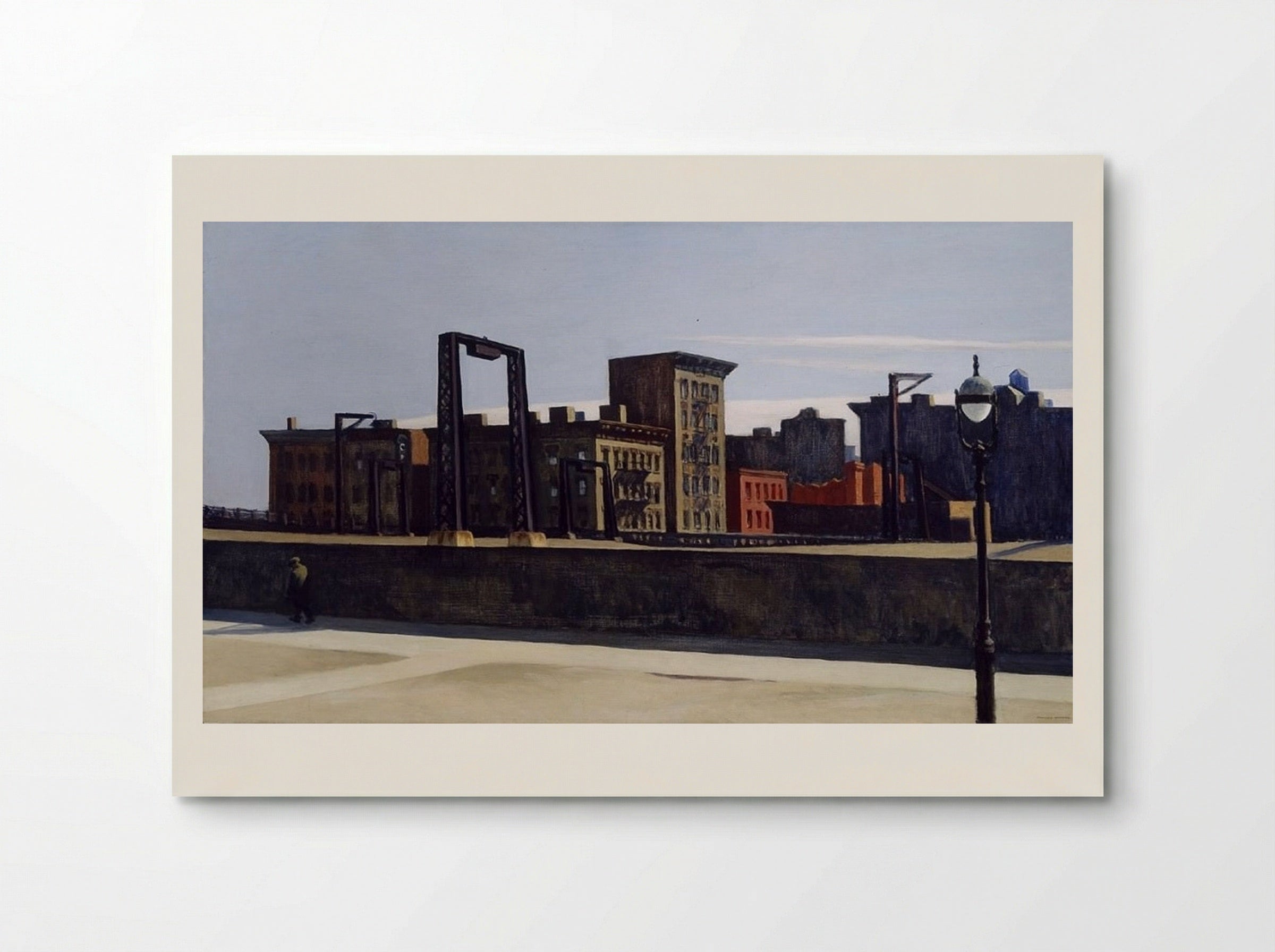
Manhattan Bridge - Edward Hopper
Archival giclée
Frames arrive ready to hang
Secure checkout
Made to order
Description
A quiet, observational study of New York City architecture, featuring the stark geometry of the Manhattan Bridge and a solitary figure.
Edward Hopper painted Manhattan Bridge in 1928, capturing a specific, quiet corner of New York City. The composition focuses on the structural elements of the city, presenting a view that avoids the typical bustle associated with the metropolis. A lone figure walks along the foreground, dwarfed by the heavy, industrial forms of the bridge supports and the surrounding brick tenements. Hopper employs a clear, controlled light that defines the geometric shapes of the buildings. The shadows are long and sharp, suggesting a specific time of day, likely late afternoon. The palette consists of muted earth tones, ochres, and deep blues, which ground the scene in a sense of physical reality. The street lamp on the right acts as a vertical anchor, balancing the horizontal expanse of the bridge structure and the wall. This work reflects Hopper's interest in the isolation of urban life. He strips away the decorative details of the architecture, leaving behind the essential forms of the city. The lack of narrative action forces the viewer to observe the stillness of the environment. The painting does not romanticise the urban setting; instead, it presents a stark, honest observation of the built environment. The interplay between the man-made structures and the empty space creates a tension that is characteristic of Hopper's approach to his subjects. By focusing on the mundane aspects of the city, he invites a contemplation of the individual's place within a vast, impersonal urban framework.
Return policy
Because every print is made to order, we don't offer change-of-mind returns, refunds or exchanges. If your order arrives faulty, damaged or incorrect, we'll replace it free of charge — just contact us within 48 hours of delivery. See our refunds page for full details.
Shipping
We ship worldwide, printing at the production hub nearest to your delivery address. Delivery times and costs vary by destination — you'll see the options available to you at checkout.
Manufacturing
Each print is produced to order using 12-colour giclée printing on FSC-certified archival paper. Designed in Britain and printed at your nearest production hub to reduce waste and speed up delivery.
Care and materials
Specific Features
Every Solis piece is made to order with archival, gallery-quality materials built to last.
- Museum-grade giclée printing for rich, fade-resistant colour
- Archival matte fine-art paper, FSC-certified
- Multiple sizes and framing options available
- Frames in black, natural wood, dark wood or white
- Framed prints arrive ready to hang
Care & Cleaning
To keep your artwork looking its best:
- Dust gently with a soft, dry cloth
- Avoid prolonged direct sunlight
- Never use liquid cleaners on the print or canvas surface
- Keep in a dry, room-temperature space
- Handle prints with clean, dry hands
Materials & Sizing
Museum-grade giclée on FSC-certified archival matte paper, with framed and canvas options.
- Paper sizes: A4, A3, A2, A1, A0 and B2 (50×70 cm)
- Canvas: XS (20×30 cm) to Large (60×90 cm)
- Frames: black, natural wood, dark wood or white
Manhattan Bridge - Edward Hopper

Artist Biography
Edward Hopper
He grew up in Nyack, a small town on the Hudson River, studied illustration, then moved to Robert Henri's painting class at the New York School of Art. Henri was the central figure of the Ashcan School, which painted American life without prettifying it. Hopper absorbed the directness but not the social energy. His paintings got quieter, more still, more concerned with what people look like when they think nobody is watching.
He went to Paris three times between 1906 and 1910 and came back with Degas and Manet in his head: cropped compositions, angled light, figures caught mid-thought. Then he spent a decade failing commercially, working as an illustrator to pay the bills, and painting watercolours that nobody bought. Success came late. His first solo show was at forty-one.
In 1924 he married Josephine Nivison, a painter who had also studied under Henri. She modelled for nearly every female figure in his paintings, managed his career, and kept detailed records of every work he produced. The marriage was difficult. Both of them had sharp tempers. She engineered his public image as a recluse, which he was, mostly.
Nighthawks, the diner painting, was made in 1942. Jo named it. Hopper admitted he was probably painting the loneliness of a large city, though he was reluctant to say so directly. The diner has no visible door. People have pointed this out for eighty years and nobody has determined whether it was intentional.
Why Choose Us ?
Damage-free delivery guarantee
Fast Shipping
Museum-Quality Materials
You May Also Like