

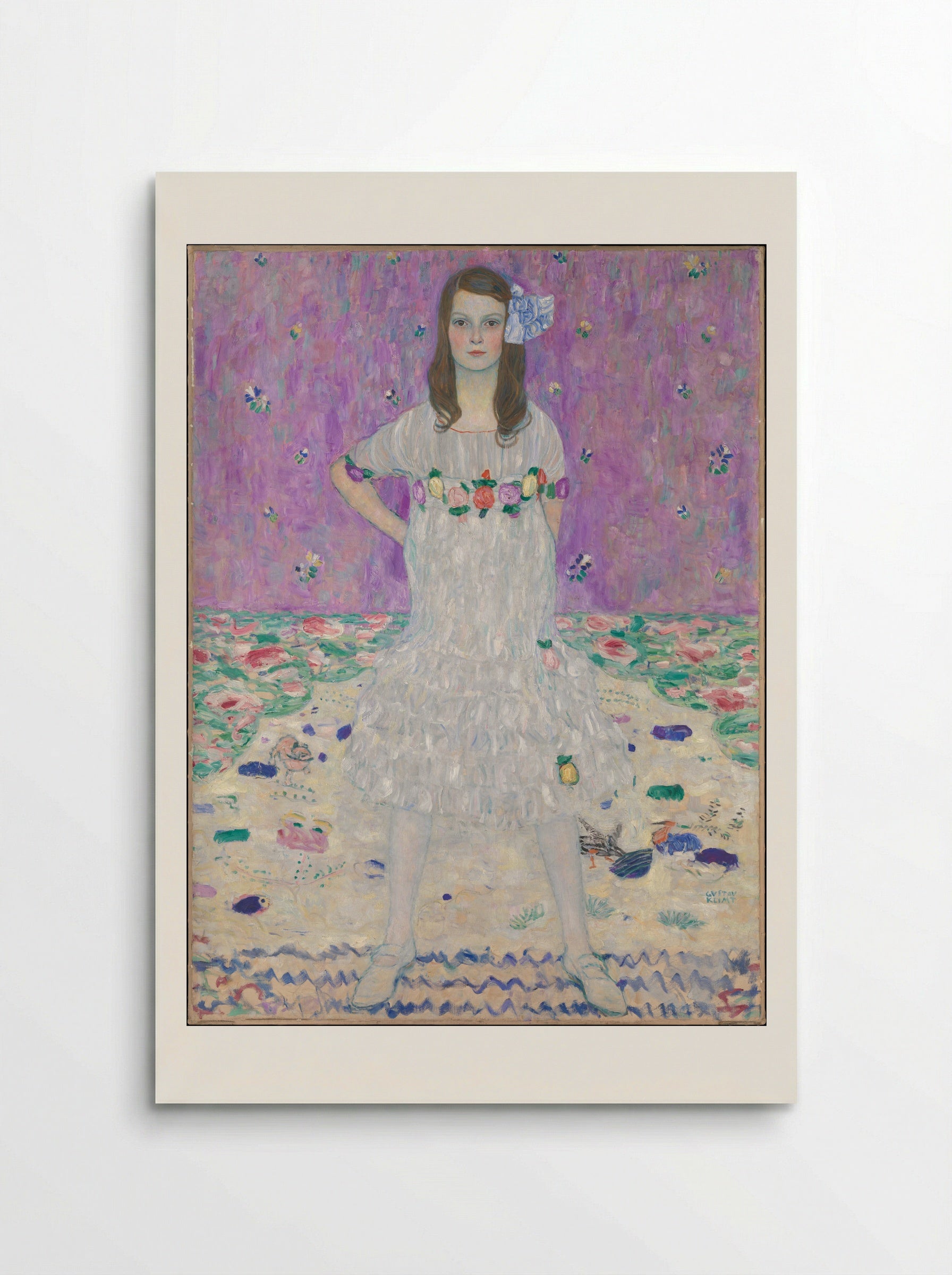
Mäda Primavesi - Gustav Klimt
Archival giclée
Frames arrive ready to hang
Secure checkout
Made to order
Description
A 1912 portrait by Gustav Klimt depicting the young Mäda Primavesi in a decorative, floral-filled setting.
Painted in 1912, this portrait depicts Mäda Primavesi, the daughter of the industrialist Otto Primavesi and the actress Eugenia Primavesi. Gustav Klimt was a central figure in the Vienna Secession, and this work reflects his mature style, which moved away from the heavy gold leaf of his earlier period toward a more painterly, decorative approach. The subject stands with a confident, almost defiant posture, her hands on her hips, looking directly at the viewer. The composition is divided into two distinct zones. The upper portion features a flat, lilac-toned background scattered with small, stylised floral motifs. In contrast, the lower section depicts a light-coloured ground covered in a dense arrangement of blossoms and foliage. Mäda wears a white, ruffled dress adorned with a garland of flowers at the waist, which echoes the botanical elements surrounding her. The brushwork is loose and expressive, particularly in the treatment of the dress and the floral carpet, demonstrating Klimt's interest in the interplay between figure and decorative surface. Klimt captures the nine-year-old subject with a sense of immediacy and character. The painting avoids the stiff formality often associated with commissioned portraits of the era. Instead, it presents a study of childhood energy and poise. The colour palette is dominated by soft purples, whites, and muted greens, creating a harmonious yet distinct visual field. This work remains a clear example of the artist's ability to integrate portraiture with the aesthetic principles of the Wiener Werkstätte, where the boundary between fine art and decorative design was intentionally blurred. The painting is currently held in the collection of the Metropolitan Museum of Art in New York.
Return policy
Because every print is made to order, we don't offer change-of-mind returns, refunds or exchanges. If your order arrives faulty, damaged or incorrect, we'll replace it free of charge — just contact us within 48 hours of delivery. See our refunds page for full details.
Shipping
We ship worldwide, printing at the production hub nearest to your delivery address. Delivery times and costs vary by destination — you'll see the options available to you at checkout.
Manufacturing
Each print is produced to order using 12-colour giclée printing on FSC-certified archival paper. Designed in Britain and printed at your nearest production hub to reduce waste and speed up delivery.
Mäda Primavesi - Gustav Klimt

Artist Biography
Gustav Klimt
Klimt’s most iconic works, including The Kiss, Portrait of Adele Bloch-Bauer I, and The Tree of Life, exemplify his unique approach to the human form, celebrating beauty, femininity, and eroticism with bold lines and richly layered textures. His so-called "Golden Phase," marked by the use of gold and silver leaf, was heavily inspired by Byzantine mosaics he saw in Ravenna. During this time, Klimt created some of his most celebrated masterpieces, blending fine art with decorative elements in ways that challenged the conventions of both.
Beyond his visual style, Klimt’s influence extended into the broader currents of European art and design. As a mentor and collaborator, he supported younger artists such as Egon Schiele and Oskar Kokoschka, and contributed to the rise of modernism in Austria. His work continues to resonate today for its emotional depth, sensuality, and fusion of fine art with decorative tradition. Klimt’s legacy is felt not only in painting but in fashion, interior design, and contemporary visual culture around the world.
Our Features
Designed for Lasting Impact
Specific Features
Every Solis piece is made to order with archival, gallery-quality materials built to last.
- Museum-grade giclée printing for rich, fade-resistant colour
- Archival matte fine-art paper, FSC-certified
- Multiple sizes and framing options available
- Frames in black, natural wood, dark wood or white
- Framed prints arrive ready to hang
Care & Cleaning
To keep your artwork looking its best:
- Dust gently with a soft, dry cloth
- Avoid prolonged direct sunlight
- Never use liquid cleaners on the print or canvas surface
- Keep in a dry, room-temperature space
- Handle prints with clean, dry hands
Materials & Sizing
Museum-grade giclée on FSC-certified archival matte paper, with framed and canvas options.
- Paper sizes: A4, A3, A2, A1, A0 and B2 (50×70 cm)
- Canvas: XS (20×30 cm) to Large (60×90 cm)
- Frames: black, natural wood, dark wood or white
Why Choose Us ?
Damage-free delivery guarantee
Fast Shipping
Museum-Quality Materials
Artist Biography
Gustav Klimt
Klimt’s most iconic works, including The Kiss, Portrait of Adele Bloch-Bauer I, and The Tree of Life, exemplify his unique approach to the human form, celebrating beauty, femininity, and eroticism with bold lines and richly layered textures. His so-called "Golden Phase," marked by the use of gold and silver leaf, was heavily inspired by Byzantine mosaics he saw in Ravenna. During this time, Klimt created some of his most celebrated masterpieces, blending fine art with decorative elements in ways that challenged the conventions of both.
Beyond his visual style, Klimt’s influence extended into the broader currents of European art and design. As a mentor and collaborator, he supported younger artists such as Egon Schiele and Oskar Kokoschka, and contributed to the rise of modernism in Austria. His work continues to resonate today for its emotional depth, sensuality, and fusion of fine art with decorative tradition. Klimt’s legacy is felt not only in painting but in fashion, interior design, and contemporary visual culture around the world.
You May Also Like