

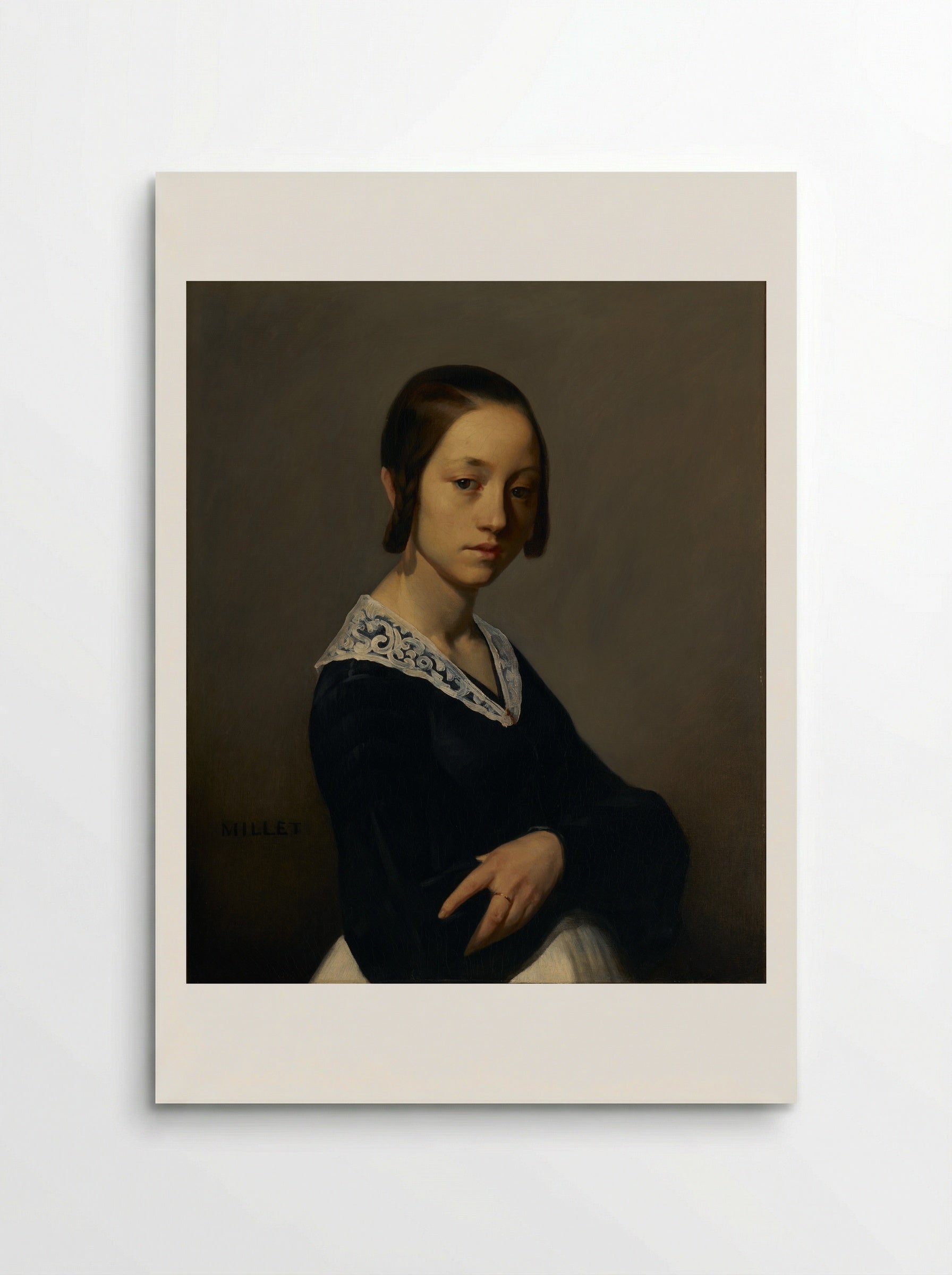
Louise-Antoinette Feuardent - Jean-Francois Millet
Archival giclée
Frames arrive ready to hang
Secure checkout
Made to order
Description
A refined portrait of Louise-Antoinette Feuardent by Jean-Francois Millet, showcasing his early mastery of light, shadow, and human character.
This portrait depicts Louise-Antoinette Feuardent, a woman from the artist's native Normandy. Painted during the early stages of Jean-Francois Millet's career, the work demonstrates his technical proficiency before he moved towards the rural subjects that defined his later output. The subject is captured in a three-quarter view, her gaze directed towards the viewer with a calm, steady expression. Millet employs a restrained palette, focusing on the contrast between the dark, sombre tones of the subject's dress and the lighter, neutral background. The lighting is soft, modelling the features of the face with precision and care. A notable detail is the white lace collar, which provides a decorative element against the simplicity of the dark garment. The artist's brushwork is controlled, smoothing the transitions between light and shadow to create a sense of volume and physical presence. The composition is balanced, with the subject's crossed arms providing a stable base for the upper body. The inclusion of a simple ring on her finger adds a personal touch, grounding the portrait in the reality of the individual. This work belongs to a period when Millet was producing commissioned portraits to support himself, yet it possesses a psychological clarity that suggests his developing interest in the human condition. The painting remains a fine example of mid-nineteenth-century French portraiture, reflecting the artist's ability to capture character through subtle observation rather than dramatic artifice. It is a quiet, dignified study that avoids unnecessary ornamentation, allowing the personality of the sitter to remain the primary focus of the viewer.
Return policy
Because every print is made to order, we don't offer change-of-mind returns, refunds or exchanges. If your order arrives faulty, damaged or incorrect, we'll replace it free of charge — just contact us within 48 hours of delivery. See our refunds page for full details.
Shipping
We ship worldwide, printing at the production hub nearest to your delivery address. Delivery times and costs vary by destination — you'll see the options available to you at checkout.
Manufacturing
Each print is produced to order using 12-colour giclée printing on FSC-certified archival paper. Designed in Britain and printed at your nearest production hub to reduce waste and speed up delivery.
Louise-Antoinette Feuardent - Jean-Francois Millet
Our Features
Designed for Lasting Impact
Specific Features
Every Solis piece is made to order with archival, gallery-quality materials built to last.
- Museum-grade giclée printing for rich, fade-resistant colour
- Archival matte fine-art paper, FSC-certified
- Multiple sizes and framing options available
- Frames in black, natural wood, dark wood or white
- Framed prints arrive ready to hang
Care & Cleaning
To keep your artwork looking its best:
- Dust gently with a soft, dry cloth
- Avoid prolonged direct sunlight
- Never use liquid cleaners on the print or canvas surface
- Keep in a dry, room-temperature space
- Handle prints with clean, dry hands
Materials & Sizing
Museum-grade giclée on FSC-certified archival matte paper, with framed and canvas options.
- Paper sizes: A4, A3, A2, A1, A0 and B2 (50×70 cm)
- Canvas: XS (20×30 cm) to Large (60×90 cm)
- Frames: black, natural wood, dark wood or white
Why Choose Us ?
Damage-free delivery guarantee
Fast Shipping
Museum-Quality Materials

Artist Biography
Jean-François Millet
Two village priests educated him in Latin and literature before he was pulled back to farm work. He eventually reached Paris, where he lived in poverty for a period, painting in a damp cellar. His first wife died of tuberculosis three years after their 1841 marriage. He later had nine children with Catherine Lemaire.
The Gleaners (1857) and The Angelus (1857-59) made him famous and controversial. Both depict peasants at work with a dignity that unnerved the bourgeoisie, who saw political radicalism in the simple act of painting agricultural labourers as worthy subjects. The Angelus became one of the most widely reproduced images in the world.
Van Gogh was obsessed with him. While in the asylum at Saint-Remy in late 1889 and early 1890, Van Gogh made twenty-one copies of Millet's paintings over three months, translating them into his own colour and brushwork. Millet died in 1875, co-founder of the Barbizon school and the painter who gave peasant life a permanent place in art.
You May Also Like