

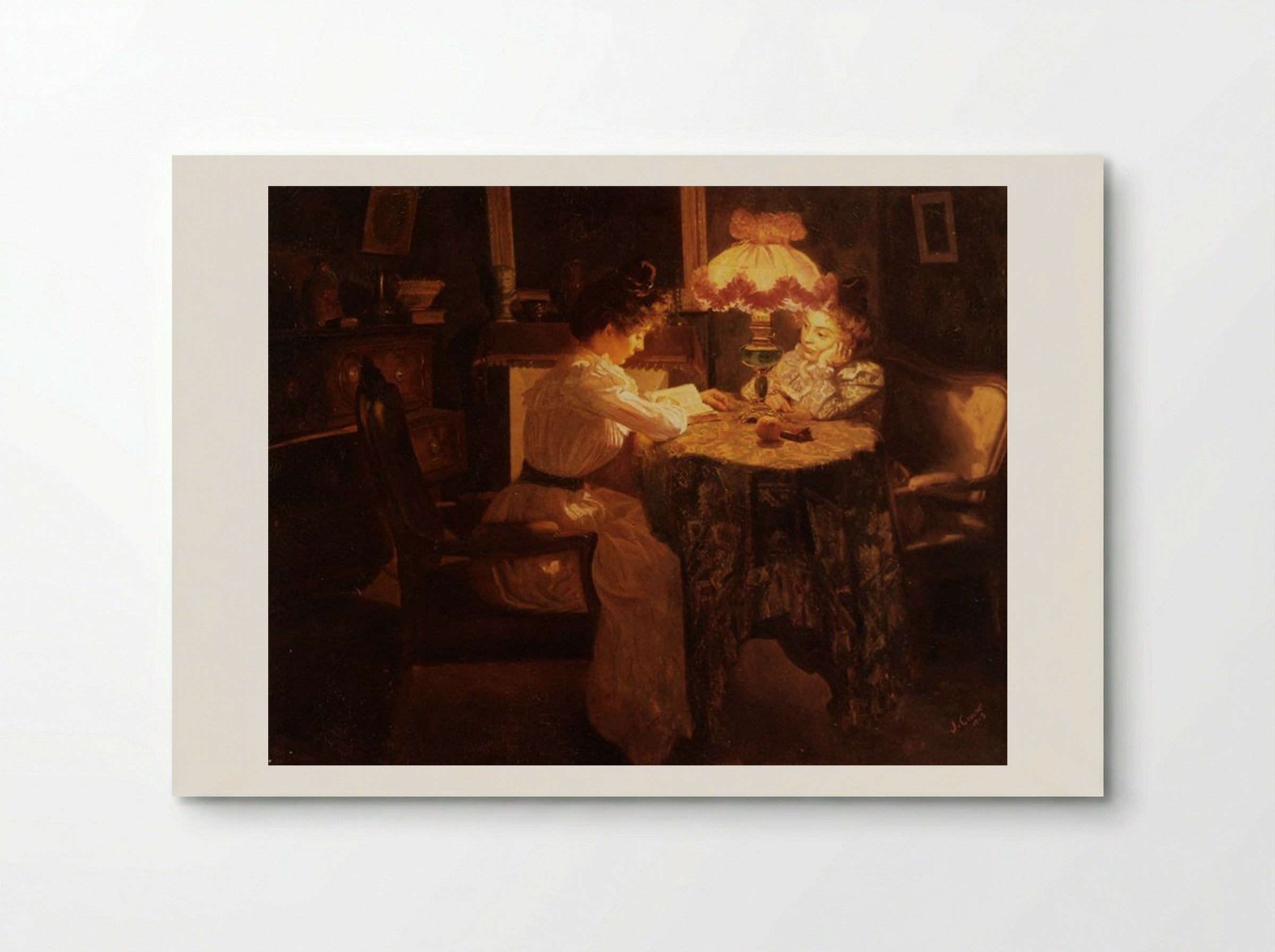
Lamp Effect - Edouard Cortes
Archival giclée
Frames arrive ready to hang
Secure checkout
Made to order
Description
A quiet, atmospheric interior scene by Edouard Cortes, capturing two figures illuminated by the warm, golden glow of a table lamp.
Edouard Cortes is widely recognised for his depictions of Parisian street scenes, yet this interior study demonstrates his technical command of artificial light. Painted in 1913, the work captures a quiet domestic moment. Two figures sit at a table, illuminated by the warm, golden glow of a fringed table lamp. The light source dictates the composition, casting deep shadows across the room while highlighting the texture of the figures' clothing and the patterned tablecloth. Cortes employs a controlled palette of amber, ochre, and deep umber to create a sense of intimacy. The brushwork is precise, allowing for the subtle rendering of light as it reflects off the surfaces of the table and the faces of the subjects. The woman on the left is absorbed in a book, while the figure opposite watches her, creating a narrative of quiet companionship. The background remains largely obscured by darkness, which pushes the viewer's attention toward the central illuminated area. This use of chiaroscuro is characteristic of the artist's interest in how light interacts with its environment, whether on a bustling boulevard or within the confines of a private home. This piece offers a departure from the artist's more common outdoor subjects. It provides insight into his ability to manage light in a confined space. The composition relies on the contrast between the warm, concentrated light of the lamp and the surrounding gloom. The result is a study of atmosphere and mood, capturing a fleeting moment of evening stillness. The painting remains a fine example of early twentieth-century French genre painting, where the focus is placed upon the quietude of daily life rather than grand historical or social narratives.
Return policy
Because every print is made to order, we don't offer change-of-mind returns, refunds or exchanges. If your order arrives faulty, damaged or incorrect, we'll replace it free of charge — just contact us within 48 hours of delivery. See our refunds page for full details.
Shipping
We ship worldwide, printing at the production hub nearest to your delivery address. Delivery times and costs vary by destination — you'll see the options available to you at checkout.
Manufacturing
Each print is produced to order using 12-colour giclée printing on FSC-certified archival paper. Designed in Britain and printed at your nearest production hub to reduce waste and speed up delivery.
Lamp Effect - Edouard Cortes
Our Features
Designed for Lasting Impact
Specific Features
Every Solis piece is made to order with archival, gallery-quality materials built to last.
- Museum-grade giclée printing for rich, fade-resistant colour
- Archival matte fine-art paper, FSC-certified
- Multiple sizes and framing options available
- Frames in black, natural wood, dark wood or white
- Framed prints arrive ready to hang
Care & Cleaning
To keep your artwork looking its best:
- Dust gently with a soft, dry cloth
- Avoid prolonged direct sunlight
- Never use liquid cleaners on the print or canvas surface
- Keep in a dry, room-temperature space
- Handle prints with clean, dry hands
Materials & Sizing
Museum-grade giclée on FSC-certified archival matte paper, with framed and canvas options.
- Paper sizes: A4, A3, A2, A1, A0 and B2 (50×70 cm)
- Canvas: XS (20×30 cm) to Large (60×90 cm)
- Frames: black, natural wood, dark wood or white
Why Choose Us ?
Damage-free delivery guarantee
Fast Shipping
Museum-Quality Materials
Artist Biography
Édouard Cortès
You May Also Like