

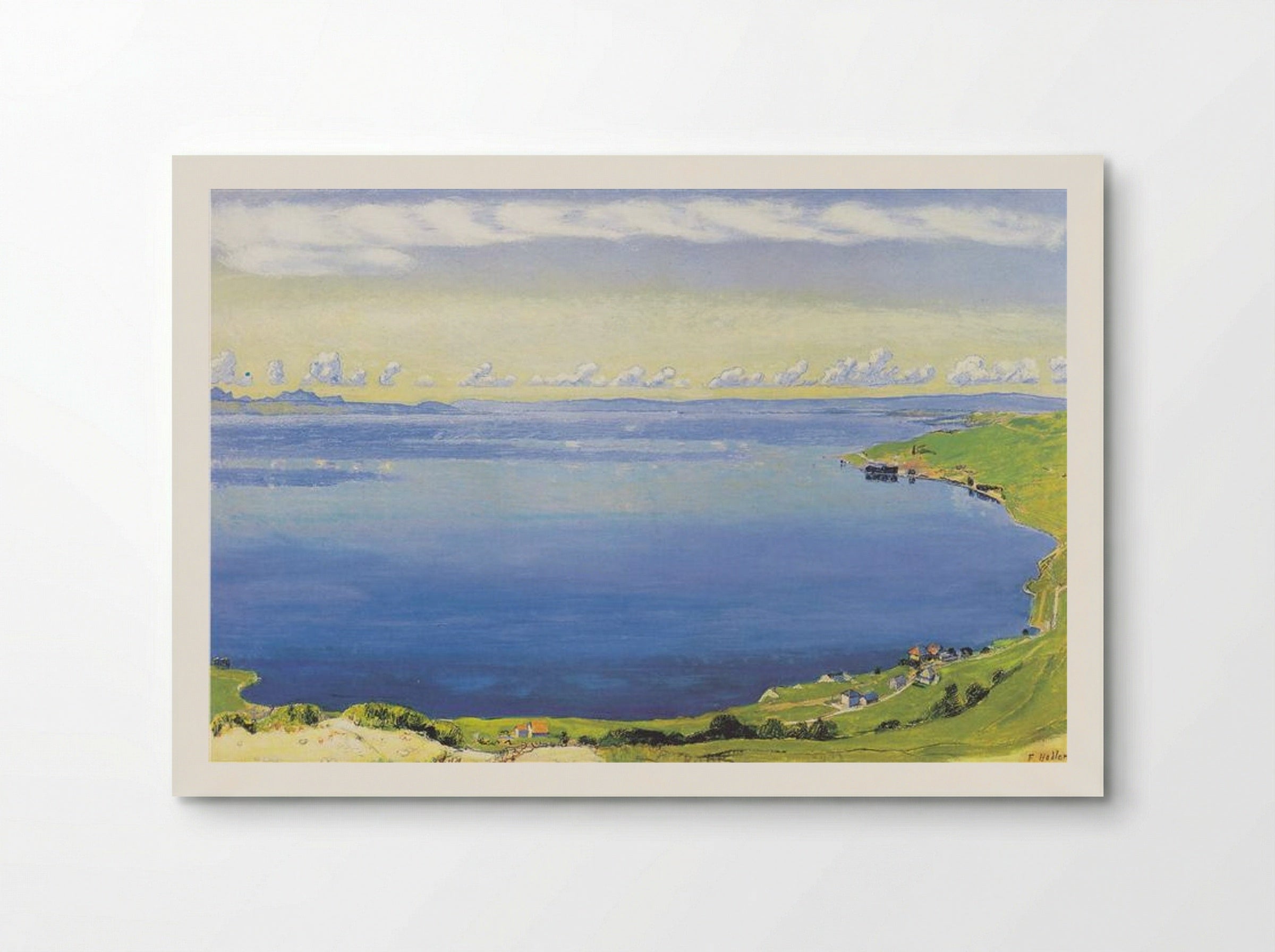
Lake Geneva from Chexbres - Ferdinand Hodler
Archival giclée
Frames arrive ready to hang
Secure checkout
Made to order
Description
A panoramic view of Lake Geneva from Chexbres, this landscape painting by Ferdinand Hodler uses horizontal bands of colour and simplified forms to evoke the beauty of the Swiss countryside.
Ferdinand Hodler (1853-1918) was a Swiss painter considered one of the most important artists of his country. His work evolved from realism to a personal form of symbolism characterised by a distinctive monumental style. Hodler's paintings often explore themes of nature, mortality, and national identity. He developed a theory of 'parallelism', which sought to represent the underlying unity and harmony of the universe through symmetrical compositions and rhythmic patterns. 'Lake Geneva from Chexbres' exemplifies Hodler's approach to depicting the Swiss countryside. The painting presents a panoramic view of Lake Geneva, captured from an elevated vantage point in Chexbres. The composition is structured around horizontal bands of colour, with the blue of the lake contrasting against the green of the surrounding hills and the pale yellow of the sky. Clouds are rendered as soft, pillowy forms, reflecting in the still surface of the water. Small villages dot the shoreline, adding a sense of human presence to the scene. Hodler's use of simplified forms and clear, bright colours creates a sense of clarity and serenity, evoking the grandeur and beauty of the Swiss landscape.
Return policy
Because every print is made to order, we don't offer change-of-mind returns, refunds or exchanges. If your order arrives faulty, damaged or incorrect, we'll replace it free of charge — just contact us within 48 hours of delivery. See our refunds page for full details.
Shipping
We ship worldwide, printing at the production hub nearest to your delivery address. Delivery times and costs vary by destination — you'll see the options available to you at checkout.
Manufacturing
Each print is produced to order using 12-colour giclée printing on FSC-certified archival paper. Designed in Britain and printed at your nearest production hub to reduce waste and speed up delivery.
Lake Geneva from Chexbres - Ferdinand Hodler

Artist Biography
Ferdinand Hodler
He studied under Barthelemy Menn in Geneva, absorbing influences from Courbet and Holbein that seem contradictory but make sense in his work: physical realism combined with formal symmetry. By the 1890s he had developed Parallelism, a system of compositional repetition where figures, gestures and landscape elements mirror each other across the canvas. He described it as an element of order inherent in nature, visible in reflections on water, in the symmetry of the human body, in the repetition of mountain forms.
The Swiss National Bank commissioned him in 1908 to design currency. Rather than portraits of statesmen, he chose a woodcutter for the 50-franc note and a reaper for the 100-franc note. Both entered circulation in 1911. His figures occupy Swiss banknotes the way his figures occupy his paintings: monumental, frontal, and slightly too symmetrical to be comfortable.
His son Hector founded the World Esperanto Association in 1908, which is a detail that belongs in the biography of any artist whose life's work concerned the search for universal order. Hodler was Switzerland's first modern painter, and the one who proved you could stay in Switzerland and still matter. He died in Geneva in 1918, having painted the view of Lake Geneva from his window every day during his final illness. The series of paintings recording the changing light over the lake is among his most moving work.
Our Features
Designed for Lasting Impact
Specific Features
Every Solis piece is made to order with archival, gallery-quality materials built to last.
- Museum-grade giclée printing for rich, fade-resistant colour
- Archival matte fine-art paper, FSC-certified
- Multiple sizes and framing options available
- Frames in black, natural wood, dark wood or white
- Framed prints arrive ready to hang
Care & Cleaning
To keep your artwork looking its best:
- Dust gently with a soft, dry cloth
- Avoid prolonged direct sunlight
- Never use liquid cleaners on the print or canvas surface
- Keep in a dry, room-temperature space
- Handle prints with clean, dry hands
Materials & Sizing
Museum-grade giclée on FSC-certified archival matte paper, with framed and canvas options.
- Paper sizes: A4, A3, A2, A1, A0 and B2 (50×70 cm)
- Canvas: XS (20×30 cm) to Large (60×90 cm)
- Frames: black, natural wood, dark wood or white
Why Choose Us ?
Damage-free delivery guarantee
Fast Shipping
Museum-Quality Materials
Artist Biography
Ferdinand Hodler
He studied under Barthelemy Menn in Geneva, absorbing influences from Courbet and Holbein that seem contradictory but make sense in his work: physical realism combined with formal symmetry. By the 1890s he had developed Parallelism, a system of compositional repetition where figures, gestures and landscape elements mirror each other across the canvas. He described it as an element of order inherent in nature, visible in reflections on water, in the symmetry of the human body, in the repetition of mountain forms.
The Swiss National Bank commissioned him in 1908 to design currency. Rather than portraits of statesmen, he chose a woodcutter for the 50-franc note and a reaper for the 100-franc note. Both entered circulation in 1911. His figures occupy Swiss banknotes the way his figures occupy his paintings: monumental, frontal, and slightly too symmetrical to be comfortable.
His son Hector founded the World Esperanto Association in 1908, which is a detail that belongs in the biography of any artist whose life's work concerned the search for universal order. Hodler was Switzerland's first modern painter, and the one who proved you could stay in Switzerland and still matter. He died in Geneva in 1918, having painted the view of Lake Geneva from his window every day during his final illness. The series of paintings recording the changing light over the lake is among his most moving work.
You May Also Like