

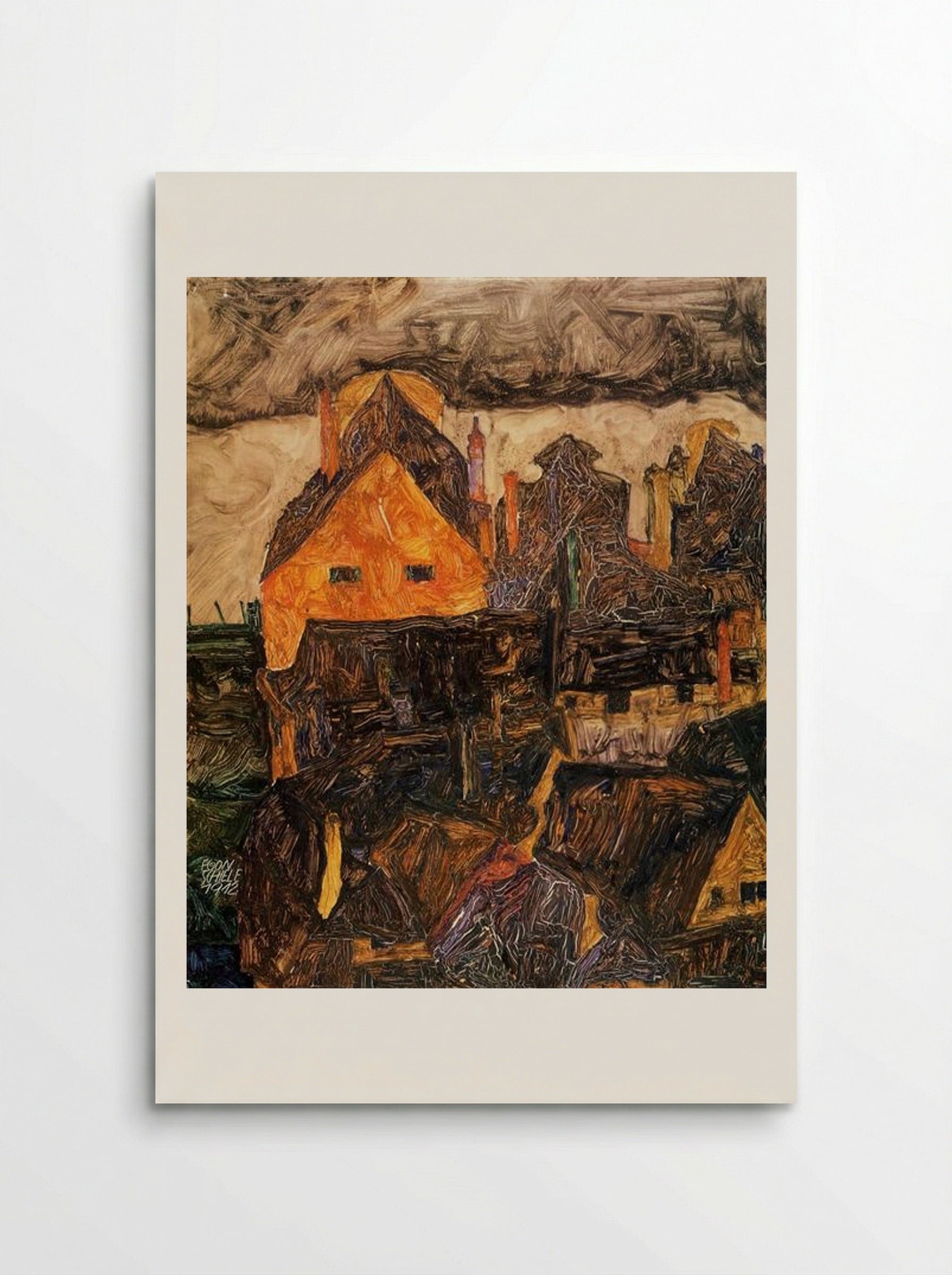
Krumau on the Moldau - Egon Schiele
Archival giclée
Frames arrive ready to hang
Secure checkout
Made to order
Description
Egon Schiele's 1912 Expressionist painting, "Krumau on the Moldau", depicts the town of Český Krumlov with agitated brushwork and a somber palette, reflecting the artist's emotional response to the place.
Egon Schiele's "Krumau on the Moldau", painted in 1912, presents a distorted view of the Bohemian town of Český Krumlov, now in the Czech Republic. Schiele, an Austrian Expressionist, captures the town's buildings huddled together, rendered in a palette of browns, oranges, and blacks. The brushwork is agitated and angular, contributing to the painting's sense of unease. The sky is a swirl of grey and beige, adding to the overall oppressive atmosphere. Schiele's Expressionist style is evident in the subjective and emotional response to the subject matter. He was interested in conveying inner feelings and psychological states through his art. Schiele's landscapes often reflect his own emotional turmoil. The town of Krumau, where his mother was born, held a particular significance for the artist. However, he was eventually expelled from the town due to the disapproval of the local residents. This painting is not a straightforward depiction; it is a psychological portrait of a place, filtered through Schiele's own experiences and anxieties. The painting is currently part of the collection of the Leopold Museum, Vienna.
Return policy
Because every print is made to order, we don't offer change-of-mind returns, refunds or exchanges. If your order arrives faulty, damaged or incorrect, we'll replace it free of charge — just contact us within 48 hours of delivery. See our refunds page for full details.
Shipping
We ship worldwide, printing at the production hub nearest to your delivery address. Delivery times and costs vary by destination — you'll see the options available to you at checkout.
Manufacturing
Each print is produced to order using 12-colour giclée printing on FSC-certified archival paper. Designed in Britain and printed at your nearest production hub to reduce waste and speed up delivery.
Care and materials
Specific Features
Every Solis piece is made to order with archival, gallery-quality materials built to last.
- Museum-grade giclée printing for rich, fade-resistant colour
- Archival matte fine-art paper, FSC-certified
- Multiple sizes and framing options available
- Frames in black, natural wood, dark wood or white
- Framed prints arrive ready to hang
Care & Cleaning
To keep your artwork looking its best:
- Dust gently with a soft, dry cloth
- Avoid prolonged direct sunlight
- Never use liquid cleaners on the print or canvas surface
- Keep in a dry, room-temperature space
- Handle prints with clean, dry hands
Materials & Sizing
Museum-grade giclée on FSC-certified archival matte paper, with framed and canvas options.
- Paper sizes: A4, A3, A2, A1, A0 and B2 (50×70 cm)
- Canvas: XS (20×30 cm) to Large (60×90 cm)
- Frames: black, natural wood, dark wood or white
Krumau on the Moldau - Egon Schiele

Artist Biography
Egon Schiele
Schiele’s art is characterised by its unflinching honesty and psychological depth. He rejected traditional notions of beauty, instead focusing on the raw, often unsettling realities of the human form and the landscapes he inhabited. Works like 'Melon' and 'House with a Bay Window in the Garden' showcase his ability to find beauty in the mundane, while his landscapes, such as 'Winding Brook' and 'Forest with Sunlit Clearing in the Background', possess an almost spiritual quality.
Though his life was tragically cut short by the Spanish Flu at just 28, Egon Schiele's impact on modern art remains profound. His unflinching gaze and emotionally charged style continue to resonate with collectors today, who are drawn to the honesty and vulnerability that permeates his iconic paintings and landscapes. Owning a Schiele print is not just acquiring art; it's embracing a piece of raw, unfiltered human experience.
Why Choose Us ?
Damage-free delivery guarantee
Fast Shipping
Museum-Quality Materials
You May Also Like