

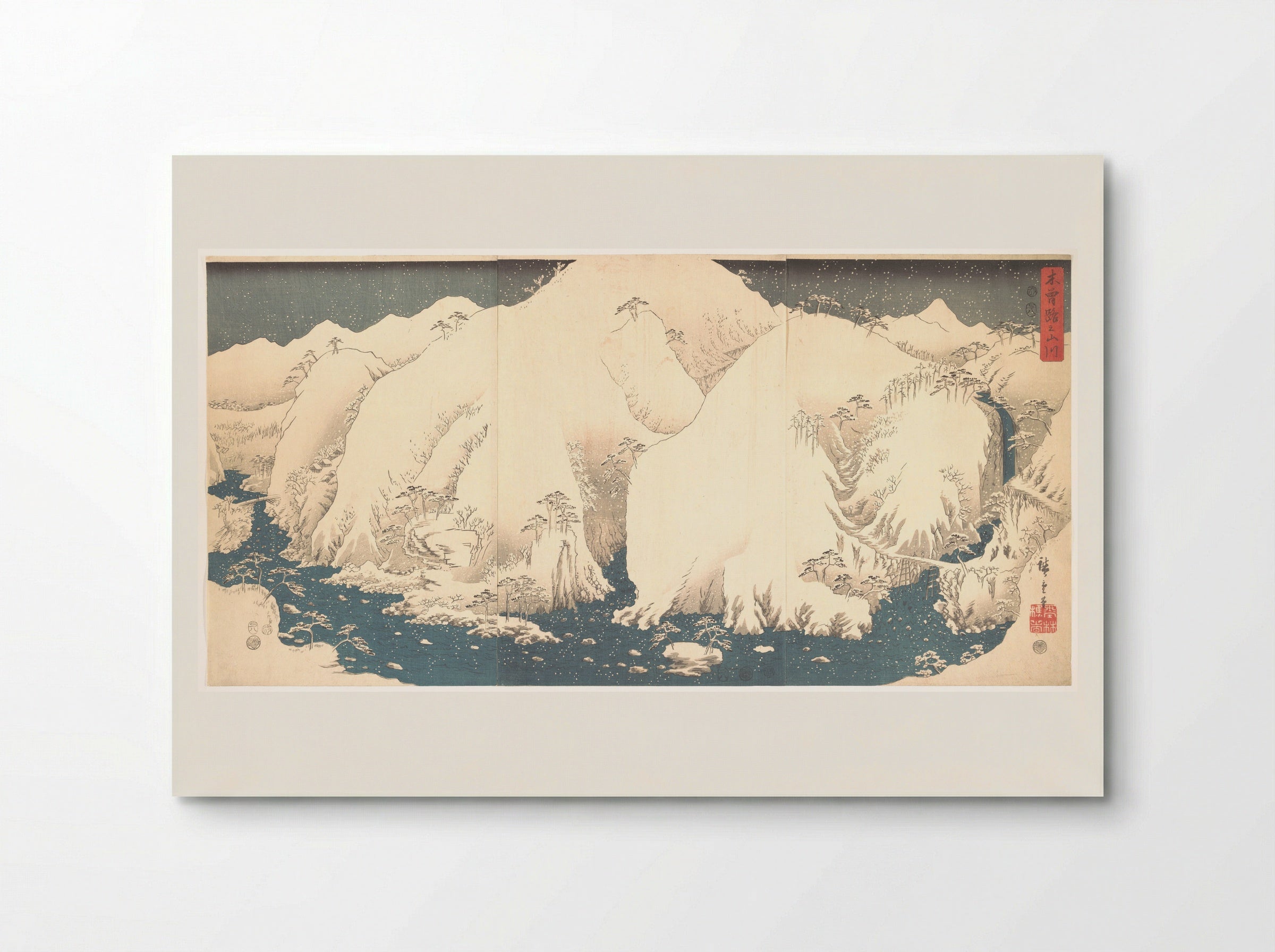
Kisō Mountains in Snow - Utagawa Hiroshige
Archival giclée
Frames arrive ready to hang
Secure checkout
Made to order
Description
A 1857 woodblock triptych by Utagawa Hiroshige depicting the snow-covered Kiso Mountains. This ukiyo-e print uses Prussian blue and white to capture a winter scene in central Japan.
Utagawa Hiroshige produced this triptych in 1857, near the end of his life. It depicts the mountainous Kiso region in central Japan during a heavy snowfall. The composition spans three vertical sheets of paper, creating a wide view of the rugged terrain. Hiroshige used a limited palette of Prussian blue and white, along with shades of grey, to convey the cold atmosphere of the winter scene. The dark blue river winds through the centre of the image, contrasting with the white peaks. Small pine trees cling to the rocky slopes, their branches weighed down by snow. In the upper portion of the print, the sky is a dark, solid tone, filled with white dots representing falling snow. This technique, known as gofun or using white lead pigment, adds texture to the surface. Hiroshige was a master of the ukiyo-e genre, specifically known for his ability to capture weather conditions and atmospheric effects. In this work, he avoids complex details in favour of broad shapes and strong tonal contrasts. The scale of the mountains is suggested by the small bridges and tiny figures visible upon closer inspection. This print is part of a set of three triptychs representing the traditional themes of Setsugekka (Snow, Moon, and Flowers). The Kiso Road was a major inland route connecting Edo and Kyoto. Hiroshige travelled this path and recorded the scenery in various series. This particular triptych is noted for technical execution, including the use of bokashi or colour gradation in the water and sky. The publisher, Okazawa-ya Taheiji, released this work during the Ansei era. The result is a balanced depiction of a quiet, frozen world. The composition uses a high vantage point, a common feature in Japanese landscape prints. This perspective allows the viewer to see the river as it disappears into the distance between the steep cliffs. A waterfall is visible on the right sheet, its vertical movement contrasting with the horizontal flow of the river. The overall effect is one of stillness and isolation.
Return policy
Because every print is made to order, we don't offer change-of-mind returns, refunds or exchanges. If your order arrives faulty, damaged or incorrect, we'll replace it free of charge — just contact us within 48 hours of delivery. See our refunds page for full details.
Shipping
We ship worldwide, printing at the production hub nearest to your delivery address. Delivery times and costs vary by destination — you'll see the options available to you at checkout.
Manufacturing
Each print is produced to order using 12-colour giclée printing on FSC-certified archival paper. Designed in Britain and printed at your nearest production hub to reduce waste and speed up delivery.
Kisō Mountains in Snow - Utagawa Hiroshige
Our Features
Designed for Lasting Impact
Specific Features
Every Solis piece is made to order with archival, gallery-quality materials built to last.
- Museum-grade giclée printing for rich, fade-resistant colour
- Archival matte fine-art paper, FSC-certified
- Multiple sizes and framing options available
- Frames in black, natural wood, dark wood or white
- Framed prints arrive ready to hang
Care & Cleaning
To keep your artwork looking its best:
- Dust gently with a soft, dry cloth
- Avoid prolonged direct sunlight
- Never use liquid cleaners on the print or canvas surface
- Keep in a dry, room-temperature space
- Handle prints with clean, dry hands
Materials & Sizing
Museum-grade giclée on FSC-certified archival matte paper, with framed and canvas options.
- Paper sizes: A4, A3, A2, A1, A0 and B2 (50×70 cm)
- Canvas: XS (20×30 cm) to Large (60×90 cm)
- Frames: black, natural wood, dark wood or white
Why Choose Us ?
Damage-free delivery guarantee
Fast Shipping
Museum-Quality Materials
Artist Biography
Utagawa Hiroshige
You May Also Like