

Fine Art Poster
From £28
A giclée print on 200gsm matte fine art paper, using a twelve-colour process for accurate, fade-resistant colour. Supplied unframed, delivered flat or rolled.



Archival giclée
Frames arrive ready to hang
Secure checkout
Made to order
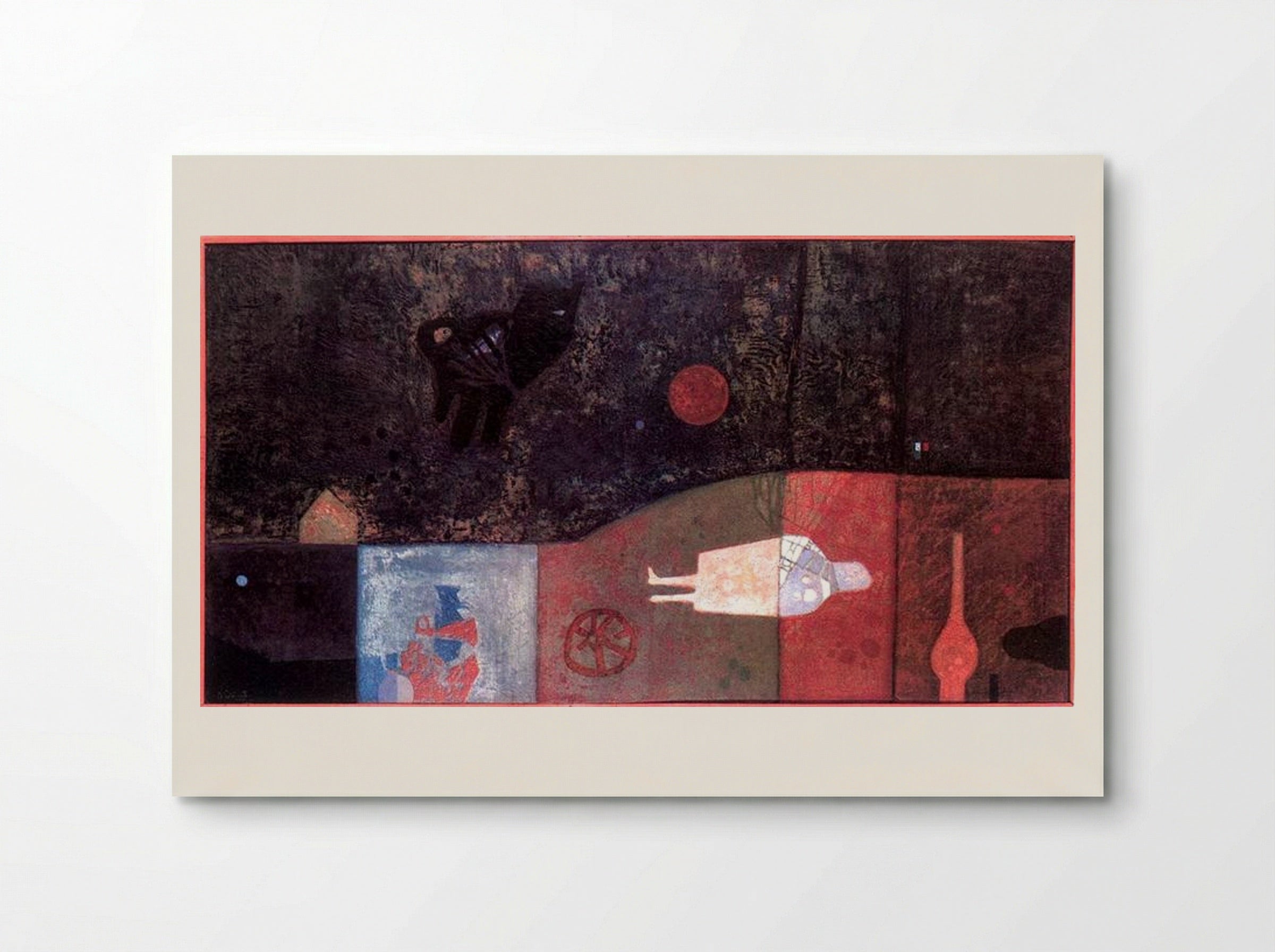
A surrealist composition by Hungarian artist Endre Bálint, featuring fragmented scenes and symbolic motifs that explore themes of memory and displacement.
Endre Bálint, a central figure in the Hungarian avant-garde, created this work during a period of intense personal and artistic exploration. The composition is divided into distinct, almost architectural, zones that suggest a fractured memory or a dreamlike sequence. A dark, textured upper register dominates the canvas, punctuated by a singular, glowing orb that provides a stark contrast to the surrounding gloom. Below this atmospheric expanse, the painting shifts into a series of compartmentalised scenes. Within these lower sections, Bálint employs a symbolic vocabulary that is characteristic of his mature style. A reclining figure, rendered in pale, ghost-like tones, rests across the boundary of two colour fields. Nearby, a simple house outline and a circular motif evoke a sense of place and displacement. The use of muted, earthy tones, interspersed with flashes of deep red and cool blue, creates a tension between the physical world and the internal state of the subject. The surface texture is deliberate, showing the artist's interest in the material quality of paint and the layering of pigment to suggest age and decay. Bálint often drew upon the visual culture of his native Budapest, blending personal history with broader surrealist concerns. This piece avoids literal narrative, preferring instead to present a collection of signs that invite the viewer to assemble their own meaning. The juxtaposition of geometric order and organic, mysterious shapes reflects the artist's preoccupation with the subconscious. By isolating objects within defined spaces, Bálint forces a focus on the individual components of the scene, allowing the viewer to contemplate the relationship between the figure and its environment. The work remains a compelling example of mid-twentieth-century European modernism, demonstrating a sophisticated balance between abstraction and representational elements.
Because every print is made to order, we don't offer change-of-mind returns, refunds or exchanges. If your order arrives faulty, damaged or incorrect, we'll replace it free of charge — just contact us within 48 hours of delivery. See our refunds page for full details.
We ship worldwide, printing at the production hub nearest to your delivery address. Delivery times and costs vary by destination — you'll see the options available to you at checkout.
Each print is produced to order using 12-colour giclée printing on FSC-certified archival paper. Designed in Britain and printed at your nearest production hub to reduce waste and speed up delivery.
Specific Features
Every Solis piece is made to order with archival, gallery-quality materials built to last.
Care & Cleaning
To keep your artwork looking its best:
Materials & Sizing
Museum-grade giclée on FSC-certified archival matte paper, with framed and canvas options.
Made to order
Every piece is printed to order. These are the five finishes, and what makes each one different.
From £28
A giclée print on 200gsm matte fine art paper, using a twelve-colour process for accurate, fade-resistant colour. Supplied unframed, delivered flat or rolled.

From £45
The same fine art print in a solid wood frame with UV-protective acrylic glaze and rigid backing. Five frame colours. Arrives ready to hang.

From £85
A deeper solid wood frame: 33mm deep with a 20mm face and Perspex glaze. The print sits unmounted for a clean gallery presentation. Black, white or natural.

From £30
Hand-stretched canvas with neat gallery-wrapped edges, giving the artwork surface texture and depth. Arrives ready to hang.

From £135
Stretched canvas set in a floating wood frame, our most substantial finish. Arrives ready to hang.
Why Choose Us ?
Damage-free delivery guarantee
Fast Shipping
Museum-Quality Materials
You May Also Like
We use cookies to measure our marketing and see which prints people love.We use cookies to measure our marketing.
By continuing to browse, you agree · Privacy Policy