

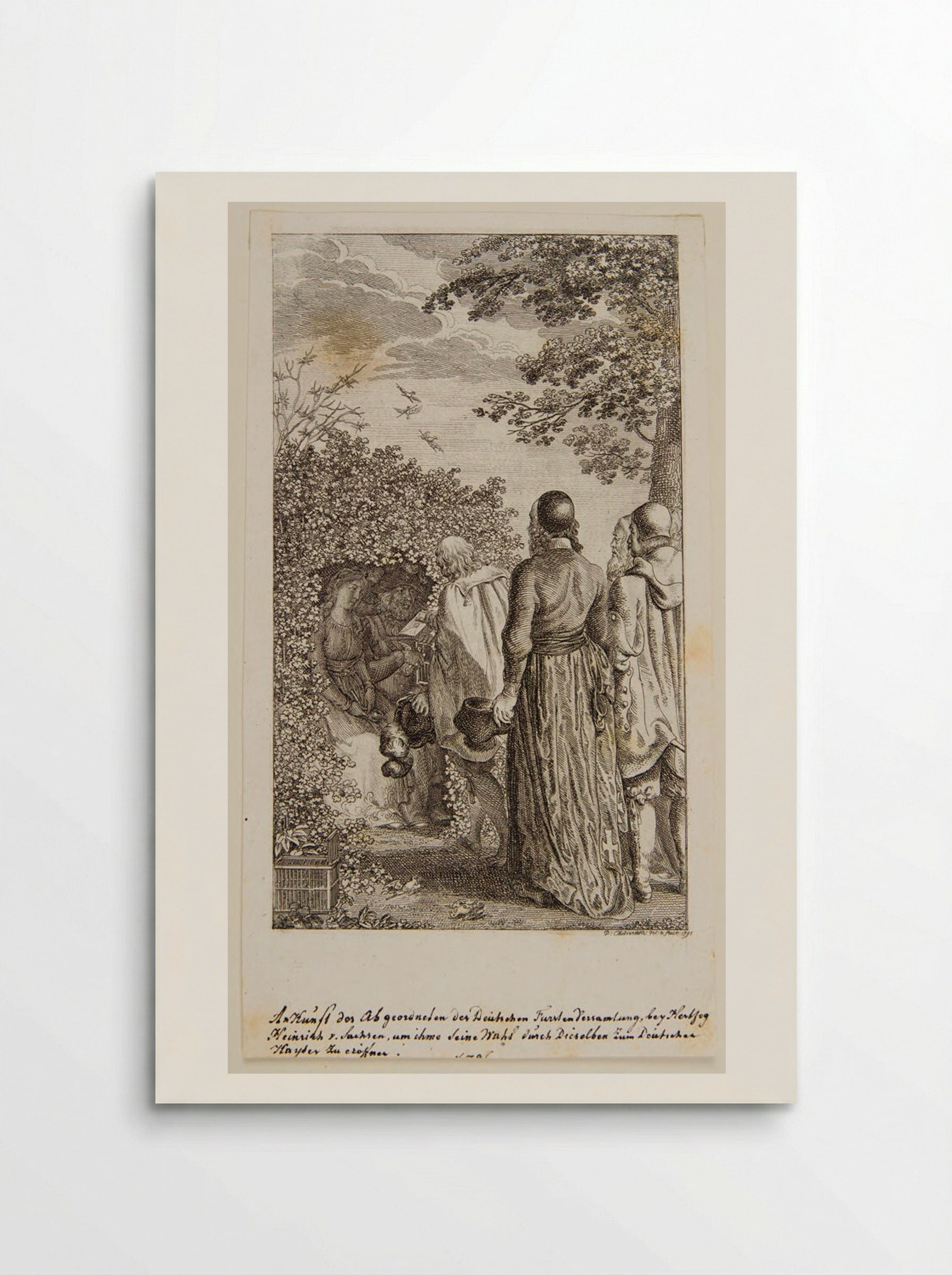
Heinrich the First Learns that He Has Been Proclaimed King - Daniel Nikolaus Chodowiecki
Archival giclée
Frames arrive ready to hang
Secure checkout
Made to order
Description
A detailed 1791 etching by Daniel Nikolaus Chodowiecki depicting the historical moment Henry the Fowler receives news of his election as King.
This etching by Daniel Nikolaus Chodowiecki, dated 1791, depicts a moment of historical significance: the arrival of delegates to inform Henry the Fowler of his election as King of Germany. Chodowiecki, a prolific illustrator and printmaker based in Berlin, was widely recognised for his ability to capture narrative clarity within small-scale compositions. His work often focused on historical, literary, and contemporary scenes, reflecting the Enlightenment interest in moral and civic virtue. The composition is structured around a central group of figures standing before a dense, flowering thicket. Henry is shown seated within the foliage, receiving the news from the emissaries who stand in the foreground. The artist employs a precise, linear technique, using fine hatching to define the textures of the clothing, the foliage, and the atmospheric sky. The figures are rendered with a focus on period-appropriate costume, a hallmark of Chodowiecki's attention to detail. The scene balances the natural setting with the formal nature of the political encounter, creating a sense of quiet gravity. Chodowiecki’s prints were highly sought after during the late eighteenth century for their technical refinement and their role in disseminating historical narratives to a broader public. This particular work demonstrates his skill in managing depth and light through the medium of etching, ensuring that the viewer's eye is drawn to the interaction between the seated monarch and the standing delegates. The inclusion of the handwritten inscription at the base of the print provides context for the scene, a common practice in his published series. This piece offers a window into the aesthetic and intellectual preoccupations of the late German Enlightenment, where history was frequently used to explore themes of leadership and duty.
Return policy
Because every print is made to order, we don't offer change-of-mind returns, refunds or exchanges. If your order arrives faulty, damaged or incorrect, we'll replace it free of charge — just contact us within 48 hours of delivery. See our refunds page for full details.
Shipping
We ship worldwide, printing at the production hub nearest to your delivery address. Delivery times and costs vary by destination — you'll see the options available to you at checkout.
Manufacturing
Each print is produced to order using 12-colour giclée printing on FSC-certified archival paper. Designed in Britain and printed at your nearest production hub to reduce waste and speed up delivery.
Care and materials
Specific Features
Every Solis piece is made to order with archival, gallery-quality materials built to last.
- Museum-grade giclée printing for rich, fade-resistant colour
- Archival matte fine-art paper, FSC-certified
- Multiple sizes and framing options available
- Frames in black, natural wood, dark wood or white
- Framed prints arrive ready to hang
Care & Cleaning
To keep your artwork looking its best:
- Dust gently with a soft, dry cloth
- Avoid prolonged direct sunlight
- Never use liquid cleaners on the print or canvas surface
- Keep in a dry, room-temperature space
- Handle prints with clean, dry hands
Materials & Sizing
Museum-grade giclée on FSC-certified archival matte paper, with framed and canvas options.
- Paper sizes: A4, A3, A2, A1, A0 and B2 (50×70 cm)
- Canvas: XS (20×30 cm) to Large (60×90 cm)
- Frames: black, natural wood, dark wood or white
Heinrich the First Learns that He Has Been Proclaimed King - Daniel Nikolaus Chodowiecki

Artist Biography
Daniel Nikolaus Chodowiecki
His artistic approach focused on the daily lives of the middle classes. He modified the aristocratic French style of fêtes galantes to suit a modest, domestic sensibility. His etchings for literary works like Voltaire's Candide and Le Sage's Gil Blas brought visual form to Enlightenment philosophy. These prints avoided the excesses of the Rococo period in favour of a restrained Neoclassical clarity.
Collectors today appreciate the scale and historical accuracy of these works. These prints were designed for personal study rather than public display. They provide a factual record of eighteenth-century fashion and domestic interiors. Pieces such as Mother and Child or The Teacher offer a direct look at the private world of the past.
Why Choose Us ?
Damage-free delivery guarantee
Fast Shipping
Museum-Quality Materials
You May Also Like