

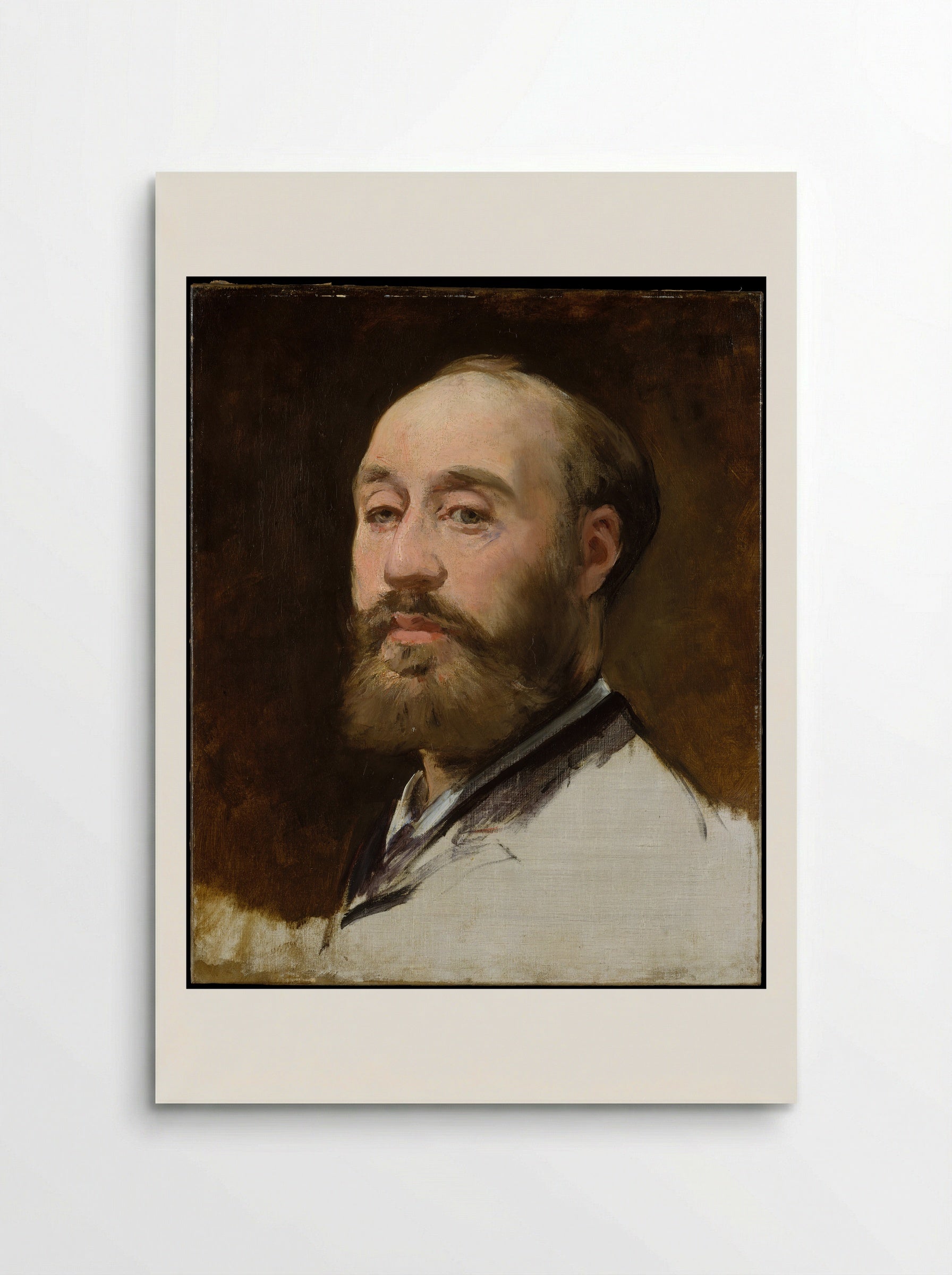
Head of Jean-Baptiste Faure - Edouard Manet
Archival giclée
Frames arrive ready to hang
Secure checkout
Made to order
Description
A portrait study of the baritone Jean-Baptiste Faure, painted by Edouard Manet with his signature loose brushwork and focus on light.
This portrait study depicts the celebrated French baritone Jean-Baptiste Faure. Painted by Edouard Manet towards the end of his career, the work captures the singer with a direct, unvarnished gaze. Manet employs his characteristic loose brushwork, focusing on the essential structure of the face rather than minute detail. The subject is rendered against a dark, atmospheric background, which pushes the illuminated features forward. Faure was a significant patron of the Impressionists and a close associate of Manet. This specific study demonstrates the artist's ability to convey personality through economy of form. The application of paint is fluid, particularly in the rendering of the beard and the subtle transitions of light across the forehead and cheekbones. The white collar provides a sharp contrast to the deeper tones of the background, grounding the figure within the frame. Manet's approach to portraiture often avoided the rigid formality of the academic tradition. Instead, he prioritised the immediate impression of the sitter. This work reflects his interest in the psychological presence of his subjects. The composition is cropped closely, directing the viewer's attention entirely to the expression and the play of light upon the skin. It remains a fine example of the artist's late style, where his technical confidence allowed for a more spontaneous and expressive handling of the medium. The painting is currently held in the collection of the Metropolitan Museum of Art, providing a clear window into the social and artistic circles of late nineteenth-century Paris.
Return policy
Because every print is made to order, we don't offer change-of-mind returns, refunds or exchanges. If your order arrives faulty, damaged or incorrect, we'll replace it free of charge — just contact us within 48 hours of delivery. See our refunds page for full details.
Shipping
We ship worldwide, printing at the production hub nearest to your delivery address. Delivery times and costs vary by destination — you'll see the options available to you at checkout.
Manufacturing
Each print is produced to order using 12-colour giclée printing on FSC-certified archival paper. Designed in Britain and printed at your nearest production hub to reduce waste and speed up delivery.
Care and materials
Specific Features
Every Solis piece is made to order with archival, gallery-quality materials built to last.
- Museum-grade giclée printing for rich, fade-resistant colour
- Archival matte fine-art paper, FSC-certified
- Multiple sizes and framing options available
- Frames in black, natural wood, dark wood or white
- Framed prints arrive ready to hang
Care & Cleaning
To keep your artwork looking its best:
- Dust gently with a soft, dry cloth
- Avoid prolonged direct sunlight
- Never use liquid cleaners on the print or canvas surface
- Keep in a dry, room-temperature space
- Handle prints with clean, dry hands
Materials & Sizing
Museum-grade giclée on FSC-certified archival matte paper, with framed and canvas options.
- Paper sizes: A4, A3, A2, A1, A0 and B2 (50×70 cm)
- Canvas: XS (20×30 cm) to Large (60×90 cm)
- Frames: black, natural wood, dark wood or white
Head of Jean-Baptiste Faure - Edouard Manet
Why Choose Us ?
Damage-free delivery guarantee
Fast Shipping
Museum-Quality Materials
You May Also Like