

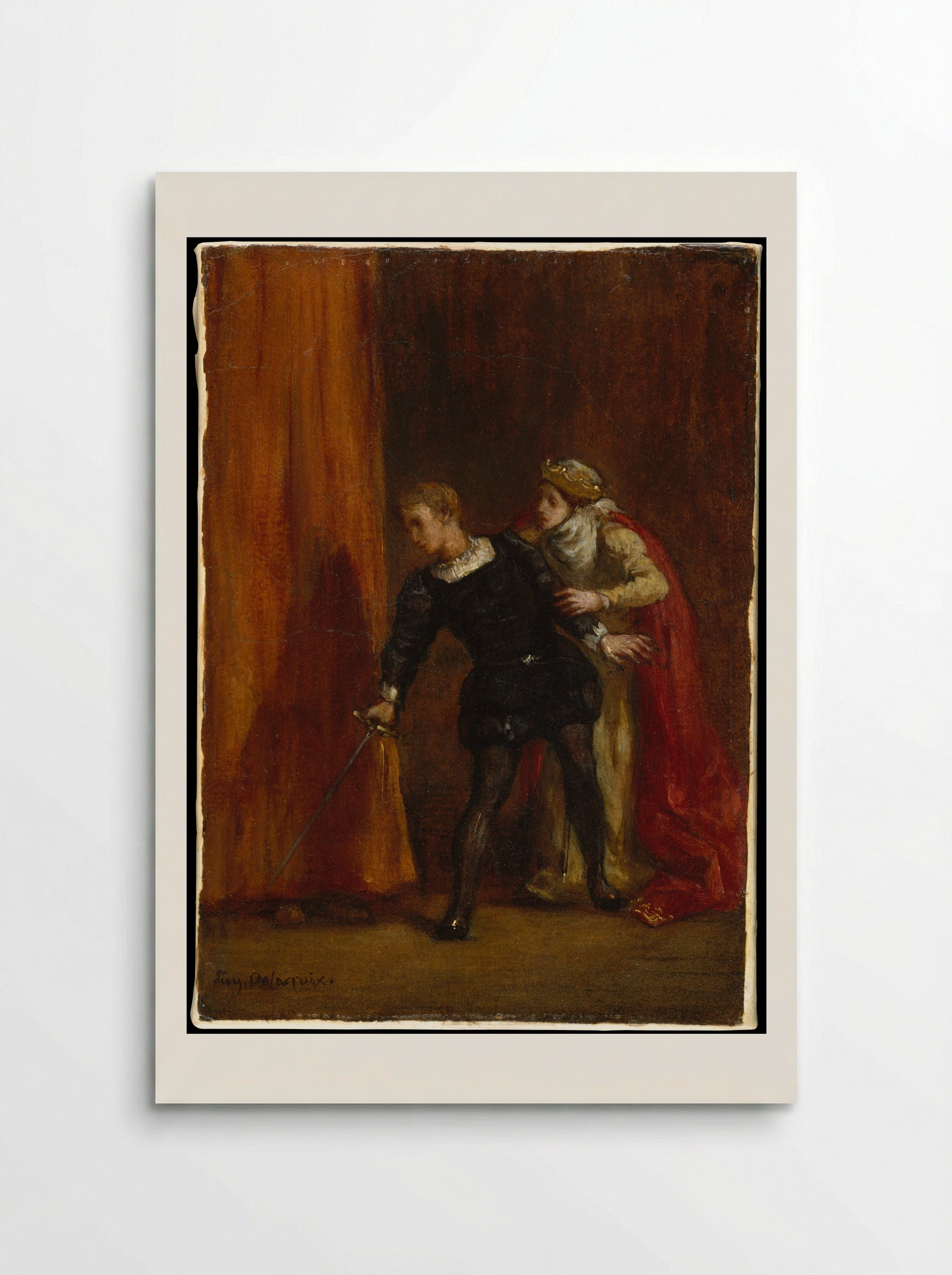
Hamlet and His Mother - Eugène Delacroix
Archival giclée
Frames arrive ready to hang
Secure checkout
Made to order
Description
A dramatic depiction of the confrontation between Hamlet and Gertrude, rendered in the expressive, shadow-heavy style of French Romanticism.
Eugène Delacroix maintained a lifelong fascination with the works of William Shakespeare, particularly the tragedy of Hamlet. This painting depicts the tense scene in Gertrude's chamber, where Hamlet confronts his mother while Polonius hides behind the arras. Delacroix captures the psychological weight of the encounter through his characteristic use of shadow and dramatic lighting. The figures are positioned in a confined space, which heightens the sense of claustrophobia and impending violence. Hamlet is shown in his traditional black attire, his hand gripping a sword as he gestures toward the curtain. Gertrude, draped in a heavy red cloak, reaches out to him with an expression of alarm. The composition relies on the contrast between the dark, murky background and the illuminated figures, a technique that draws the viewer into the emotional turmoil of the characters. Delacroix avoids rigid academic precision, preferring instead to focus on the movement and the raw energy of the scene. His brushwork remains fluid, allowing the forms to emerge from the gloom with a sense of urgency. This work reflects the Romantic interest in themes of madness, betrayal, and familial conflict. Delacroix produced several iterations of this subject throughout his career, demonstrating his ongoing engagement with the narrative possibilities of the play. The painting does not merely illustrate the text, but interprets the internal state of the protagonists through colour and composition. The deep, warm tones of the curtain and the queen's robes provide a stark backdrop for the starker, cooler tones of Hamlet's clothing, creating a visual tension that mirrors the dialogue of the scene. This piece remains a primary example of how nineteenth-century French painters translated literary drama into visual form.
Return policy
Because every print is made to order, we don't offer change-of-mind returns, refunds or exchanges. If your order arrives faulty, damaged or incorrect, we'll replace it free of charge — just contact us within 48 hours of delivery. See our refunds page for full details.
Shipping
We ship worldwide, printing at the production hub nearest to your delivery address. Delivery times and costs vary by destination — you'll see the options available to you at checkout.
Manufacturing
Each print is produced to order using 12-colour giclée printing on FSC-certified archival paper. Designed in Britain and printed at your nearest production hub to reduce waste and speed up delivery.
Hamlet and His Mother - Eugène Delacroix
Our Features
Designed for Lasting Impact
Specific Features
Every Solis piece is made to order with archival, gallery-quality materials built to last.
- Museum-grade giclée printing for rich, fade-resistant colour
- Archival matte fine-art paper, FSC-certified
- Multiple sizes and framing options available
- Frames in black, natural wood, dark wood or white
- Framed prints arrive ready to hang
Care & Cleaning
To keep your artwork looking its best:
- Dust gently with a soft, dry cloth
- Avoid prolonged direct sunlight
- Never use liquid cleaners on the print or canvas surface
- Keep in a dry, room-temperature space
- Handle prints with clean, dry hands
Materials & Sizing
Museum-grade giclée on FSC-certified archival matte paper, with framed and canvas options.
- Paper sizes: A4, A3, A2, A1, A0 and B2 (50×70 cm)
- Canvas: XS (20×30 cm) to Large (60×90 cm)
- Frames: black, natural wood, dark wood or white
Why Choose Us ?
Damage-free delivery guarantee
Fast Shipping
Museum-Quality Materials

Artist Biography
Eugène Delacroix
He was born in Charenton-Saint-Maurice, near Paris. His legal father was a diplomat. His biological father may have been Talleyrand, the foreign minister, which would explain several things about his career including his early access to government commissions. He studied at the Ecole des Beaux-Arts under Pierre-Narcisse Guerin and was influenced by Gericault's The Raft of the Medusa, which showed him that contemporary events could be painted at the scale previously reserved for mythology.
His brushwork was loose and fast by the standards of the Academy. He preferred colour to line, which put him in direct opposition to Ingres, the master of precise contour. The rivalry between Delacroix and Ingres, colour versus drawing, became the central argument of French painting in the mid-nineteenth century. Delacroix won in the long run: the Impressionists claimed him, the Fauves revered him, and Cezanne called him the starting point of modern painting.
He travelled to Morocco in 1832 and came back with notebooks full of colour studies that influenced the rest of his career. The North African light loosened his palette permanently. He died in 1863, at sixty-five, and left a journal that is one of the most intelligent accounts of painting ever written.
You May Also Like