

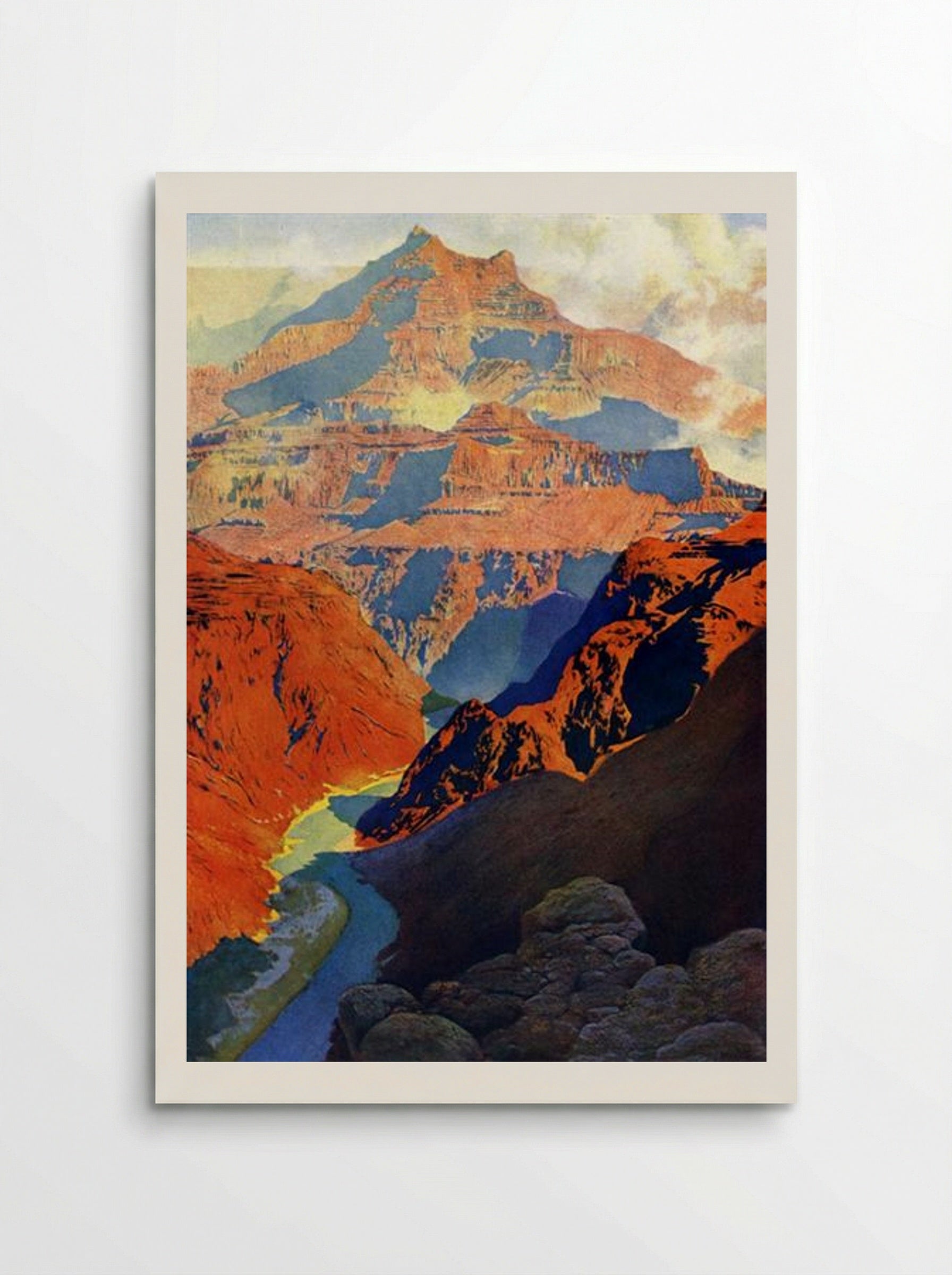
Grand Canyon - Maxfield Parrish
Archival giclée
Frames arrive ready to hang
Secure checkout
Made to order
Description
A luminous depiction of the Grand Canyon by American illustrator Maxfield Parrish, featuring his signature glazing technique and dramatic use of light.
Maxfield Parrish was commissioned by the Santa Fe Railway to produce a series of images depicting the American West, a project that resulted in this interpretation of the Grand Canyon. Parrish utilised his signature technique of glazing, which involved applying thin, transparent layers of oil paint over a white base. This method allowed light to reflect through the layers, creating a luminous quality that defined his commercial work during the early twentieth century. The composition employs a dramatic perspective, looking down into the gorge towards the Colorado River. Parrish balances the deep, shadowed foreground with the sun-drenched peaks in the distance. His use of colour is deliberate, contrasting the warm, saturated oranges and reds of the rock formations against the cool, deep blues of the shadows and the river. This specific approach to light and shadow creates a sense of depth that is characteristic of his approach to illustration. Unlike traditional plein air painters, Parrish often worked from photographs and architectural models to construct his scenes. This allowed him to manipulate the geometry of the canyon to suit his aesthetic preferences. The result is a highly stylised representation of the natural world, prioritising clarity and atmospheric effect over topographical accuracy. The work reflects the broader cultural interest in the American wilderness during the early 1900s, serving as a promotional tool for tourism in the region. The precision of the forms and the smooth application of paint demonstrate the technical discipline Parrish maintained throughout his career as an illustrator. This print captures the specific tonal range and clarity of the original board, providing a clear view of the artist's method for managing light and colour in a large-scale composition.
Return policy
Because every print is made to order, we don't offer change-of-mind returns, refunds or exchanges. If your order arrives faulty, damaged or incorrect, we'll replace it free of charge — just contact us within 48 hours of delivery. See our refunds page for full details.
Shipping
We ship worldwide, printing at the production hub nearest to your delivery address. Delivery times and costs vary by destination — you'll see the options available to you at checkout.
Manufacturing
Each print is produced to order using 12-colour giclée printing on FSC-certified archival paper. Designed in Britain and printed at your nearest production hub to reduce waste and speed up delivery.
Grand Canyon - Maxfield Parrish

Artist Biography
Maxfield Parrish
He called himself a mechanic who paints. Beneath his studio he built a workshop filled with machines, and used them to construct model scenes, props and lighting rigs for his paintings. The process was closer to set design than to plein air. He would build a miniature landscape, light it from specific angles, photograph it, then paint from the photograph using a layering technique borrowed from the Old Masters: thin coats of transparent oil glaze over a plaster base, each layer drying before the next, so the under-colours shone through. The method eliminated visible brushstrokes and produced a luminosity that looked like stained glass.
Daybreak, painted in 1922, became the most reproduced art print of the twentieth century. It outsold Warhol's Campbell's Soup Cans and Da Vinci's Last Supper in print form. By the mid-1920s it was estimated that one in four American households had a Parrish print on the wall. The image appeared in Terrence Malick's Badlands and inspired the poster for The Princess Bride. For three models he used his own daughter Jean, Kitty Owen (granddaughter of William Jennings Bryan), and his young nanny Susan Lewin.
In 1900, tuberculosis followed by a nervous breakdown forced him to stop working. The recovery period changed his technique: it was during this convalescence that he developed the glazing method that defined the rest of his career. He lived to ninety-five, painting until the last few years.
Our Features
Designed for Lasting Impact
Specific Features
Every Solis piece is made to order with archival, gallery-quality materials built to last.
- Museum-grade giclée printing for rich, fade-resistant colour
- Archival matte fine-art paper, FSC-certified
- Multiple sizes and framing options available
- Frames in black, natural wood, dark wood or white
- Framed prints arrive ready to hang
Care & Cleaning
To keep your artwork looking its best:
- Dust gently with a soft, dry cloth
- Avoid prolonged direct sunlight
- Never use liquid cleaners on the print or canvas surface
- Keep in a dry, room-temperature space
- Handle prints with clean, dry hands
Materials & Sizing
Museum-grade giclée on FSC-certified archival matte paper, with framed and canvas options.
- Paper sizes: A4, A3, A2, A1, A0 and B2 (50×70 cm)
- Canvas: XS (20×30 cm) to Large (60×90 cm)
- Frames: black, natural wood, dark wood or white
Why Choose Us ?
Damage-free delivery guarantee
Fast Shipping
Museum-Quality Materials
Artist Biography
Maxfield Parrish
He called himself a mechanic who paints. Beneath his studio he built a workshop filled with machines, and used them to construct model scenes, props and lighting rigs for his paintings. The process was closer to set design than to plein air. He would build a miniature landscape, light it from specific angles, photograph it, then paint from the photograph using a layering technique borrowed from the Old Masters: thin coats of transparent oil glaze over a plaster base, each layer drying before the next, so the under-colours shone through. The method eliminated visible brushstrokes and produced a luminosity that looked like stained glass.
Daybreak, painted in 1922, became the most reproduced art print of the twentieth century. It outsold Warhol's Campbell's Soup Cans and Da Vinci's Last Supper in print form. By the mid-1920s it was estimated that one in four American households had a Parrish print on the wall. The image appeared in Terrence Malick's Badlands and inspired the poster for The Princess Bride. For three models he used his own daughter Jean, Kitty Owen (granddaughter of William Jennings Bryan), and his young nanny Susan Lewin.
In 1900, tuberculosis followed by a nervous breakdown forced him to stop working. The recovery period changed his technique: it was during this convalescence that he developed the glazing method that defined the rest of his career. He lived to ninety-five, painting until the last few years.
You May Also Like