

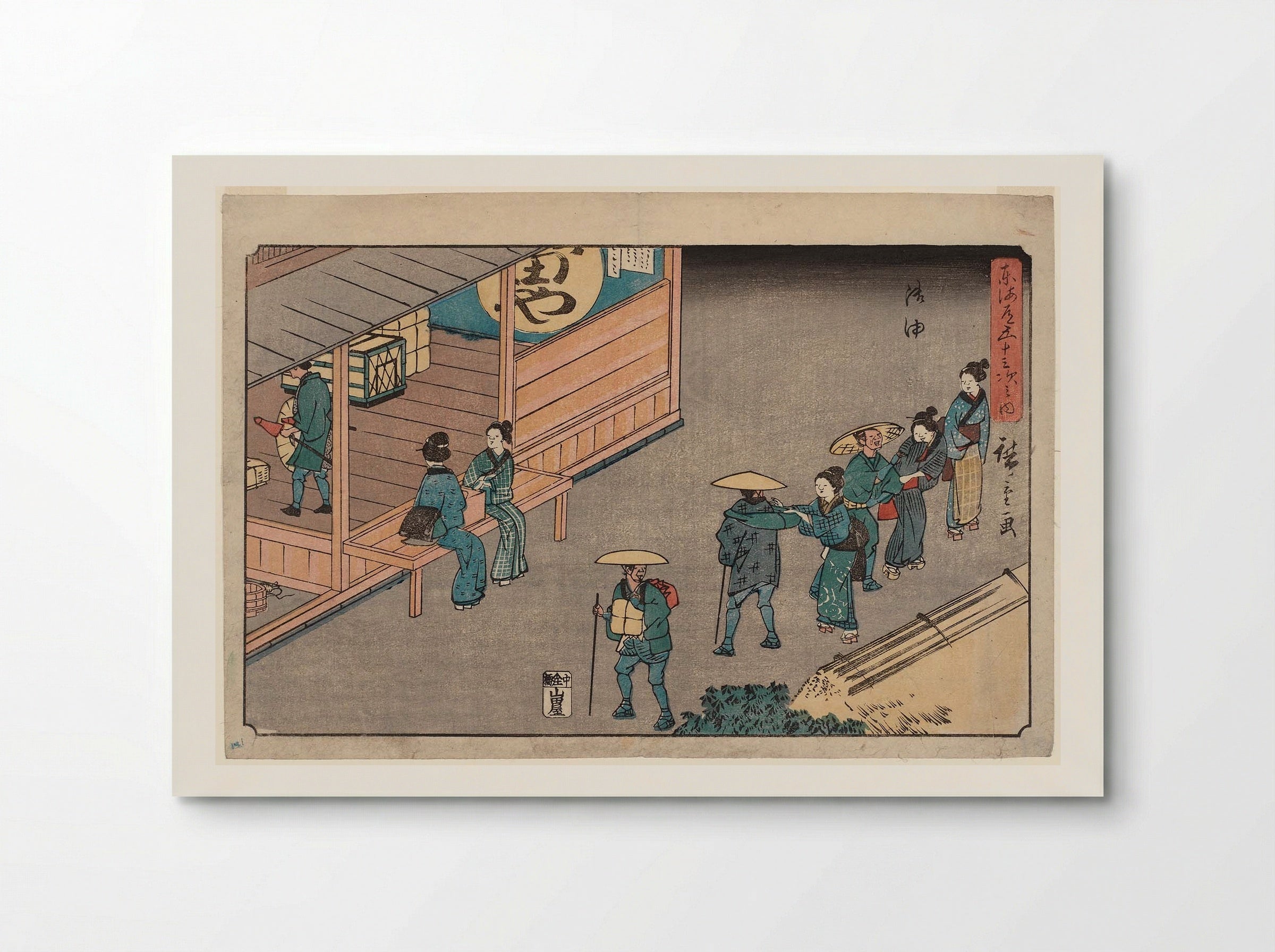
Goyu: Women Soliciting Travellers - Utagawa Hiroshige
Archival giclée
Frames arrive ready to hang
Secure checkout
Made to order
Description
A humorous woodblock print from Hiroshige's Tōkaidō series depicting inn servants in Goyu attempting to pull travellers into their lodgings at dusk.
This woodblock print depicts the station of Goyu, the thirty-fifth stop on the Tōkaidō road connecting Edo and Kyoto. Hiroshige focuses on a humorous genre scene rather than a purely naturalistic view. The composition centres on the aggressive tactics of the meshimori-onna, or inn servants, who attempt to drag weary travellers into their establishments for the night. The station of Goyu was located in present-day Aichi Prefecture. In this scene, Hiroshige provides a glimpse into the competitive nature of the hospitality industry during the Edo period. The women depicted are meshimori-onna, who worked as both waitresses and providers of other services at the lower-class inns. Their physical struggle with the travellers is a common theme in comic literature of the time, such as the Shank's Mare (Tōkaidōchū Hizakurige). The architectural elements create a strong diagonal line from the top left. This structure opens to reveal the interior of an inn where a guest is already settling in and washing his feet. Outside, the figures are caught in a tug-of-war. One traveller is pulled by his arms and luggage by two women, while another man walks past with a stoic expression. The use of bokashi (colour gradation) in the sky suggests the onset of evening, a time when competition between inns was most fierce. Hiroshige used a limited palette of indigo and earth tones to define the forms. The large circular sign hanging from the eaves identifies the establishment. Such signs were essential for attracting customers in the crowded station towns. The calligraphy on the right side of the print provides the series title and the station name, alongside the artist's signature. This print is an example of how ukiyo-e artists documented the social customs and daily lives of ordinary people. It remains a clear record of the bustling activity that defined the Tōkaidō road.
Return policy
Because every print is made to order, we don't offer change-of-mind returns, refunds or exchanges. If your order arrives faulty, damaged or incorrect, we'll replace it free of charge — just contact us within 48 hours of delivery. See our refunds page for full details.
Shipping
We ship worldwide, printing at the production hub nearest to your delivery address. Delivery times and costs vary by destination — you'll see the options available to you at checkout.
Manufacturing
Each print is produced to order using 12-colour giclée printing on FSC-certified archival paper. Designed in Britain and printed at your nearest production hub to reduce waste and speed up delivery.
Goyu: Women Soliciting Travellers - Utagawa Hiroshige
Our Features
Designed for Lasting Impact
Specific Features
Every Solis piece is made to order with archival, gallery-quality materials built to last.
- Museum-grade giclée printing for rich, fade-resistant colour
- Archival matte fine-art paper, FSC-certified
- Multiple sizes and framing options available
- Frames in black, natural wood, dark wood or white
- Framed prints arrive ready to hang
Care & Cleaning
To keep your artwork looking its best:
- Dust gently with a soft, dry cloth
- Avoid prolonged direct sunlight
- Never use liquid cleaners on the print or canvas surface
- Keep in a dry, room-temperature space
- Handle prints with clean, dry hands
Materials & Sizing
Museum-grade giclée on FSC-certified archival matte paper, with framed and canvas options.
- Paper sizes: A4, A3, A2, A1, A0 and B2 (50×70 cm)
- Canvas: XS (20×30 cm) to Large (60×90 cm)
- Frames: black, natural wood, dark wood or white
Why Choose Us ?
Damage-free delivery guarantee
Fast Shipping
Museum-Quality Materials
Artist Biography
Utagawa Hiroshige
You May Also Like