

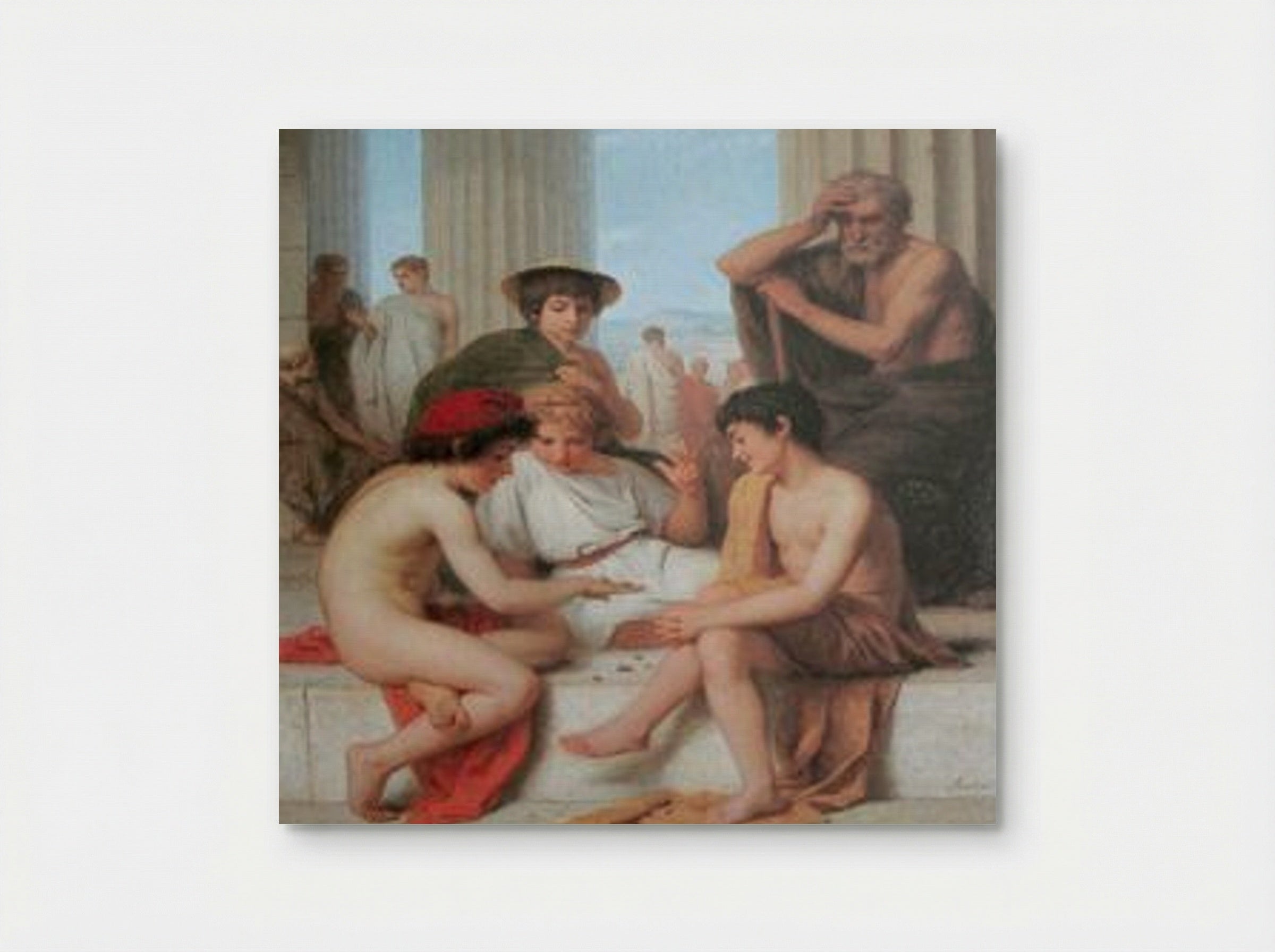
Die Knöchelspieler - Albert Anker
Archival giclée
Frames arrive ready to hang
Secure checkout
Made to order
Description
A 1864 oil painting by Albert Anker depicting youths playing an ancient game of knucklebones in a classical architectural setting.
Albert Anker painted Die Knöchelspieler in 1864 during a period when he frequently explored classical and historical themes. The work depicts a group of youths engaged in a game of knucklebones, an ancient pastime played with the small bones of sheep or goats. Anker places the scene against a backdrop of Doric columns and stone steps, suggesting a Mediterranean or Greek setting. This departure from his usual depictions of Swiss rural life demonstrates his formal training in Paris under Charles Gleyre. Gleyre was known for his preference for classical subjects, and his influence is visible in the clear outlines and balanced arrangement of this piece. The composition focuses on three boys in the foreground. One sits naked on a red cloth, reaching towards the small bones scattered on the stone. Another boy in a white tunic watches intently, while a third youth sits opposite them wrapped in a brown garment. An older, bearded man rests his head on his hand in the upper right, observing the game with a weary or contemplative expression. Other figures in classical dress move through the background, providing a sense of a populated public space. The inclusion of the older man provides a contrast between the fleeting play of youth and the stillness of age. Anker uses a restrained colour palette dominated by earthy ochres and terracotta tones. The light is soft and diffused, characteristic of his academic style. He pays close attention to the anatomy of the figures and the texture of the stone surfaces. This painting reflects the mid-nineteenth-century interest in antiquity and the daily lives of people in the ancient world. It is a quiet study of concentration and leisure. The artist avoids the dramatic narratives often found in history painting, preferring instead to capture a mundane moment from the past.
Return policy
Because every print is made to order, we don't offer change-of-mind returns, refunds or exchanges. If your order arrives faulty, damaged or incorrect, we'll replace it free of charge — just contact us within 48 hours of delivery. See our refunds page for full details.
Shipping
We ship worldwide, printing at the production hub nearest to your delivery address. Delivery times and costs vary by destination — you'll see the options available to you at checkout.
Manufacturing
Each print is produced to order using 12-colour giclée printing on FSC-certified archival paper. Designed in Britain and printed at your nearest production hub to reduce waste and speed up delivery.
Die Knöchelspieler - Albert Anker
Our Features
Designed for Lasting Impact
Specific Features
Every Solis piece is made to order with archival, gallery-quality materials built to last.
- Museum-grade giclée printing for rich, fade-resistant colour
- Archival matte fine-art paper, FSC-certified
- Multiple sizes and framing options available
- Frames in black, natural wood, dark wood or white
- Framed prints arrive ready to hang
Care & Cleaning
To keep your artwork looking its best:
- Dust gently with a soft, dry cloth
- Avoid prolonged direct sunlight
- Never use liquid cleaners on the print or canvas surface
- Keep in a dry, room-temperature space
- Handle prints with clean, dry hands
Materials & Sizing
Museum-grade giclée on FSC-certified archival matte paper, with framed and canvas options.
- Paper sizes: A4, A3, A2, A1, A0 and B2 (50×70 cm)
- Canvas: XS (20×30 cm) to Large (60×90 cm)
- Frames: black, natural wood, dark wood or white
Why Choose Us ?
Damage-free delivery guarantee
Fast Shipping
Museum-Quality Materials

Artist Biography
Albert Anker
You May Also Like