

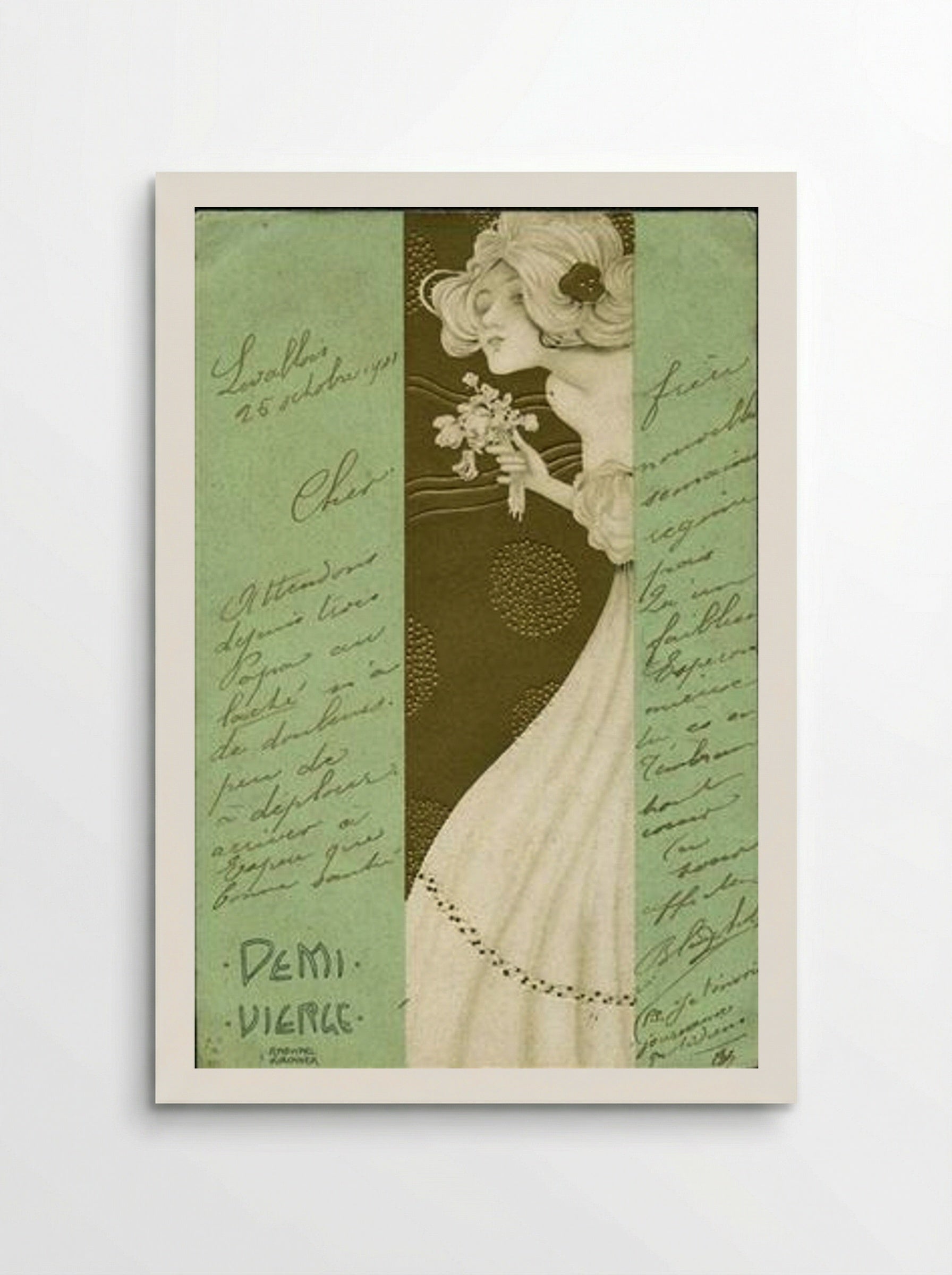
Demi-Vierge - Raphael Kirchner
Archival giclée
Frames arrive ready to hang
Secure checkout
Made to order
Description
An Art Nouveau illustration by Raphael Kirchner from 1901. It features a woman in profile within a vertical composition, flanked by sage green panels with handwritten French script.
Raphael Kirchner was an Austrian artist who became a leading figure in the postcard industry during the Belle Époque. This work, titled Demi-Vierge, is part of a series that gained popularity in Paris at the turn of the century. The composition follows a vertical format, divided into three distinct sections. The central panel contains the primary figure: a woman with pale skin and voluminous blonde hair. She holds a small bouquet of flowers and wears a white gown decorated with a delicate beaded trim. The background of the central section uses a dark olive or brown tone, featuring stylised patterns of dots and wavy lines. These elements are characteristic of the Jugendstil movement, which favoured organic forms and rhythmic patterns. The side panels are a pale sage green and contain handwritten French text. This specific print includes a date of 25 October 1901, providing a clear temporal context for its production and use. The handwritten text on the left and right margins adds a personal, historical layer to the image. These inscriptions are typical of the era when postcards were a primary mode of quick communication. The script is fluid and cursive, contrasting with the more structured, graphic elements of the central illustration. The title Demi-Vierge is visible at the bottom left, rendered in a stylised font that matches the overall Art Nouveau aesthetic. Kirchner's style is defined by a soft, almost ethereal treatment of the female form. He often depicted women with a specific type of idealised beauty that became known as the Kirchner Girl. This aesthetic influenced later pin-up art and commercial illustration. The use of flat colour fields and strong verticality reflects the influence of Japanese woodblock prints on European graphic arts during this period. This piece is a representative example of the intersection between fine art and mass-produced ephemera in the early twentieth century.
Return policy
Because every print is made to order, we don't offer change-of-mind returns, refunds or exchanges. If your order arrives faulty, damaged or incorrect, we'll replace it free of charge — just contact us within 48 hours of delivery. See our refunds page for full details.
Shipping
We ship worldwide, printing at the production hub nearest to your delivery address. Delivery times and costs vary by destination — you'll see the options available to you at checkout.
Manufacturing
Each print is produced to order using 12-colour giclée printing on FSC-certified archival paper. Designed in Britain and printed at your nearest production hub to reduce waste and speed up delivery.
Demi-Vierge - Raphael Kirchner

Artist Biography
Raphael Kirchner
He was born in Vienna in 1875, studied at the Academy of Fine Arts there, and moved to Paris in 1900. At the outbreak of the First World War he relocated to New York, where he spent his final years designing panels, costumes and programmes for Florenz Ziegfeld's Follies at the Century Theatre. He died in New York in 1917, at forty-two.
Our Features
Designed for Lasting Impact
Specific Features
Every Solis piece is made to order with archival, gallery-quality materials built to last.
- Museum-grade giclée printing for rich, fade-resistant colour
- Archival matte fine-art paper, FSC-certified
- Multiple sizes and framing options available
- Frames in black, natural wood, dark wood or white
- Framed prints arrive ready to hang
Care & Cleaning
To keep your artwork looking its best:
- Dust gently with a soft, dry cloth
- Avoid prolonged direct sunlight
- Never use liquid cleaners on the print or canvas surface
- Keep in a dry, room-temperature space
- Handle prints with clean, dry hands
Materials & Sizing
Museum-grade giclée on FSC-certified archival matte paper, with framed and canvas options.
- Paper sizes: A4, A3, A2, A1, A0 and B2 (50×70 cm)
- Canvas: XS (20×30 cm) to Large (60×90 cm)
- Frames: black, natural wood, dark wood or white
Why Choose Us ?
Damage-free delivery guarantee
Fast Shipping
Museum-Quality Materials
Artist Biography
Raphael Kirchner
He was born in Vienna in 1875, studied at the Academy of Fine Arts there, and moved to Paris in 1900. At the outbreak of the First World War he relocated to New York, where he spent his final years designing panels, costumes and programmes for Florenz Ziegfeld's Follies at the Century Theatre. He died in New York in 1917, at forty-two.
You May Also Like