

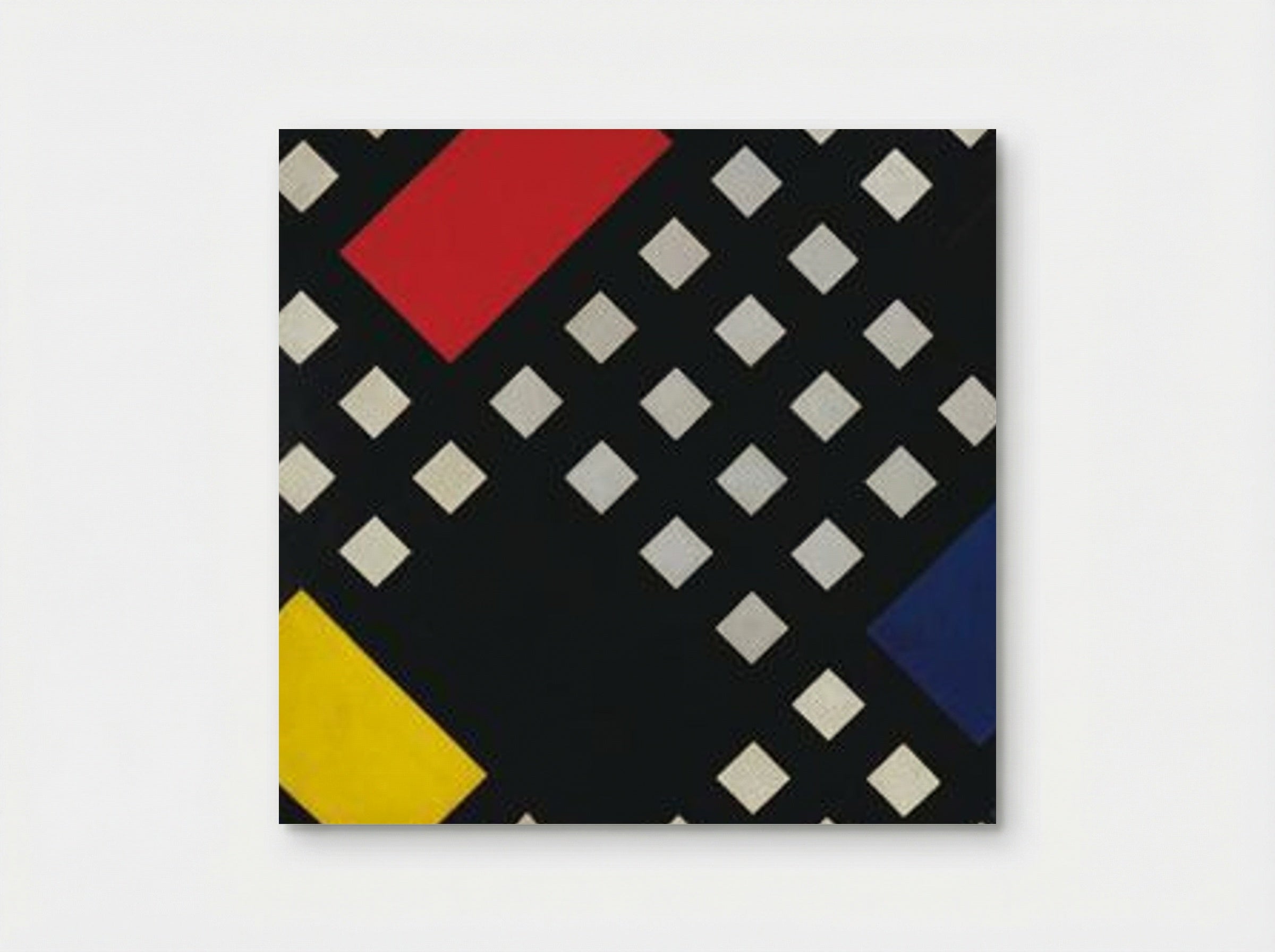
Counter-Composition XV - Theo van Doesburg
Archival giclée
Frames arrive ready to hang
Secure checkout
Made to order
Description
This abstract painting by Theo van Doesburg features a dynamic grid of white squares on a black background, overlaid with primary-coloured rectangles. 'Counter-Composition XV' exemplifies the De Stijl movement's focus on geometric forms and primary colours.
Theo van Doesburg, born Christiaan Emil Marie Küpper, was a Dutch artist, architect, and theorist. He is best known as a founder and leading figure of De Stijl, a Dutch artistic movement that advocated pure abstraction and universality by a reduction to the essentials of form and colour; he simplified visual compositions to vertical and horizontal directions, and used only primary colours along with black and white. Van Doesburg sought a total work of art that integrated all aspects of life and art. 'Counter-Composition XV' exemplifies van Doesburg's mature style. The painting features a grid of small, tilted squares in white against a black background. Overlaid on this grid are larger rectangles in primary colours: red, yellow, and blue. The composition is dynamic, with the tilted grid creating a sense of movement and instability. The use of primary colours and geometric shapes reflects the De Stijl aesthetic, aiming for a universal and harmonious visual language.
Return policy
Because every print is made to order, we don't offer change-of-mind returns, refunds or exchanges. If your order arrives faulty, damaged or incorrect, we'll replace it free of charge — just contact us within 48 hours of delivery. See our refunds page for full details.
Shipping
We ship worldwide, printing at the production hub nearest to your delivery address. Delivery times and costs vary by destination — you'll see the options available to you at checkout.
Manufacturing
Each print is produced to order using 12-colour giclée printing on FSC-certified archival paper. Designed in Britain and printed at your nearest production hub to reduce waste and speed up delivery.
Care and materials
Specific Features
Every Solis piece is made to order with archival, gallery-quality materials built to last.
- Museum-grade giclée printing for rich, fade-resistant colour
- Archival matte fine-art paper, FSC-certified
- Multiple sizes and framing options available
- Frames in black, natural wood, dark wood or white
- Framed prints arrive ready to hang
Care & Cleaning
To keep your artwork looking its best:
- Dust gently with a soft, dry cloth
- Avoid prolonged direct sunlight
- Never use liquid cleaners on the print or canvas surface
- Keep in a dry, room-temperature space
- Handle prints with clean, dry hands
Materials & Sizing
Museum-grade giclée on FSC-certified archival matte paper, with framed and canvas options.
- Paper sizes: A4, A3, A2, A1, A0 and B2 (50×70 cm)
- Canvas: XS (20×30 cm) to Large (60×90 cm)
- Frames: black, natural wood, dark wood or white
Counter-Composition XV - Theo van Doesburg

Artist Biography
Theo Van Doesburg
He was born in Utrecht in 1883. After encountering Mondrian's work around 1915, he sought him out and together they launched the magazine De Stijl in 1917, along with Bart van der Leck, Vilmos Huszar, J.J.P. Oud and Antony Kok. Van Doesburg was the movement's organiser, publicist and ambassador, travelling across Europe to promote Neoplasticism while Mondrian stayed in his studio.
In 1922 he moved to Weimar and set up an unofficial school near the Bauhaus to attract students to Constructivist and De Stijl ideas. Walter Gropius acknowledged the influence but refused to give Van Doesburg a teaching post. The rivalry was productive: Bauhaus design absorbed De Stijl principles without crediting the source.
The break with Mondrian came over diagonals. Mondrian insisted on strictly horizontal and vertical lines; Van Doesburg introduced the diagonal in his Counter-Compositions, arguing for dynamic rather than static geometry. They stopped speaking. In 1929 they met accidentally in a Paris cafe and reconciled.
He married three times. His third wife, Nelly van Moorsel, was an artist, pianist and choreographer. He died in Davos in 1931, at forty-seven, from a heart attack. De Stijl ended with him.
Why Choose Us ?
Damage-free delivery guarantee
Fast Shipping
Museum-Quality Materials
You May Also Like