

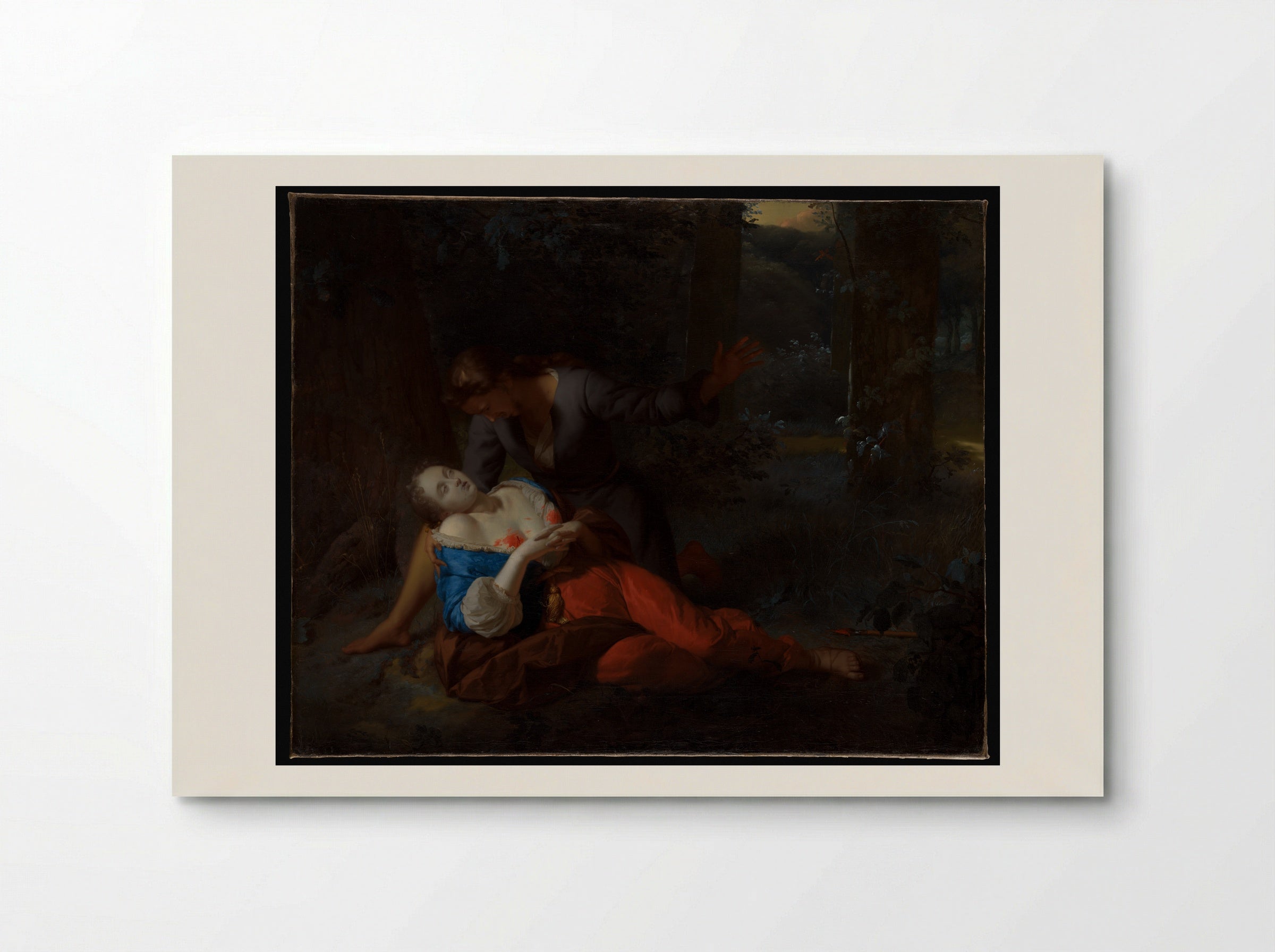
Cephalus and Procris - Godfried Schalcken
Archival giclée
Frames arrive ready to hang
Secure checkout
Made to order
Description
A dramatic scene from Ovid's "Metamorphoses", Godfried Schalcken's "Cephalus and Procris" captures the tragic moment of Procris' accidental death, rendered with chiaroscuro and emotional intensity.
Godfried Schalcken's "Cephalus and Procris" depicts a tragic scene from Ovid's "Metamorphoses". The painting shows the aftermath of Procris' accidental death, caused by her husband Cephalus. The narrative unfolds in a dimly lit forest, enhancing the drama and emotional intensity of the moment. Procris lies dying in Cephalus' arms, an arrow piercing her chest, while Cephalus gestures in despair, realising the fatal error. Schalcken's use of chiaroscuro, with strong contrasts between light and shadow, heightens the emotional impact of the scene. The figures are rendered with careful attention to detail, capturing their expressions of grief and remorse. The composition draws the viewer into the heart of the tragedy, inviting contemplation on themes of love, loss, and human fallibility. The dark background and muted colours contribute to the overall sombre mood, reflecting the gravity of the event. Schalcken's work exemplifies the Dutch Golden Age's interest in classical mythology and its ability to convey complex human emotions through visual storytelling.
Return policy
Because every print is made to order, we don't offer change-of-mind returns, refunds or exchanges. If your order arrives faulty, damaged or incorrect, we'll replace it free of charge — just contact us within 48 hours of delivery. See our refunds page for full details.
Shipping
We ship worldwide, printing at the production hub nearest to your delivery address. Delivery times and costs vary by destination — you'll see the options available to you at checkout.
Manufacturing
Each print is produced to order using 12-colour giclée printing on FSC-certified archival paper. Designed in Britain and printed at your nearest production hub to reduce waste and speed up delivery.
Care and materials
Specific Features
Every Solis piece is made to order with archival, gallery-quality materials built to last.
- Museum-grade giclée printing for rich, fade-resistant colour
- Archival matte fine-art paper, FSC-certified
- Multiple sizes and framing options available
- Frames in black, natural wood, dark wood or white
- Framed prints arrive ready to hang
Care & Cleaning
To keep your artwork looking its best:
- Dust gently with a soft, dry cloth
- Avoid prolonged direct sunlight
- Never use liquid cleaners on the print or canvas surface
- Keep in a dry, room-temperature space
- Handle prints with clean, dry hands
Materials & Sizing
Museum-grade giclée on FSC-certified archival matte paper, with framed and canvas options.
- Paper sizes: A4, A3, A2, A1, A0 and B2 (50×70 cm)
- Canvas: XS (20×30 cm) to Large (60×90 cm)
- Frames: black, natural wood, dark wood or white
Cephalus and Procris - Godfried Schalcken

Artist Biography
Godfried Schalcken
He was born in Made, North Brabant, in 1643, the son of a Latin school rector. He studied under Samuel van Hoogstraten in Dordrecht, then under Gerrit Dou in Leiden, absorbing the highly polished manner of the Leiden fijnschilders. He worked in Leiden, Dordrecht and The Hague, painting genre scenes, portraits and candlelit compositions.
In 1692 he sailed to England hoping to become court painter to William and Mary. He produced unusually large canvases to compete with the incumbent Sir Godfrey Kneller, but the appointment never came. He also served as court painter to the Elector Palatine in Dusseldorf. His atmospheric work inspired Sheridan Le Fanu's gothic horror story Strange Event in the Life of Schalken the Painter, later adapted by the BBC in 1979. He married Francoise van Diemen in 1679 and had seven children, though only one daughter survived to adulthood. He died in The Hague in 1706.
Why Choose Us ?
Damage-free delivery guarantee
Fast Shipping
Museum-Quality Materials
You May Also Like