

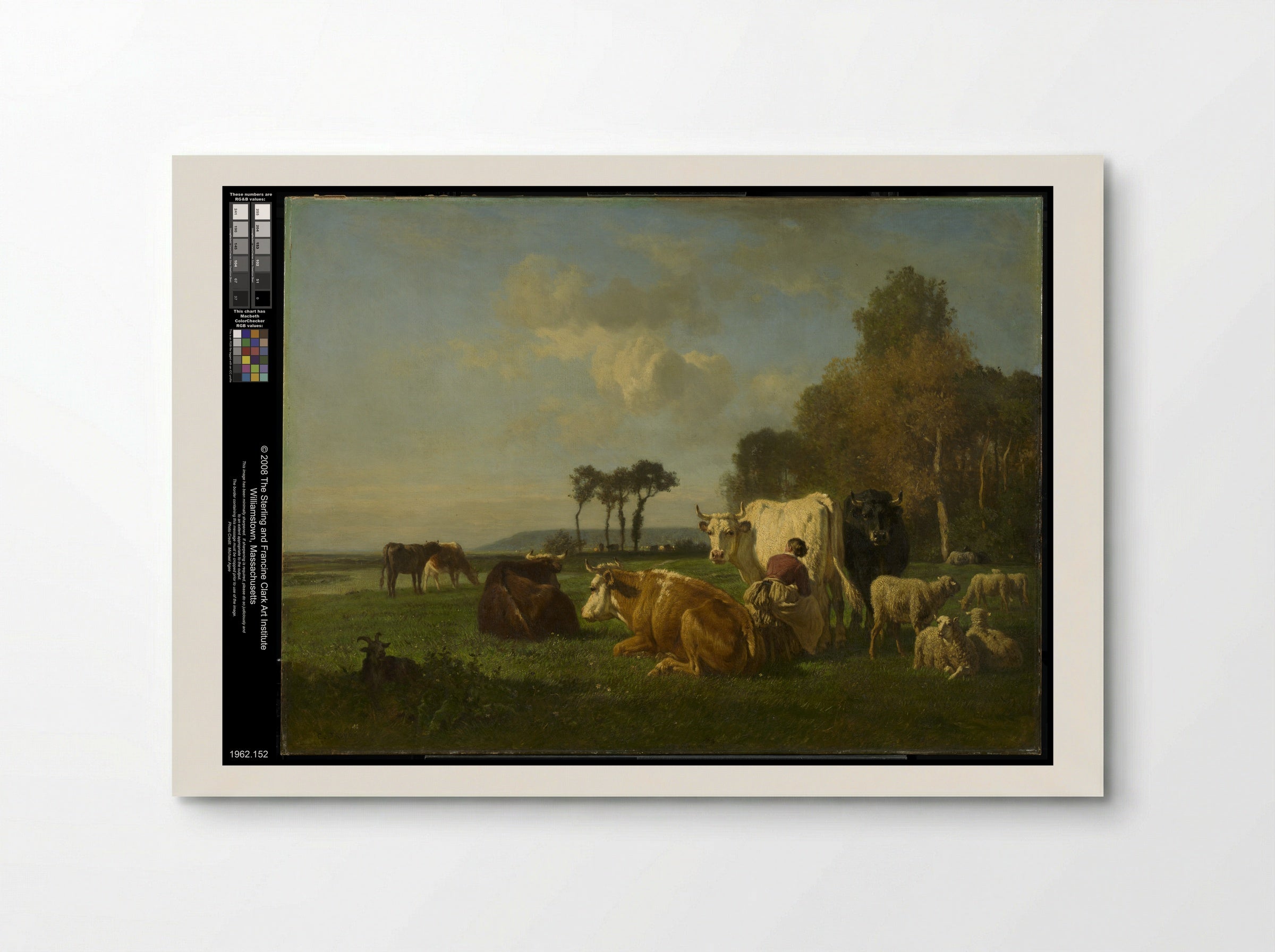
Cattle and Sheep in a Pasture - Constant Troyon
Archival giclée
Frames arrive ready to hang
Secure checkout
Made to order
Description
A pastoral scene by Constant Troyon featuring cattle and sheep in a French field, painted in the style of the Barbizon School.
Constant Troyon, a member of the Barbizon School, produced this work during the mid-nineteenth century. The composition focuses on a group of livestock resting in a verdant field, a subject that occupied much of his career after his travels to the Netherlands, where he studied the works of seventeenth-century Dutch masters such as Paulus Potter and Aelbert Cuyp. The painting demonstrates his ability to integrate animal subjects into a broader atmospheric setting. The scene is dominated by a large white cow, a dark bull, and several smaller cattle and sheep, all rendered with careful attention to their physical presence and texture. A figure, likely a shepherdess, is positioned near the centre, providing a sense of scale and human activity within the rural environment. The background features a low horizon line, allowing the expansive sky to occupy a significant portion of the canvas. The clouds are painted with soft, diffused light, suggesting a calm day in the French countryside. Troyon was known for his technical proficiency in handling oil paint, particularly in the way he captured the play of light across the animals' hides and the surrounding grass. The palette consists of earthy tones, including ochre, deep brown, and muted greens, contrasted against the pale blue of the sky. This work reflects the Barbizon School's interest in direct observation of nature and the rural life of France, moving away from the rigid historical subjects favoured by the contemporary Academy. The painting is held in the collection of the Sterling and Francine Clark Art Institute, where it is recognised for its balanced composition and technical execution.
Return policy
Because every print is made to order, we don't offer change-of-mind returns, refunds or exchanges. If your order arrives faulty, damaged or incorrect, we'll replace it free of charge — just contact us within 48 hours of delivery. See our refunds page for full details.
Shipping
We ship worldwide, printing at the production hub nearest to your delivery address. Delivery times and costs vary by destination — you'll see the options available to you at checkout.
Manufacturing
Each print is produced to order using 12-colour giclée printing on FSC-certified archival paper. Designed in Britain and printed at your nearest production hub to reduce waste and speed up delivery.
Care and materials
Specific Features
Every Solis piece is made to order with archival, gallery-quality materials built to last.
- Museum-grade giclée printing for rich, fade-resistant colour
- Archival matte fine-art paper, FSC-certified
- Multiple sizes and framing options available
- Frames in black, natural wood, dark wood or white
- Framed prints arrive ready to hang
Care & Cleaning
To keep your artwork looking its best:
- Dust gently with a soft, dry cloth
- Avoid prolonged direct sunlight
- Never use liquid cleaners on the print or canvas surface
- Keep in a dry, room-temperature space
- Handle prints with clean, dry hands
Materials & Sizing
Museum-grade giclée on FSC-certified archival matte paper, with framed and canvas options.
- Paper sizes: A4, A3, A2, A1, A0 and B2 (50×70 cm)
- Canvas: XS (20×30 cm) to Large (60×90 cm)
- Frames: black, natural wood, dark wood or white
Cattle and Sheep in a Pasture - Constant Troyon

Artist Biography
Constant Troyon
He was born in Sevres in 1810. His father worked at the famous porcelain manufactory, and the boy entered the ateliers young, spending years learning the minute decorative skills of porcelain painting. The precision served him well but took years to shake off. His early landscapes were tight and conventional.
The breakthrough came in 1846, when he travelled to the Netherlands and saw Paulus Potter's The Young Bull at the Hague, along with Cuyp's sunny landscapes and Rembrandt. He returned to France with a new approach: larger canvases, freer brushwork, and cattle as the central subject. Within a few years he was the leading animal painter in France, decorated with the Legion of Honour, five times a medallist at the Paris Salon, and collected by Napoleon III.
All his best pictures date from between 1850 and 1864. Success came late, and he never quite believed in it; even when he could command the market of several countries, he complained about his treatment. His mother, who survived him, established the Troyon prize for animal painting at the Ecole des Beaux-Arts. He died in Paris in 1865, at fifty-four, unmarried, after a period of deteriorating mental health.
Why Choose Us ?
Damage-free delivery guarantee
Fast Shipping
Museum-Quality Materials
You May Also Like