

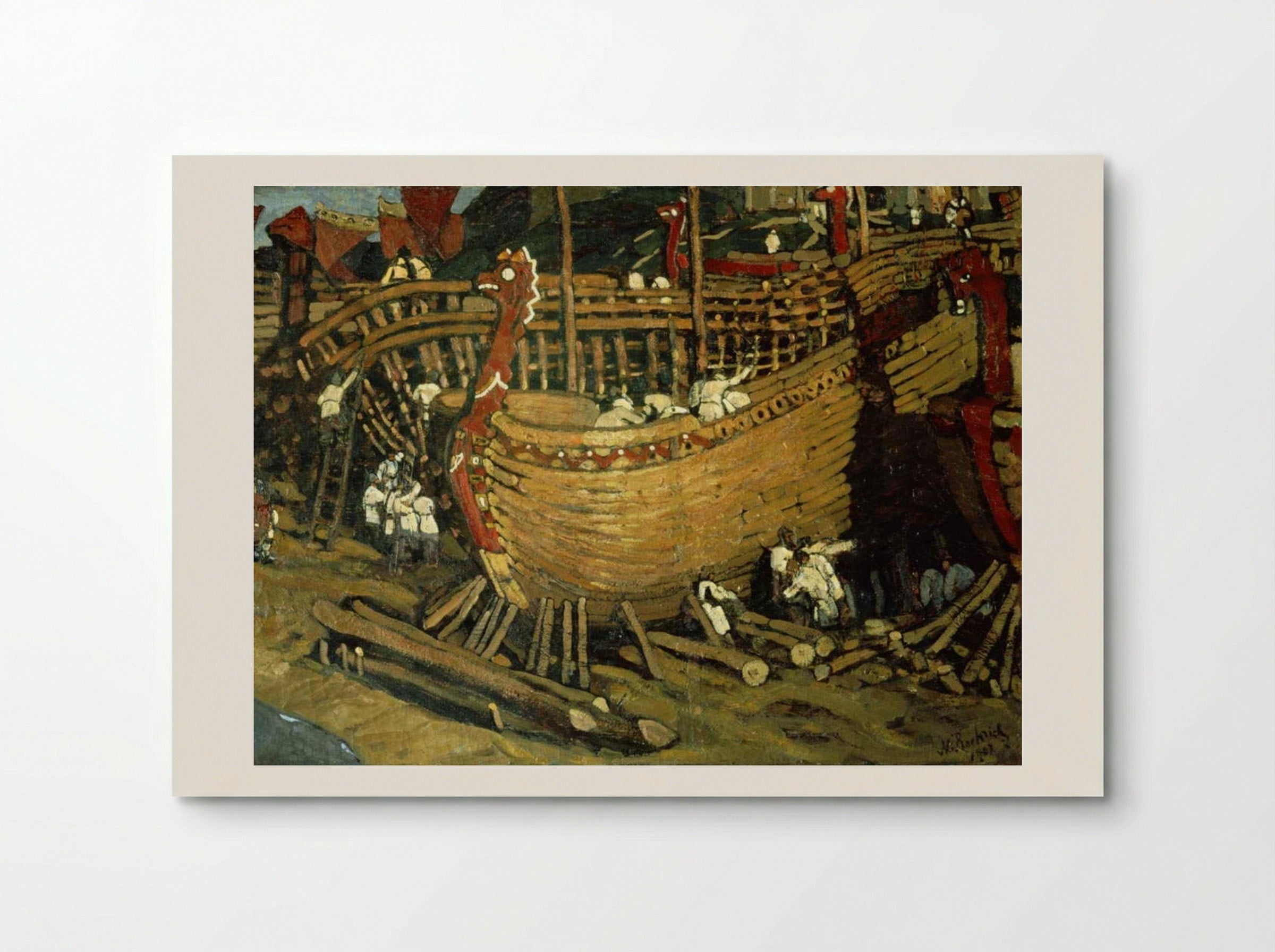
Building the Ships - Nicholas Roerich
Archival giclée
Frames arrive ready to hang
Secure checkout
Made to order
Description
A depiction of historical shipbuilding by Nicholas Roerich, featuring earthy tones and a focus on the rhythmic process of construction.
Nicholas Roerich produced this work during his early period, a time when he focused on the ancient history of the Slavic people. The composition depicts the construction of traditional wooden vessels, likely referencing the Viking-era ships that navigated the rivers of early Russia. Roerich employs a flattened perspective, which draws attention to the rhythmic arrangement of the timber hulls and the repetitive actions of the workers. The colour palette is dominated by earthy tones, reflecting the raw materials of wood and soil. The red accents on the prow of the ships provide a visual contrast against the muted browns and greys of the construction site. Roerich uses thick, deliberate brushwork to define the forms, giving the scene a tactile quality. The figures are rendered with minimal detail, functioning as components of the larger structural arrangement rather than as individual portraits. This painting reflects Roerich's interest in the synthesis of archaeology and art. He often sought to capture the spirit of ancient life through simplified forms and a focus on communal labour. The scene avoids unnecessary ornamentation, allowing the viewer to focus on the scale and process of the shipbuilding. The work is characteristic of his early style, which moved away from academic realism toward a more decorative and symbolic interpretation of historical subjects. By stripping away extraneous detail, Roerich creates a sense of timelessness, suggesting that this activity is part of a recurring cycle in human history. The composition is balanced, with the vertical lines of the scaffolding and the curved forms of the ships creating a sense of order amidst the busy scene of manual work.
Return policy
Because every print is made to order, we don't offer change-of-mind returns, refunds or exchanges. If your order arrives faulty, damaged or incorrect, we'll replace it free of charge — just contact us within 48 hours of delivery. See our refunds page for full details.
Shipping
We ship worldwide, printing at the production hub nearest to your delivery address. Delivery times and costs vary by destination — you'll see the options available to you at checkout.
Manufacturing
Each print is produced to order using 12-colour giclée printing on FSC-certified archival paper. Designed in Britain and printed at your nearest production hub to reduce waste and speed up delivery.
Building the Ships - Nicholas Roerich

Artist Biography
Nicholas Roerich
He was born in St Petersburg in 1874 and studied law and art simultaneously before choosing art. After the Revolution, he left Russia and eventually settled in the Kullu Valley of India, where he established a research institute. His paintings of Central Asian mountains, produced in enormous quantities, glow with a flat, saturated colour that reflects his interest in theosophy and Eastern spiritual traditions.
The Roerich Pact, his treaty for protecting cultural sites during wartime, was the precursor to the 1954 Hague Convention. He died in Naggar, Himachal Pradesh, in 1947, at seventy-three.
Our Features
Designed for Lasting Impact
Specific Features
Every Solis piece is made to order with archival, gallery-quality materials built to last.
- Museum-grade giclée printing for rich, fade-resistant colour
- Archival matte fine-art paper, FSC-certified
- Multiple sizes and framing options available
- Frames in black, natural wood, dark wood or white
- Framed prints arrive ready to hang
Care & Cleaning
To keep your artwork looking its best:
- Dust gently with a soft, dry cloth
- Avoid prolonged direct sunlight
- Never use liquid cleaners on the print or canvas surface
- Keep in a dry, room-temperature space
- Handle prints with clean, dry hands
Materials & Sizing
Museum-grade giclée on FSC-certified archival matte paper, with framed and canvas options.
- Paper sizes: A4, A3, A2, A1, A0 and B2 (50×70 cm)
- Canvas: XS (20×30 cm) to Large (60×90 cm)
- Frames: black, natural wood, dark wood or white
Why Choose Us ?
Damage-free delivery guarantee
Fast Shipping
Museum-Quality Materials
Artist Biography
Nicholas Roerich
He was born in St Petersburg in 1874 and studied law and art simultaneously before choosing art. After the Revolution, he left Russia and eventually settled in the Kullu Valley of India, where he established a research institute. His paintings of Central Asian mountains, produced in enormous quantities, glow with a flat, saturated colour that reflects his interest in theosophy and Eastern spiritual traditions.
The Roerich Pact, his treaty for protecting cultural sites during wartime, was the precursor to the 1954 Hague Convention. He died in Naggar, Himachal Pradesh, in 1947, at seventy-three.
You May Also Like