

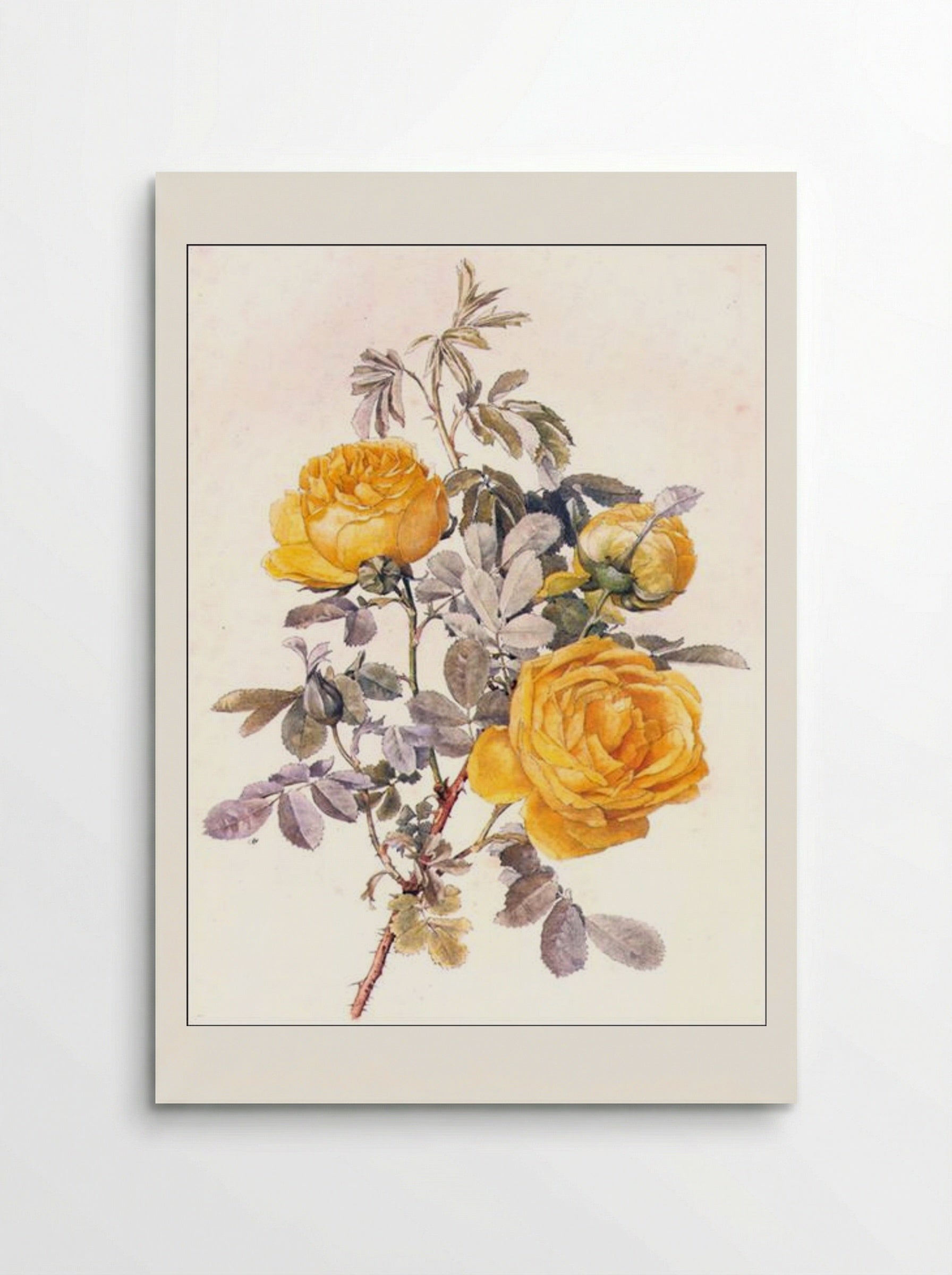
Botanical Illustration of Yellow Roses - Alfred Parsons
Archival giclée
Frames arrive ready to hang
Secure checkout
Made to order
Description
A watercolour botanical illustration by Alfred Parsons shows a cluster of yellow roses with detailed petals and muted green leaves, reflecting Victorian interest in natural history.
This botanical illustration features a cluster of yellow roses, meticulously rendered in watercolour. The composition centres on the blooms, each depicted with careful attention to form and detail. The petals display subtle gradations of colour, capturing the light and shadow that define their shape. The leaves, rendered in muted greens and greys, provide a soft backdrop, their delicate veins adding to the overall sense of realism. The stems, with their thorns, add a touch of wildness to the composition. Alfred Parsons (1847-1920) was an English artist, known for his illustrations and garden designs. He collaborated with William Robinson on *The English Flower Garden*, and his detailed botanical illustrations were highly regarded. Parsons's work often combined artistic skill with scientific observation, reflecting the Victorian interest in natural history and the aesthetic movement's appreciation for beauty in the natural world. His illustrations contributed to the popularisation of gardening and the appreciation of flowers as subjects for art.
Return policy
Because every print is made to order, we don't offer change-of-mind returns, refunds or exchanges. If your order arrives faulty, damaged or incorrect, we'll replace it free of charge — just contact us within 48 hours of delivery. See our refunds page for full details.
Shipping
We ship worldwide, printing at the production hub nearest to your delivery address. Delivery times and costs vary by destination — you'll see the options available to you at checkout.
Manufacturing
Each print is produced to order using 12-colour giclée printing on FSC-certified archival paper. Designed in Britain and printed at your nearest production hub to reduce waste and speed up delivery.
Care and materials
Specific Features
Every Solis piece is made to order with archival, gallery-quality materials built to last.
- Museum-grade giclée printing for rich, fade-resistant colour
- Archival matte fine-art paper, FSC-certified
- Multiple sizes and framing options available
- Frames in black, natural wood, dark wood or white
- Framed prints arrive ready to hang
Care & Cleaning
To keep your artwork looking its best:
- Dust gently with a soft, dry cloth
- Avoid prolonged direct sunlight
- Never use liquid cleaners on the print or canvas surface
- Keep in a dry, room-temperature space
- Handle prints with clean, dry hands
Materials & Sizing
Museum-grade giclée on FSC-certified archival matte paper, with framed and canvas options.
- Paper sizes: A4, A3, A2, A1, A0 and B2 (50×70 cm)
- Canvas: XS (20×30 cm) to Large (60×90 cm)
- Frames: black, natural wood, dark wood or white
Botanical Illustration of Yellow Roses - Alfred Parsons

Artist Biography
Alfred Parsons
It was his eye for gardens that set him apart. Parsons had a genuine feeling for the way English cottage and manor gardens worked: their colour sequences, their relationship to the surrounding landscape, the social world they implied. His collaboration with the gardening writer E.T. Cook on articles for various publications developed into a consistent visual language for the late Victorian garden, and his paintings were sought after by the country-house owners whose properties he depicted.
In 1891 he contributed illustrations to Henry James's collection of essays A Little Tour in France, though gardens rather than buildings remained his primary subject. He was elected to the Royal Academy in 1911. Parsons also designed gardens professionally, most notably The Courts in Wiltshire, which he began laying out around 1900 and which passed eventually to the National Trust.
His watercolours have a directness that reads as almost modern: flat washes, clear light, plants described with botanical accuracy but without preciousness. He died in Broadway, Worcestershire in 1920, having spent many years in that colony of Anglo-American artists centred on John Singer Sargent and Francis Millet.
Why Choose Us ?
Damage-free delivery guarantee
Fast Shipping
Museum-Quality Materials
You May Also Like