

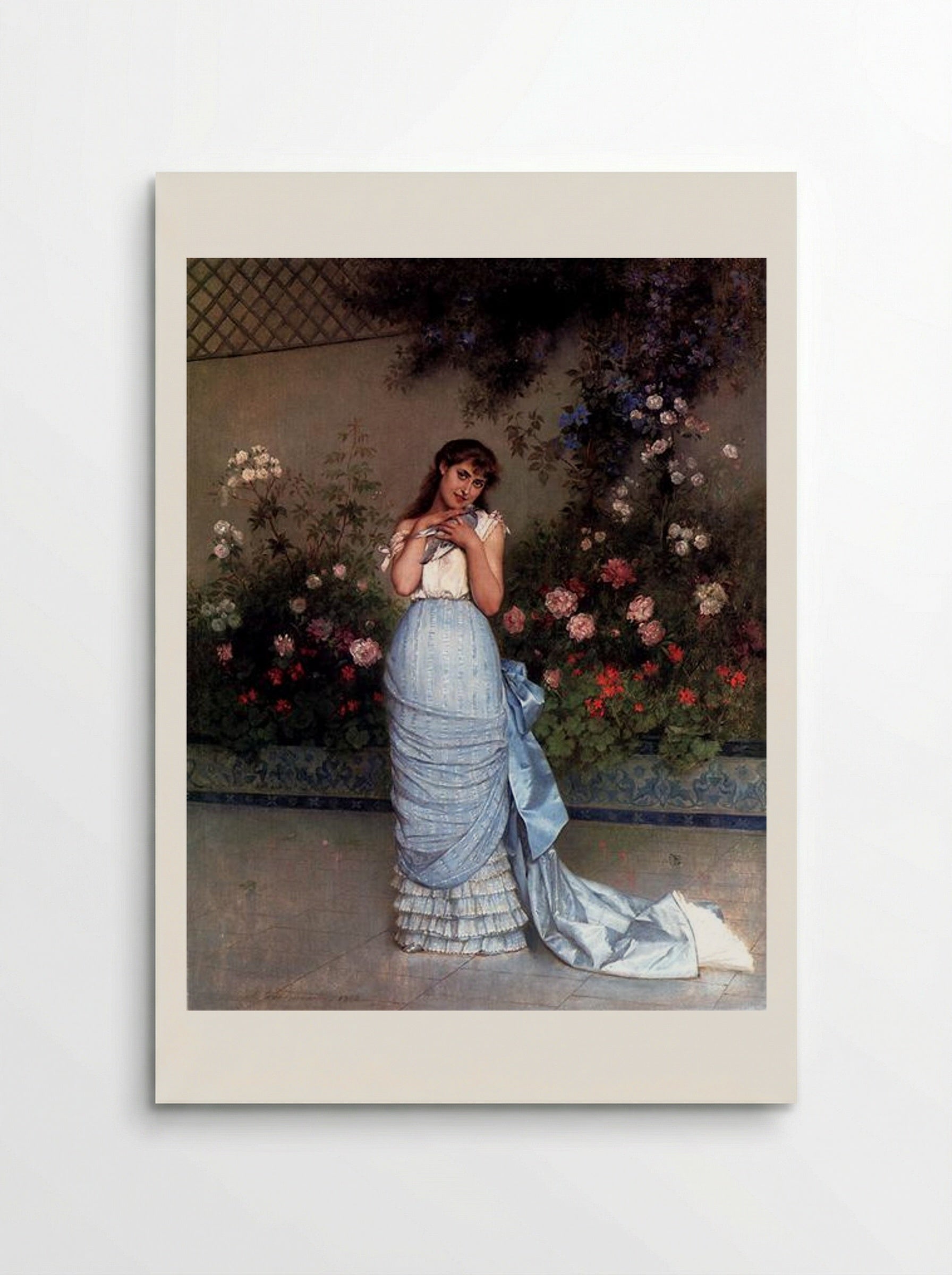
An Elegant Beauty - Auguste Toulmouche
Archival giclée
Frames arrive ready to hang
Secure checkout
Made to order
Description
A portrait of a woman in a pale blue silk gown, set against a lush floral backdrop, painted by the French Academic artist Auguste Toulmouche.
Auguste Toulmouche, a French painter associated with the Academic tradition, produced this work in 1882. The painting depicts a young woman standing in a garden setting, holding a small bird against her chest. She wears a voluminous, pale blue gown with a long train, featuring layers of ruffles at the hem. The fabric of the dress is rendered with attention to the sheen and texture of silk, a hallmark of Toulmouche's technical approach to nineteenth-century fashion. The figure is positioned centrally, framed by dense clusters of roses and other flowering plants. The background suggests a controlled, domestic garden environment, with a trellis visible at the top left. The artist employs a smooth brushwork technique, characteristic of the Salon painters of the period, which prioritises clarity of form and a polished surface finish. The lighting is soft, illuminating the subject while maintaining a balanced tone across the composition. Toulmouche was known for his depictions of the Parisian bourgeoisie, often focusing on the domestic lives and leisure activities of women. His works frequently feature elaborate costumes and carefully arranged interiors or gardens. This piece reflects the artist's interest in the intersection of portraiture and genre painting, where the subject is presented as an idealised figure within a curated space. The inclusion of the bird adds a narrative element, suggesting a moment of quiet interaction or sentimentality. The colour palette is dominated by cool blues and the varied hues of the floral backdrop, creating a harmonious visual experience. The work remains a representative example of the aesthetic preferences of the French upper-middle class during the late nineteenth century, focusing on refinement, material detail, and the display of contemporary dress.
Return policy
Because every print is made to order, we don't offer change-of-mind returns, refunds or exchanges. If your order arrives faulty, damaged or incorrect, we'll replace it free of charge — just contact us within 48 hours of delivery. See our refunds page for full details.
Shipping
We ship worldwide, printing at the production hub nearest to your delivery address. Delivery times and costs vary by destination — you'll see the options available to you at checkout.
Manufacturing
Each print is produced to order using 12-colour giclée printing on FSC-certified archival paper. Designed in Britain and printed at your nearest production hub to reduce waste and speed up delivery.
Care and materials
Specific Features
Every Solis piece is made to order with archival, gallery-quality materials built to last.
- Museum-grade giclée printing for rich, fade-resistant colour
- Archival matte fine-art paper, FSC-certified
- Multiple sizes and framing options available
- Frames in black, natural wood, dark wood or white
- Framed prints arrive ready to hang
Care & Cleaning
To keep your artwork looking its best:
- Dust gently with a soft, dry cloth
- Avoid prolonged direct sunlight
- Never use liquid cleaners on the print or canvas surface
- Keep in a dry, room-temperature space
- Handle prints with clean, dry hands
Materials & Sizing
Museum-grade giclée on FSC-certified archival matte paper, with framed and canvas options.
- Paper sizes: A4, A3, A2, A1, A0 and B2 (50×70 cm)
- Canvas: XS (20×30 cm) to Large (60×90 cm)
- Frames: black, natural wood, dark wood or white
An Elegant Beauty - Auguste Toulmouche

Artist Biography
Auguste Toulmouche
Born in Nantes in 1829, Toulmouche studied at the École des Beaux-Arts under Thomas Couture, painter of *Romans of the Decadence*. It was through family connections that the young Claude Monet, arriving in Paris in 1862, came to Toulmouche's studio and was directed on to Charles Gleyre's atelier, where Monet met Renoir, Sisley, and Bazille. That brief intersection with Impressionism's future is now the most-cited fact in Toulmouche's biography, which says something about how thoroughly the academic tradition he represented was superseded by the movement it inadvertently helped to launch.
Toulmouche was awarded the Légion d'honneur and produced work that remained commercially popular throughout his lifetime. Later critics placed him alongside Jean Béraud and Raffaelli as painters whose primary interest lies in the period record they provide: precise documentation of the clothes, furnishings, and domestic arrangements of bourgeois Parisian life in the Second Empire and early Third Republic. He died in Paris in 1890.
Why Choose Us ?
Damage-free delivery guarantee
Fast Shipping
Museum-Quality Materials
You May Also Like