

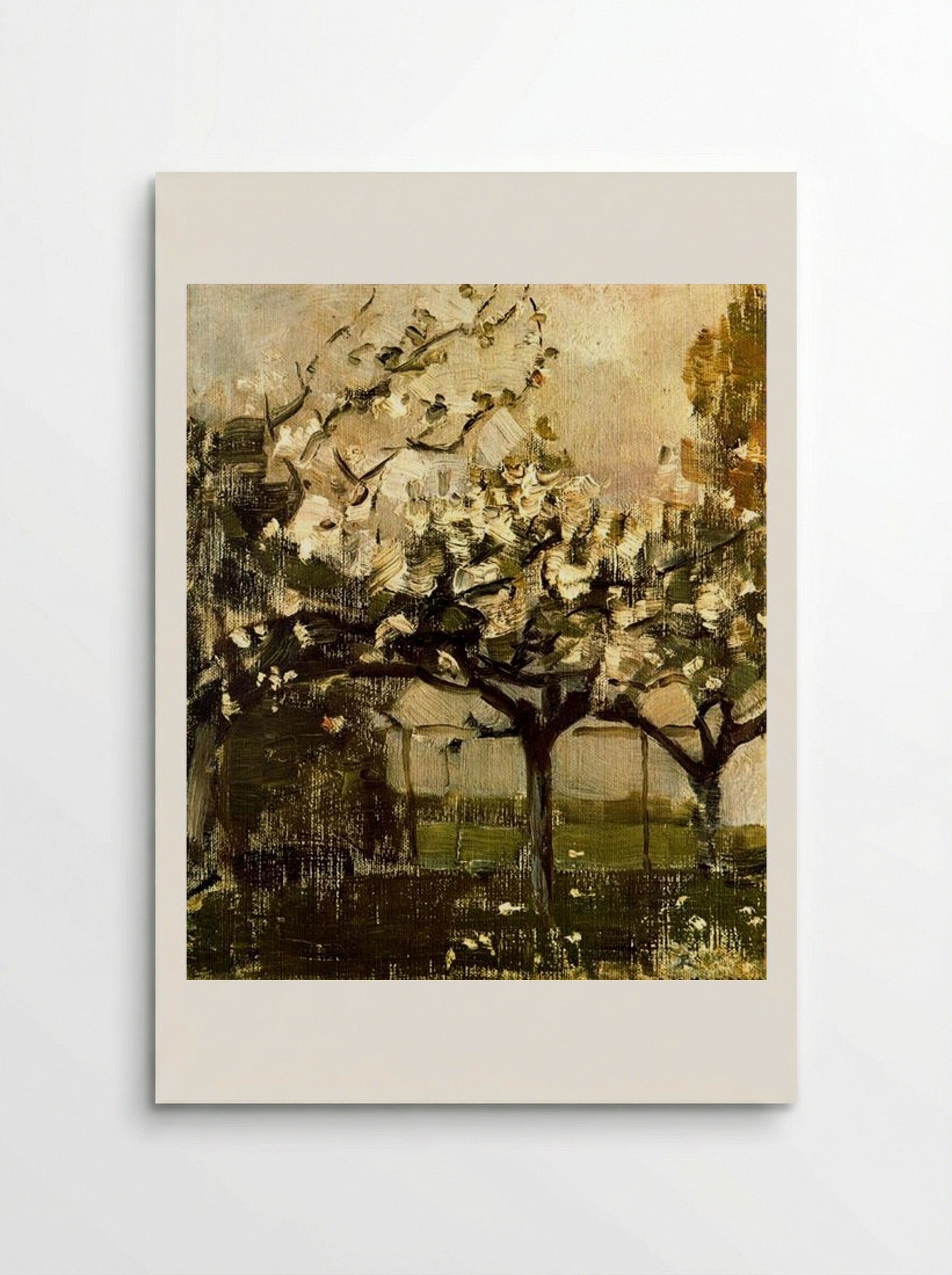
Alberi (Trees) - Piet Mondrian
Archival giclée
Frames arrive ready to hang
Secure checkout
Made to order
Description
An early work by Piet Mondrian, this piece captures the structural form of trees through heavy, textured brushwork and a muted, earthy palette.
This work by Piet Mondrian, titled Alberi, dates to his early period before he transitioned into the geometric abstraction for which he is widely known. During this time, Mondrian engaged with the natural world through a lens influenced by Post-Impressionism and the Dutch Luminist tradition. The composition focuses on the structural form of trees, rendered with a palette dominated by earthy tones, ochres, and muted greens. The brushwork is deliberate and heavy, creating a textured surface that captures the play of light through the branches. Rather than seeking a photographic representation, Mondrian uses the vertical and horizontal elements of the trees to explore the relationship between the subject and the surrounding space. The application of paint is thick, with visible strokes that suggest the movement of light and shadow across the bark and foliage. This approach reflects his interest in the underlying rhythm of nature, a theme that would continue to occupy his thoughts as his style moved toward greater simplification. In this piece, the viewer observes a transition from traditional representation toward a more analytical method of seeing. The trees are not merely objects in a field, but are treated as a series of lines and masses that define the pictorial plane. This early experimentation provides insight into the artist's developing visual language, showing how he began to break down complex natural forms into their essential components. The work remains a study of light and structure, capturing a specific moment of observation while hinting at the systematic approach that would define his later career. It is a piece that rewards close inspection, revealing the careful balance between the physical reality of the trees and the artist's subjective interpretation of their form.
Return policy
Because every print is made to order, we don't offer change-of-mind returns, refunds or exchanges. If your order arrives faulty, damaged or incorrect, we'll replace it free of charge — just contact us within 48 hours of delivery. See our refunds page for full details.
Shipping
We ship worldwide, printing at the production hub nearest to your delivery address. Delivery times and costs vary by destination — you'll see the options available to you at checkout.
Manufacturing
Each print is produced to order using 12-colour giclée printing on FSC-certified archival paper. Designed in Britain and printed at your nearest production hub to reduce waste and speed up delivery.
Care and materials
Specific Features
Every Solis piece is made to order with archival, gallery-quality materials built to last.
- Museum-grade giclée printing for rich, fade-resistant colour
- Archival matte fine-art paper, FSC-certified
- Multiple sizes and framing options available
- Frames in black, natural wood, dark wood or white
- Framed prints arrive ready to hang
Care & Cleaning
To keep your artwork looking its best:
- Dust gently with a soft, dry cloth
- Avoid prolonged direct sunlight
- Never use liquid cleaners on the print or canvas surface
- Keep in a dry, room-temperature space
- Handle prints with clean, dry hands
Materials & Sizing
Museum-grade giclée on FSC-certified archival matte paper, with framed and canvas options.
- Paper sizes: A4, A3, A2, A1, A0 and B2 (50×70 cm)
- Canvas: XS (20×30 cm) to Large (60×90 cm)
- Frames: black, natural wood, dark wood or white
Alberi (Trees) - Piet Mondrian

Artist Biography
Piet Mondrian
Mondrian's move towards abstraction was gradual but decisive. He was influenced by Cubism after moving to Paris, but he ultimately distilled his art to its most essential elements. This radical simplification led to the birth of De Stijl, a Dutch artistic movement that sought universal harmony through pure abstraction. Mondrian believed that by reducing painting to its fundamental components – line, colour, and form – he could reveal a deeper, more spiritual reality.
Though he lived and worked in Europe for much of his life, Mondrian eventually settled in New York City during World War II. His final paintings, such as "Broadway Boogie Woogie," reflect the vibrant energy of his new urban environment. This iconic work, with its pulsating rhythms and dynamic composition, stands as a testament to Mondrian's enduring quest to capture the essence of modern life through the language of pure abstraction. His legacy continues to inspire artists and designers today.
Why Choose Us ?
Damage-free delivery guarantee
Fast Shipping
Museum-Quality Materials
You May Also Like