

Fine Art Poster
From £28
A giclée print on 200gsm matte fine art paper, using a twelve-colour process for accurate, fade-resistant colour. Supplied unframed, delivered flat or rolled.

Archival giclée
Frames arrive ready to hang
Secure checkout
Made to order
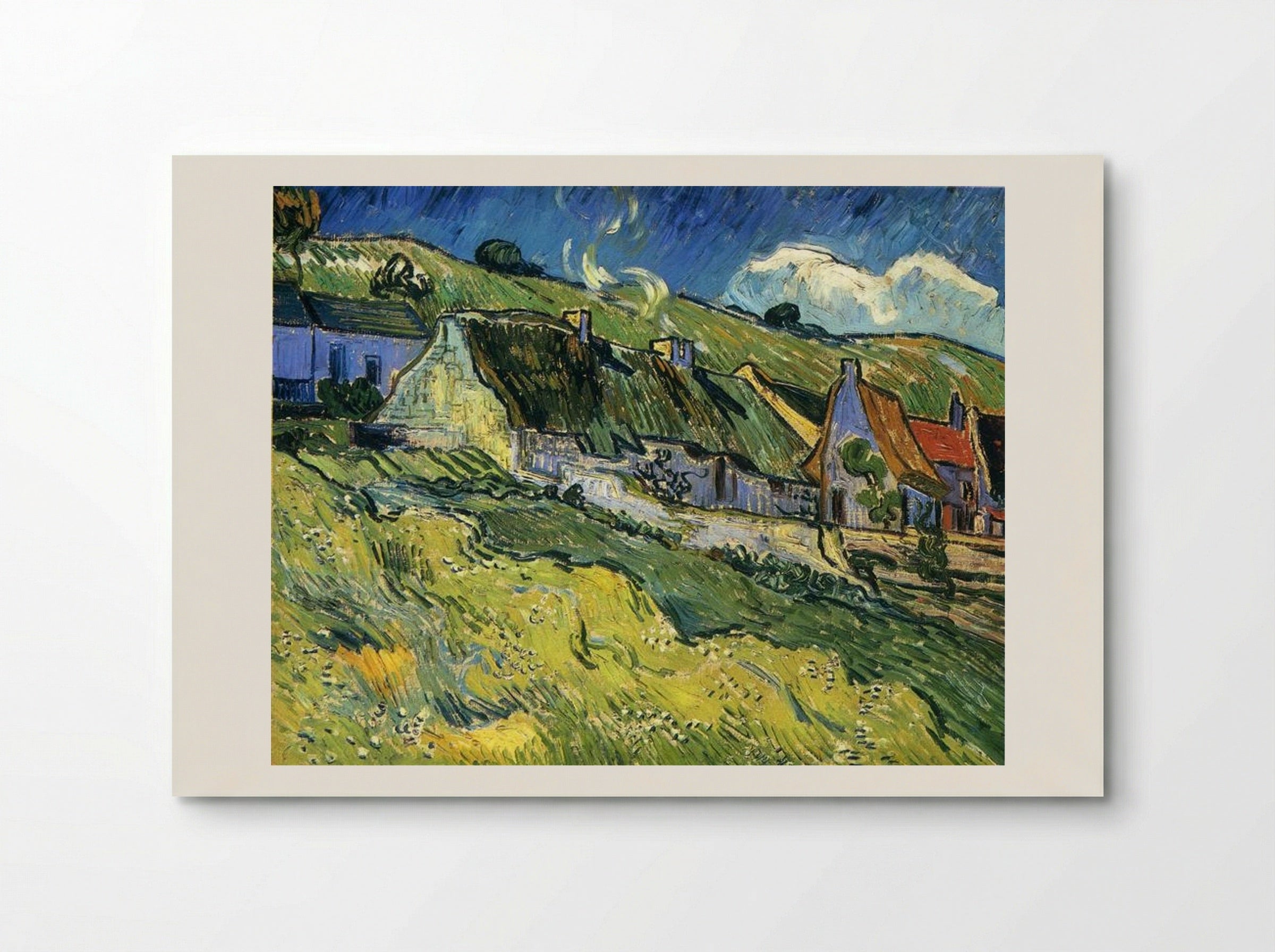
A rural scene from Auvers-sur-Oise, featuring thatched cottages set against rolling hills and a deep blue sky, rendered in thick, expressive brushstrokes.
Painted in 1890 during his final months in Auvers-sur-Oise, this work captures the rural character of the French countryside. Van Gogh employs his characteristic impasto technique, applying paint in thick, rhythmic strokes that animate the surface of the canvas. The composition is dominated by the sloping hills and the thatched roofs of the cottages, which appear to merge with the undulating terrain. The colour palette is defined by high-contrast pairings. The deep, cobalt blue of the sky provides a stark backdrop for the golden-yellow grasses and the earthy tones of the architecture. Van Gogh uses directional brushwork to guide the eye across the foreground, where the texture of the meadow is rendered with short, energetic marks. Smoke rising from the chimneys adds a sense of domestic activity to the quiet scene, while the clouds are shaped with swirling, rapid motions that suggest a breezy day. This painting reflects the artist's focus on the simplicity of village life, a subject he returned to throughout his career. Unlike his earlier, darker works from the Netherlands, this piece demonstrates his mastery of light and colour developed during his time in the south of France. The structure of the cottages is simplified, allowing the focus to remain on the interaction between the natural environment and the built form. The work remains a clear example of his ability to imbue a modest subject with a sense of movement and emotional weight through the application of paint alone.
Because every print is made to order, we don't offer change-of-mind returns, refunds or exchanges. If your order arrives faulty, damaged or incorrect, we'll replace it free of charge — just contact us within 48 hours of delivery. See our refunds page for full details.
We ship worldwide, printing at the production hub nearest to your delivery address. Delivery times and costs vary by destination — you'll see the options available to you at checkout.
Each print is produced to order using 12-colour giclée printing on FSC-certified archival paper. Designed in Britain and printed at your nearest production hub to reduce waste and speed up delivery.

Artist Biography
Our Features
Designed for Lasting Impact
Every Solis piece is made to order with archival, gallery-quality materials built to last.
To keep your artwork looking its best:
Museum-grade giclée on FSC-certified archival matte paper, with framed and canvas options.
Made to order
Every piece is printed to order. These are the five finishes, and what makes each one different.
From £28
A giclée print on 200gsm matte fine art paper, using a twelve-colour process for accurate, fade-resistant colour. Supplied unframed, delivered flat or rolled.

From £45
The same fine art print in a solid wood frame with UV-protective acrylic glaze and rigid backing. Five frame colours. Arrives ready to hang.
Why Choose Us ?
Damage-free delivery guarantee
Fast Shipping
Museum-Quality Materials
Artist Biography
Vincent van Gogh
You May Also Like
We use cookies to measure our marketing and see which prints people love.We use cookies to measure our marketing.
By continuing to browse, you agree · Privacy Policy