

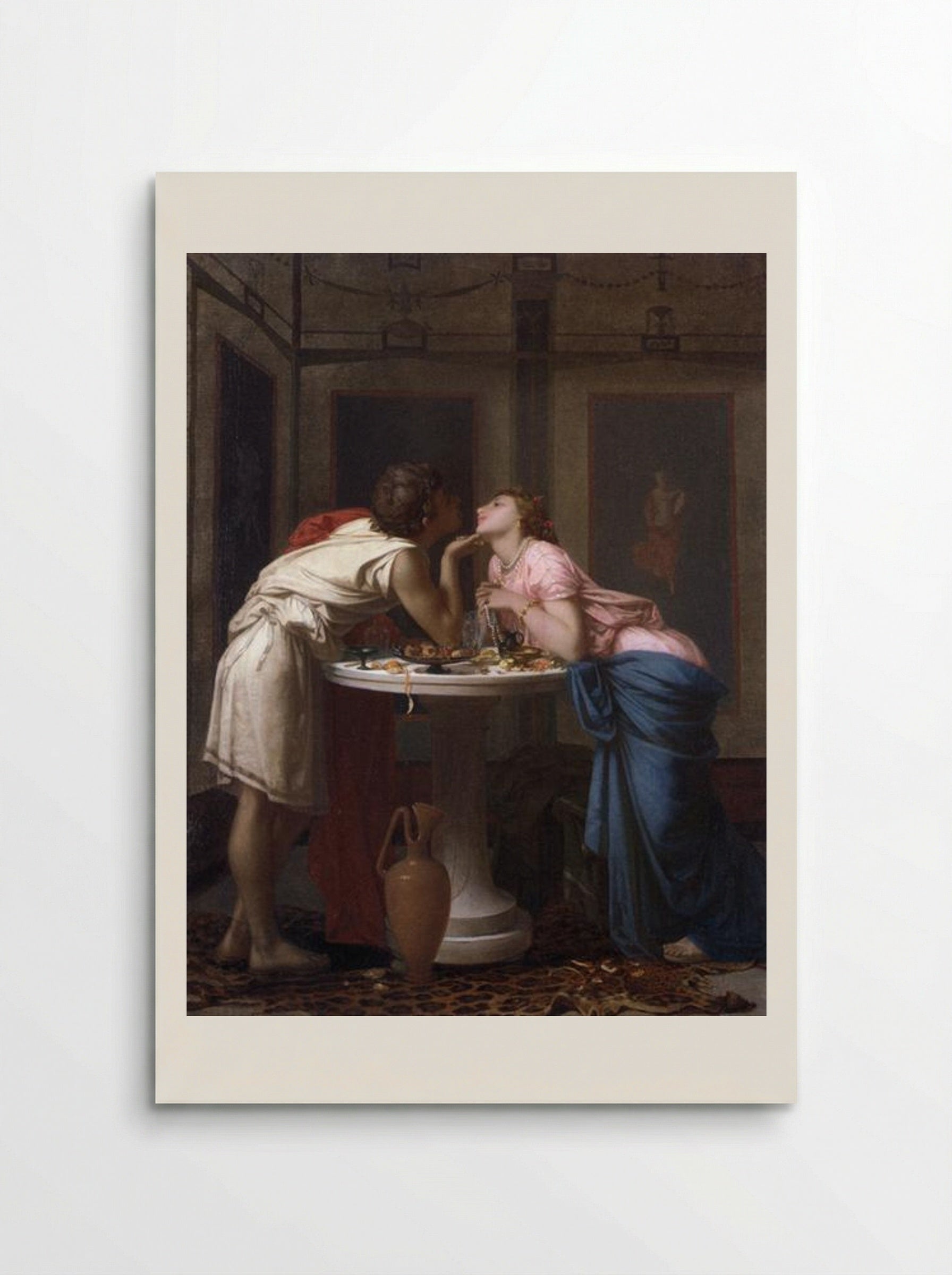
A Classical Courtship - Auguste Toulmouche
Archival giclée
Frames arrive ready to hang
Secure checkout
Made to order
Description
A refined genre painting by Auguste Toulmouche, depicting a romantic encounter within a classical setting, executed with the precision of the Academic tradition.
Auguste Toulmouche, a French painter associated with the Academic tradition, produced this work during the mid-nineteenth century. The composition depicts a romantic encounter set within a classical interior, a popular subject for artists of the period who sought to blend historical themes with domestic sentiment. The figures are dressed in garments reminiscent of antiquity, leaning towards one another across a central pedestal table. The table holds a modest spread of food and drink, suggesting a private moment of intimacy. The artist employs a smooth, polished technique characteristic of the École des Beaux-Arts training. The lighting is controlled, focusing the viewer's attention on the interaction between the two figures. The background features architectural elements and wall decorations that evoke a Roman setting, providing a sense of historical distance while maintaining the focus on the emotional exchange. Toulmouche was well-regarded during his lifetime for his ability to capture refined social interactions, often focusing on the nuances of gesture and expression. This piece demonstrates the artist's technical precision, particularly in the rendering of fabric folds and the subtle play of light across the skin tones. The blue drapery worn by the woman provides a strong colour contrast against the warmer, lighter tones of the man's attire and the surrounding environment. The inclusion of an animal skin rug on the floor adds a textural element to the composition, grounding the figures within the space. While Toulmouche is frequently associated with scenes of contemporary Parisian life, this work shows his engagement with the neo-classical aesthetic that remained a significant influence on European painting throughout the nineteenth century. The work remains a clear example of the period's preference for staged, narrative-driven imagery that prioritised clarity of form and technical finish.
Return policy
Because every print is made to order, we don't offer change-of-mind returns, refunds or exchanges. If your order arrives faulty, damaged or incorrect, we'll replace it free of charge — just contact us within 48 hours of delivery. See our refunds page for full details.
Shipping
We ship worldwide, printing at the production hub nearest to your delivery address. Delivery times and costs vary by destination — you'll see the options available to you at checkout.
Manufacturing
Each print is produced to order using 12-colour giclée printing on FSC-certified archival paper. Designed in Britain and printed at your nearest production hub to reduce waste and speed up delivery.
Care and materials
Specific Features
Every Solis piece is made to order with archival, gallery-quality materials built to last.
- Museum-grade giclée printing for rich, fade-resistant colour
- Archival matte fine-art paper, FSC-certified
- Multiple sizes and framing options available
- Frames in black, natural wood, dark wood or white
- Framed prints arrive ready to hang
Care & Cleaning
To keep your artwork looking its best:
- Dust gently with a soft, dry cloth
- Avoid prolonged direct sunlight
- Never use liquid cleaners on the print or canvas surface
- Keep in a dry, room-temperature space
- Handle prints with clean, dry hands
Materials & Sizing
Museum-grade giclée on FSC-certified archival matte paper, with framed and canvas options.
- Paper sizes: A4, A3, A2, A1, A0 and B2 (50×70 cm)
- Canvas: XS (20×30 cm) to Large (60×90 cm)
- Frames: black, natural wood, dark wood or white
A Classical Courtship - Auguste Toulmouche

Artist Biography
Auguste Toulmouche
Born in Nantes in 1829, Toulmouche studied at the École des Beaux-Arts under Thomas Couture, painter of *Romans of the Decadence*. It was through family connections that the young Claude Monet, arriving in Paris in 1862, came to Toulmouche's studio and was directed on to Charles Gleyre's atelier, where Monet met Renoir, Sisley, and Bazille. That brief intersection with Impressionism's future is now the most-cited fact in Toulmouche's biography, which says something about how thoroughly the academic tradition he represented was superseded by the movement it inadvertently helped to launch.
Toulmouche was awarded the Légion d'honneur and produced work that remained commercially popular throughout his lifetime. Later critics placed him alongside Jean Béraud and Raffaelli as painters whose primary interest lies in the period record they provide: precise documentation of the clothes, furnishings, and domestic arrangements of bourgeois Parisian life in the Second Empire and early Third Republic. He died in Paris in 1890.
Why Choose Us ?
Damage-free delivery guarantee
Fast Shipping
Museum-Quality Materials
You May Also Like