

About Enrico Caruso
Italian · 1873–1921
- opera
The greatest operatic tenor of the early twentieth century, who also produced hundreds of caricatures published in the Italian[1]-American press.
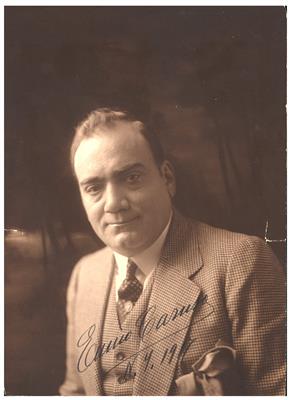
Where to see Enrico Caruso
Ranked by works you can see in person.
Frequently Asked Questions
Where can I see Enrico Caruso's work?
To view art from the Art Deco period, you can visit several museums in the United States, Canada, the United Kingdom, and Italy. In the United States, notable institutions include the Charles Hosmer Morse Museum of American Art (Winter Park, Florida), the Los Angeles County Museum of Art (Los Angeles), the Metropolitan Museum of Art (New York), the Minneapolis Institute of Arts (Minneapolis), the Museum of Modern Art (New York), the Virginia Museum of Fine Arts (Richmond), and the Wolfsonian at Florida International University (Miami Beach). In Canada, the Royal Ontario Museum (Toronto) has relevant holdings. Within the United Kingdom, you might visit the Bakelite Museum (Williton), the Brighton Museum & Art Gallery (Brighton), the Geffrye Museum (London), the Manchester Art Gallery (Manchester), the National Museums of Scotland, Royal Museum (Edinburgh), and the Victoria & Albert Museum (London). In Italy, consider the Fondazione Regionale Cristoforo Colombo (Genova), the Museo del Bijou di Casalmaggiore (Casalmaggiore), and the Museo Richard-Ginori della Manifattura di Doccia (Sesto Fiorentino).What should I know about Enrico Caruso's prints?
Enrico Caruso (1873[1]-1921[1]) was a celebrated Italian[1] operatic tenor, but he also produced visual art, including caricatures. Examples of his work can be found in collections such as the Museo Enrico Caruso in Milan. Many of Caruso's drawings were reproduced as prints, often published in newspapers and magazines. These prints provide a glimpse into his personal life and artistic interests outside of music. He often depicted fellow performers, friends, and himself in humorous situations. As a singer, Caruso travelled extensively, and his caricatures often reflect his experiences and observations from these travels. The prints range from quick sketches to more elaborate compositions, demonstrating his skill as a draughtsman. While not as widely known as his vocal achievements, Caruso's prints offer a unique perspective on the early 20th-century world of entertainment and society. They are collected both as mementos of the singer and as examples of period caricature.Why are Enrico Caruso's works important today?
Enrico Caruso (1873[1]-1921[1]) was a celebrated Italian[1] operatic tenor. His importance stems from his vocal talent and recording career. Caruso's voice was powerful and expressive, suited to Italian and French operatic roles. He made over 260 recordings, primarily for the Victor Talking Machine Company (later RCA Victor). These recordings helped popularise opera[1] with a wider audience. Before mass media, opera was mainly experienced live in theatres. Caruso's records allowed people to hear opera at home. His performances at the Metropolitan Opera in New York, from 1903[1] to 1920, were highly successful. He sang leading roles in operas such as "Rigoletto", "Tosca", and "Aida". His interpretations became benchmarks for later tenors. Caruso's recordings are still available and studied by singers. They offer insight into early 20th-century operatic style and technique. His fame helped elevate the status of opera singers in popular culture.What techniques or materials did Enrico Caruso use?
Enrico Caruso (1873[1]-1921[1]) is much better known as an opera[1] singer than as a visual artist. His caricatures, however, provide insight into his world and opinions. Caruso favoured pen and ink, often with watercolour washes, for his drawings. The caricatures are usually small, rapidly executed, and capture a likeness with a few strokes. He often drew on hotel stationery or whatever paper was at hand. The works are informal and immediate, like snapshots. Many of his drawings depict fellow singers, conductors, or productions. Some are self-portraits. Others are of people he encountered in his travels. The caricatures offer a glimpse into the opera world during the early 20th century, from the perspective of a leading performer. They are not highly finished works of art, but rather spontaneous expressions and personal observations. The caricatures were a means of relaxation and amusement for Caruso, a creative outlet separate from his singing career.Who did Enrico Caruso influence?
Enrico Caruso (1873[1]-1921[1]) was a celebrated Italian[1] operatic tenor. His influence is most apparent in the generation of tenors who followed him, particularly those who embraced a more naturalistic and emotionally direct style of singing. Singers such as Beniamino Gigli (1890[1]-1957[1]) were directly inspired by Caruso's vocal technique and stage presence. Gigli, often considered Caruso's successor, adopted a similar warm timbre and passionate delivery. Other Italian tenors, including Giacomo Lauri-Volpi (1892-1979), admired Caruso's ability to connect with audiences. Caruso's extensive recordings also broadened his reach. These recordings provided aspiring singers with a tangible model for vocal performance and interpretation. His commercial success helped to popularise opera[1], and paved the way for future generations of opera singers to reach wider audiences. His impact extends beyond opera; many popular singers have acknowledged his influence on vocal performance more generally.Who influenced Enrico Caruso?
It is difficult to name specific influences on Enrico Caruso, but we can examine the influences on artists of the period. One such artist is Caravaggio. Art historians have attributed the figures in Caravaggio's work to the intellectual heritage of a school that promoted the style of imitation. During his training in Simone Peterzano’s studio, Caravaggio had time to absorb his master's principles. He acquainted himself with painting that was 'faithful to reality', combining Lombard realism and the influence of the Venetian school in its treatment of light and colours. Some art historians consider Jacopo Robusti, Michelangelo Buonarroti, and Jacopo della Quercia to be precursors of this style. However, it is difficult to confirm a single origin for this manner. Instead of searching for the origins of Caravaggio’s expressive methods in his predecessors, it may be more judicious to search for it within his own mind.What is Enrico Caruso's most famous work?
While Enrico Caruso was a celebrated operatic tenor, he was not a painter. The question may refer to Michelangelo Merisi da Caravaggio (1571-1610[1]), the Italian[1] artist known as Caravaggio. One work that would have made him remembered is the Messina Nativity. It is an apotheosis of the models he used in his paintings: struggling girls, ancient women, and worn-out working men. The men appear as if cast in bronze. They are his last great rendering of labourers of the mezzogiorno, who defined his work since Rome. The painting recalls the northern country realism of Lombard painters, whose work he had seen as a child. They quietly established the unrhetorical dignity of ordinary life. The parishioners of Caravaggio, and the people of Messina, recognised their lives in it. The city paid him a thousand scudi for it. Powerful collectors tried to acquire the Nativity, but the priests transferred ownership to the city senate to secure it for the people.What style or movement did Enrico Caruso belong to?
Enrico Caruso (1873[1]-1921[1]) lived during a period of shifting artistic styles. The late 19th and early 20th centuries saw the decline of some movements and the rise of others, including modernism. The Baroque style, which had its origins around 1600, was characterised by dynamic compositions. Artists like Rubens favoured a spiral line to give vitality to their work. Figures within a Baroque work surge, twist, and turn, with forms blending into one another. The movement appears logical once the viewer accepts the initial artificiality. Bernini's sculptures show a similar principle of movement, with energy running through the figures. However, by the 18th century, Baroque styles had evolved. Movements became quicker and more graceful, with lighter forms. Figures had thinner bodies, and heads were often turned away from the viewer. While Caruso's career occurred after the height of the Baroque period, elements of dramatic expression and dynamic performance could be linked to Baroque traditions.
Sources
Where to See guide aggregates verified holdings of Enrico Caruso's works across the following collections.
- [1] wikipedia Wikipedia: Enrico Caruso Used for: biography.
- [2] book Walls, Peter (Editor), Baroque Music Used for: stylistic analysis.
- [3] book Getty, Getty - Conserving Canvas Used for: biography.
- [4] book guggenheim-artoftomorrowfif1939gugg Used for: biography.
- [5] book guggenheim-futurismmodernfo00solo Used for: biography.
- [6] book Braun, Emily, 1957-; Asor Rosa, Alberto; Royal Academy of Arts (Great Britain), Italian art in the 20th century : painting and sculpture, 1900-1988 Used for: biography.
Editorial overseen by Solis Prints. Sources verified 2026-08-31. Click a source for details, or hover over [N] in the page above to preview.
Editorial standardsMethodologyCorrectionsAI disclosureAbout the editorial team