

About Cristovao de Figueiredo
Kingdom of Portugal · 1500–1543
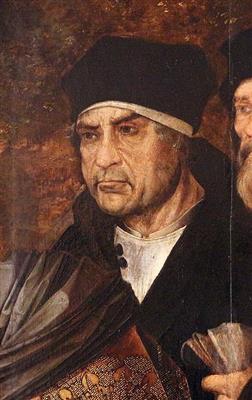
Portuguese Renaissance painter known for altarpieces, active at the Monasteries of Santa Cruz and Ferreirim in the early sixteenth century.
Where to see Cristovao de Figueiredo
Ranked by works you can see in person.
Frequently Asked Questions
Where can I see Cristovao de Figueiredo's work?
It is difficult to pinpoint exactly where Cristovao de Figueiredo's work can be viewed, as readily available resources do not offer a comprehensive list of locations. However, some museums with collections of related art styles include the Museu Calouste Gulbenkian (Lisbon); the Museu d’Art Modern (Barcelona); and the Museo Art Nouveau y Art Deco (Salamanca, Spain). In the United States, museums with relevant collections are the Charles Hosmer Morse Museum of American Art (Winter Park, Florida); the Los Angeles County Museum of Art; the Metropolitan Museum of Art (New York); the Minneapolis Institute of Arts; the Museum of Modern Art (New York); the Royal Ontario Museum (Toronto); the Virginia Museum of Fine Arts (Richmond); and the Wolfsonian (Miami Beach). In the United Kingdom, try the Bakelite Museum (Williton); Brighton Museum & Art Gallery; the Geffrye Museum (London); Manchester Art Gallery; the National Museums of Scotland (Edinburgh); and the Victoria & Albert Museum (London).What should I know about Cristovao de Figueiredo's prints?
Prints fall into several categories, including original prints, offset reproductions, and giclée prints. Original prints, also called hand-pulled prints, include woodcuts, engravings, or lithographs. The artist produces these by hand, directly creating the artwork on a plate, woodblock, or screen. These are often sold through specialist galleries, frame shops, and fine-art galleries. Because the plates are made by hand, they can only withstand a limited amount of use; the number of prints is limited by the number of impressions possible before the plate wears out. Some publishers set limits to increase a print’s value, typically between 250 and 1,000 impressions. Offset reproductions, also known as posters or image prints, are created using photochemical reproduction. There is no physical limit to the number of prints that can be made. Giclée prints are fine art prints made using inkjet technology. Canvas transfers involve transferring the image onto canvas, giving it the appearance of a painting. When buying prints, it is important to check for edition numbers, which indicate where a print falls within a limited run; for example, 35/100 means it is the 35th print out of a total of 100.Why are Cristovao de Figueiredo's works important today?
Cristovao de Figueiredo (active 1515[1]-1543[1]) was a court painter during the reigns of Manuel I and John III. He is known for his portraits and religious paintings, many of which are important examples of Portuguese Renaissance art. Figueiredo's attention to detail, use of colour, and ability to capture the likenesses of his subjects made him a sought-after artist among the Portuguese elite. His paintings provide valuable insights into the courtly life, religious beliefs, and artistic tastes of 16th-century Portugal. His work demonstrates the influence of both Flemish and Italian Renaissance styles on Portuguese art. Figueiredo's paintings are important historical documents, offering visual representations of prominent figures and events from a significant period in Portuguese history. They contribute to a broader understanding of the cultural and artistic exchanges that occurred in Europe during the Renaissance.Who was Cristovao de Figueiredo?
Cristóvão de Figueiredo was an accomplished painter in Portugal during the early sixteenth century. He produced altarpieces of considerable scale at a time when the Manueline court was supporting the arts with generosity. He was documented as a pupil of Jorge Afonso.What techniques or materials did Cristovao de Figueiredo use?
Details regarding Cristovao de Figueiredo's specific techniques are scarce. However, we can discuss some common practices of the period, and extrapolate from those. Figueiredo likely employed oil paints, a popular medium at the time. The support would probably have been a canvas prepared with a ground layer. Artists often used brushes of varying sizes to apply paint, building up forms through layers of colour. Some artists used thin washes for shadows and thicker paint, or impasto, for highlights. During this period, the separation between drawing and painting diminished. Some artists worked directly on the canvas with paint, foregoing preparatory drawings. Pigments were mixed with oils like linseed or walnut, and varnishes were sometimes added to increase transparency and aid drying, especially for darker colours. The techniques of Figueiredo's contemporaries suggest a range of approaches, from smooth, blended brushwork to more textured applications with visible brushstrokes.Who influenced Cristovao de Figueiredo?
Cristovao de Figueiredo's artistic development occurred during a period of considerable stylistic change; Rococo was emerging as a distinct style. Giuseppe Maria Crespi, an Italian artist, explored everyday life in his art. Crespi studied the Bolognese school and Venetian art, which led to his interest in genre imagery. His paintings of contemporary fairs around Florence attracted the patronage of Grand Prince Ferdinando de Medici. Antoine Coysevox, a sculptor, absorbed Classical and Baroque stylistic models, notably the antique and Gian Lorenzo Bernini. He completed garden sculptures for Versailles and Marly. His work, such as The Duchess de Bourgogne as Diana (1710), adapted classical themes to the Rococo spirit. Pierre Crozat, a financier and collector, amassed a large collection of drawings. Antoine Watteau and Charles de La Fosse studied Crozat’s Old Master drawings. Crozat's home became a social setting for discussions of art and music.What is Cristovao de Figueiredo's most famous work?
It is difficult to name Cristovao de Figueiredo's single 'most famous work'. Several paintings are associated with him, located in collections and religious buildings in Spain and the United States. Figueiredo's noted works include: * *The Holy Trinity*, completed in 1577, which is held at the Museo del Prado, Madrid. * *El Espolio (The Spoliation, Christ Stripped of His Garments)*, dating from 1577 to 1579, which can be found in the Sacristy of Toledo Cathedral, Toledo. * *The Adoration of the Shepherds*, created between 1612 and 1614, also held at the Museo del Prado. * *The Opening of the Fifth Seal of the Apocalypse*, dating from around 1608 to 1614, which is part of the collection at the Metropolitan Museum of Art, New York. * *Baptism of Christ*, dating from 1608 to 1614, located at the Hospital de San Juan Bautista de Afuera, Toledo.What style or movement did Cristovao de Figueiredo belong to?
Cristovao de Figueiredo was active during a period of transition from late 16th-century styles toward the Baroque. The Baroque style, which saw its genesis in Italy, did not appear in full force until the 1620s. Before that time, artists struggled to incorporate coherence and correct proportions in their work, moving away from the prevailing Mannerist style. This change was particularly noticeable in architecture and sculpture, as these arts are closely linked to everyday life. Baroque architecture saw buildings that were taller in relation to their width, creating a sense of upward movement. Even the handling of architectural detail changed, with the classical vocabulary of forms broken up, allowing different parts of a building to flow into each other. Cristovao de Figueiredo can be seen as working in the late phases of Mannerism, or possibly among the first generation of artists working to establish the Baroque style.
Sources
Where to See guide aggregates verified holdings of Cristovao de Figueiredo's works across the following collections.
- [1] wikipedia Wikipedia: Cristovao de Figueiredo Used for: biography.
- [2] book Masterpieces of western art : a history of art in 900 individual studies from the Gothic to the present day Used for: biography.
- [3] book Cuttler, Charles D, Northern painting from Pucelle to Bruegel: fourteenth, fifteenth, and sixteenth centuries Used for: biography.
- [4] book Charles D. Cuttler, Northern Painting From Pucelle to Bruegel Fourteenth, Fifteenth, and Sixteenth Centuries Used for: biography.
Editorial overseen by Solis Prints. Sources verified 2026-08-31. Click a source for details, or hover over [N] in the page above to preview.
Editorial standardsMethodologyCorrectionsAI disclosureAbout the editorial team