

About Brian Clarke
British · 1953–2025
- contemporary art
- Neo-Constructivism
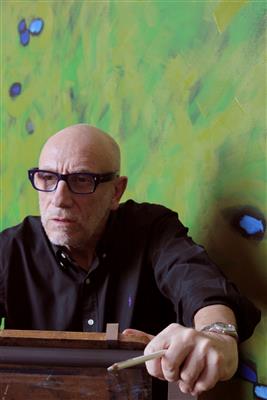
British[1] stained glass artist who created architectural glass on four continents, from a Saudi airport mosque to a 1,000 sq m shopping mall skylight in Rio.
Museums1
Countries1
Most worksVictoria and Albert Museum, London · 1 works
Loading map…
Where to see Brian Clarke
Ranked by works you can see in person.
-
1 works
Victoria and Albert Museum
London, United Kingdom

Frequently Asked Questions
Where can I see Brian Clarke's work?
Brian Clarke's work can be viewed in several museums and galleries that feature art deco and Arts and Crafts Movement pieces. These institutions house collections that include stained glass and other decorative arts, which sometimes include Clarke's pieces. In the United Kingdom, notable places include the Victoria & Albert Museum in London, which has extensive collections of decorative arts; the Brighton Museum & Art Gallery; the Geffrye Museum in London; the Manchester Art Gallery; and the National Museums of Scotland Royal Museum in Edinburgh. Other locations include the William Morris Gallery, Lloyd Park, Walthamstow, London; Red House, Red House Lane, Bexleyheath; St Mary the Virgin, Great Warley, Brentwood; Standen, West Hoathly Road, East Grinstead; Watts Gallery and Mortuary Chapel, Down Lane, Compton, Guildford; and Westminster Cathedral, Francis Street, London. In Europe, Musée des Arts Décoratifs in Paris and the Brangwyn Museum in Bruges may hold relevant works. In the United States, consider the Metropolitan Museum of Art in New York, the Los Angeles County Museum of Art (LACMA), and the Charles Hosmer Morse Museum of American Art in Winter Park, Florida. Other US locations include the Minneapolis Institute of Arts, the Museum of Modern Art in New York, the Royal Ontario Museum in Toronto, the Virginia Museum of Fine Arts, and the Wolfsonian at Florida International University.What should I know about Brian Clarke's prints?
When considering Brian Clarke's prints, it is important to understand some basic principles. An original print is conceived as a print, made solely as a print, and usually produced in a numbered and signed edition. Each print is created individually from a plate, stone, screen, or block. There is no single original from which copies are made. The artist decides the number of prints in an edition. Numbering accounts for the prints; for example, 12/25 indicates the twelfth print in an edition of twenty-five. Early prints were not always numbered or signed; sometimes the artist signed the plate instead. A reproduction is a copy of artwork initially created in another medium, such as painting or watercolour. It is usually made using photomechanical methods. Numbering and signing a reproduction does not make it an original print. Prints are marked with the edition number on the bottom left, the title in the centre, and the signature on the right. These are usually written in pencil. There are no strict rules for these conventions, but they are widely respected among printmakers.Why are Brian Clarke's works important today?
Brian Clarke is a British[1] artist known for his work in stained glass, mosaic, and other architectural art forms. His practice has pushed the boundaries of stained glass, moving it away from traditional religious contexts and towards secular, abstract, and monumental applications. Clarke's importance lies in his innovative approach to a traditional medium. He treats stained glass not just as decorative, but as a structural and expressive element in architecture. His designs often incorporate bold colours and geometric patterns, creating dynamic visual experiences. Clarke's work can be seen in various public and private buildings around the world. His collaborations with architects have resulted in significant integrations of art and architecture. These projects demonstrate how stained glass can be a contemporary art[1] form, relevant to modern design. Clarke's contribution is his continued exploration of the medium's potential, ensuring its place in contemporary art and architecture.Who was Brian Clarke?
Brian Clarke, born in Lancashire in 1953[1], is described as England's foremost stained glass artist. He trained in the Gothic glazing tradition, applying those methods to large-scale projects.What techniques or materials did Brian Clarke use?
Brian Clarke is known for his work with stained glass; he often incorporates it into large-scale architectural projects. While details on his specific methods are scarce, the general techniques of stained glass manufacture are well documented. The process begins with creating a design, often a cartoon or full-scale drawing, to guide the cutting and assembly of the glass. Different colours are achieved by using various metallic oxides during the glassmaking process; these colourants are added to the molten glass. Individual pieces of coloured glass are then cut to the required shapes. Paint, often a vitreous enamel, can be applied to the surface of the glass to add details or shading; this is then fired in a kiln to fuse the paint to the glass. Finally, the pieces of glass are assembled using lead cames, which are grooved strips of lead that hold the glass in place. The joints are then soldered to create a rigid structure. Clarke's work frequently moves beyond these traditional methods, incorporating modern techniques and materials to push the boundaries of the medium.Who did Brian Clarke influence?
Brian Clarke's work has influenced other artists through his innovative use of colour and form. The American painter Brice Marden stated that Mark Rothko was a significant influence on his practice. Marden noted that Rothko's approach to colour, combined with hard edges and atmospheric effects, was something he greatly admired. Marden also adopted Rothko's technique of applying vertical strokes to monochromatic panels, a subtle detail that added energy to the work. He visited the Rothko Chapel in Houston multiple times to study the paintings in different lighting conditions. Marden found Rothko's willingness to explore emotional and spiritual dimensions in painting, without embarrassment, particularly encouraging. This validation from a predecessor was important for Marden in justifying his own artistic beliefs and direction.Who influenced Brian Clarke?
Brian Clarke's artistic development involved several influences, though he is best known for his work in stained glass. Clarke studied at the Canterbury College of Art from 1969[1] to 1974. There, he rejected what he saw as the limitations of painting on canvas. His early work was influenced by the abstract expressionism of Jackson Pollock and Mark Rothko. Clarke moved away from the traditional methods of stained glass production, preferring to create large-scale, abstract designs. He was also inspired by the architecture of Frank Lloyd Wright, particularly Wright's use of glass as a structural element. Clarke's collaborations with architects such as Arata Isozaki further shaped his artistic vision. Isozaki's designs often incorporated Clarke's stained glass, creating a synthesis of art and architecture. These collaborations allowed Clarke to explore the possibilities of glass in new and innovative ways. His work also shows an appreciation for the work of earlier stained glass artists, such as those of the medieval cathedrals.What is Brian Clarke's most famous work?
Brian Clarke is best known for his large-scale stained glass projects. He came to prominence in the late 1970s and early 1980s, as an artist working outside the established traditions of stained glass production. Among his most recognised works is the stained glass for the Al Faisaliah Centre in Riyadh, Saudi Arabia (completed in 2000[1]). This project features a monumental glass screen that incorporates both abstract and figurative elements. The screen uses innovative techniques for laminating and suspending the glass. Another significant commission was for the Pfizer World Headquarters in New York. Clarke designed a large stained glass wall for the building's lobby. This work, completed in 2001, uses a complex arrangement of coloured glass pieces to create a dynamic visual effect. Clarke's work for St Elizabeth's Roman Catholic Church in Rainhill, Merseyside, also receives attention. This project, completed in several phases, includes a series of stained glass windows that depict religious themes in a contemporary style. These windows use bold colours and geometric patterns.
Sources
Where to See guide aggregates verified holdings of Brian Clarke's works across the following collections.
- [1] wikipedia Wikipedia: Brian Clarke Used for: biography.
- [2] book Beard, Lee, 1973- author, Butler, Adam, author; Van Cleave, Claire, author; Fortenberry, Diane, author; Stirling, Susan, author, Beard, Lee, 1973- author, Butler, Adam, author; Van Cleave, Claire, author; Fortenberry, Diane, author; Stirling, Susan, author - The Art Book_ New Edition, Mini Format Used for: biography.
- [3] book guggenheim-richardhamilton00hami Used for: biography.
- [4] book Masterpieces of western art : a history of art in 900 individual studies from the Gothic to the present day Used for: biography.
Editorial overseen by Solis Prints. Sources verified 2026-08-23. Click a source for details, or hover over [N] in the page above to preview.
Editorial standardsMethodologyCorrectionsAI disclosureAbout the editorial team