



About Antonio Donghi
Italian · 1897–1963
- magic realism
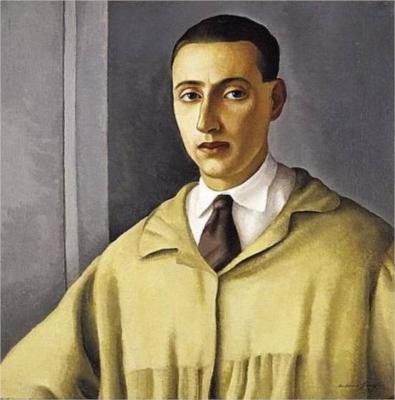
Italian[1] Magic Realist whose smooth, hypnotically still canvases of circus performers and cafe scenes freeze the everyday into uncanny precision.
Museums1
Countries1
Largest reported holdingCa' Pesaro, Venice · 1 recorded work
Loading map…
Where to see Antonio Donghi
Collection holdings are reported here; current display varies. Check with each museum before visiting.

Own a piece of it
Antonio Donghi prints
Hand-finished archival prints from Antonio Donghi's body of work.


Can't travel? Bring Antonio Donghi home.
See all Antonio Donghi prints →Frequently Asked Questions
Where can I see Antonio Donghi's work?
Antonio Donghi's paintings are held in several Italian[1] museums. The Pinacoteca di Brera (Milan) has paintings acquired via donation. The Civico Museo d’Arte Contemporanea (also in Milan) and the Galleria Nazionale d’Arte Moderna (Rome) also hold examples. These museums have modern Italian art in their collections. Catalogues from museum shows may also contain information about owners of particular works, though some prefer to remain anonymous. Outside Italy, it may be possible to view his paintings at the Musées Royaux des Beaux-Arts de Belgique (Brussels), the Wilhelm-Lehmbruck-Museum (Duisburg), the Städel Museum (Frankfurt), the Staatsgalerie moderner Kunst (Munich), the Kunsthaus (Zurich), the Toledo Museum of Art, the Carnegie Museum of Art (Pittsburgh), the Los Angeles County Museum of Art, the Art Gallery of Ontario (Toronto), the Hirshhorn Museum (Washington DC), the Menil Collection (Houston), and the Metropolitan Museum of Art (New York).What should I know about Antonio Donghi's prints?
Information regarding Antonio Donghi's prints is scarce. Printmaking reference books may include him, but this is not assured. Readers should consult specialist collections. S. W. Hayter's *New Ways of Gravure* (1949[1]) and *About Prints* (1962) offer technical information. Arthur M. Hind's *History of Engraving and Etching* (1963[1]) covers earlier printmaking. William M. Ivins, Jr.'s *How Prints Look* (1958) and *Prints and Visual Communication* (1968) discuss the appearance and function of prints. Riva Castleman's *Prints of the Twentieth Century: A History* (1976) might mention Donghi. Catalogues of graphic works by other artists, such as Edvard Munch and Pablo Picasso, are available, which may provide context. Exhibition catalogues from institutions like the Guggenheim Museum and the Museum of Modern Art may also prove useful for researching artists of a similar period.Why are Antonio Donghi's works important today?
Antonio Donghi's paintings offer a unique perspective on early 20th-century Italian[1] art. Although he is not as widely known as some of his contemporaries, such as Giorgio de Chirico, his work provides valuable insight into the artistic climate of the inter-war period. Donghi's style, characterised by its precise realism and detached observation, stands in contrast to the more emotionally charged movements of the time, such as Futurism. His paintings often depict ordinary people in everyday settings, rendered with a cool, almost clinical detachment. This approach offers a subtle commentary on Italian society during a period of significant political and social change. Interest in Italian art between the wars has grown, as has recognition of movements beyond those associated with Fascism or Communism. Donghi's work contributes to a broader understanding of the diverse artistic currents that existed in Italy during this era. His paintings are appreciated for their technical skill, their quiet observation, and their unique contribution to the history of Italian art.Who influenced Antonio Donghi?
It is difficult to summarise Antonio Donghi's influences, as sources disagree. Some scholars claim Donghi was inspired by masters of the Italian[1] Renaissance, such as Giotto, Masaccio, and Leonardo da Vinci. These artists' emphasis on clarity, form, and a certain stillness may have resonated with Donghi's artistic sensibilities. Other scholars point to the influence of Post-Impressionist painters like Paul Cézanne, Edgar Degas, and Édouard Manet. These artists moved away from strict realism, exploring new ways of representing form and space. Their experiments with composition and perspective might have informed Donghi's approach to his subjects. Futurism also had an impact; figures such as Carlo Carra and Romolo Romani may have shaped his artistic development.What style or movement did Antonio Donghi belong to?
Antonio Donghi's style is often associated with the Italian[1] art movement known as the Scuola Romana (Roman School). This movement emerged in the early 20th century, particularly between the two World Wars. It included artists who, while diverse in their individual approaches, shared certain characteristics. These included a return to figurative painting, an interest in classical forms, and a rejection of the more extreme avant-garde movements like Futurism. Donghi's paintings often depict scenes of Roman life, with a focus on everyday people and settings. His style is characterised by its clarity, precision, and a certain stillness, evoking a sense of timelessness. While not formally unified by a manifesto or specific set of principles, the Scuola Romana artists contributed to a distinctive chapter in Italian modernism, one that balanced international trends with local traditions.What was Antonio Donghi known for?
Antonio Donghi (1897[1]-1963[1]) was an Italian[1] painter best known for his contribution to the Magic Realism movement. This style, which he shared with the early Novecento group, is defined by crystalline purity and an enigmatic tone. Donghi's paintings often featured scenes of Roman life, circuses, and portraits. His style is characterised by a meticulous attention to detail, smooth surfaces, and a sense of stillness. The figures in his paintings appear detached, almost frozen in time, contributing to the dreamlike quality of his work. Although he participated in Novecento exhibitions during the 1920s, Donghi maintained a profile distinct from the movement. His work provides a unique perspective on the artistic climate of inter-war Italy.What is Antonio Donghi known for?
Antonio Donghi is known for his still canvases of the 1920s and 1930s. These paintings depict figures frozen in poses of calm, such as a woman juggling or circus performers between acts.What was Antonio Donghi's art style?
Donghi developed a style associated with Magic Realism. His technique is meticulous, using smooth surfaces, clean edges, and muted pastels that give his paintings the quality of frescoes.
Sources
Where to See guide aggregates verified holdings of Antonio Donghi's works across the following collections.
- [1] wikipedia Wikipedia: Antonio Donghi Used for: biography.
- [2] book guggenheim-twopri00weis Used for: biography.
- [3] book Braun, Emily, 1957-; Asor Rosa, Alberto; Royal Academy of Arts (Great Britain), Italian art in the 20th century : painting and sculpture, 1900-1988 Used for: biography.
- [4] book Post-impressionism : cross-currents in European painting Used for: biography.
Editorial overseen by Solis Prints. Sources verified 2026-10-14. Click a source for details, or hover over [N] in the page above to preview.
Editorial standardsMethodologyCorrectionsAI disclosureAbout the editorial team